Reviewed · SPLIT TOURS
The Best of Split Private Tour
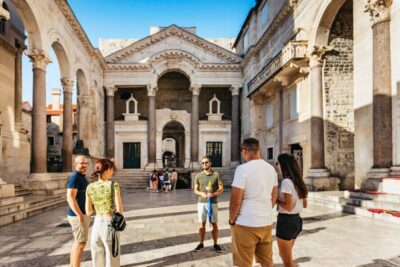
Split’s most remarkable feature is not simply Diocletian’s Palace. It is the way ordinary city life carries on inside a 1,700-year-old Roman complex. This private walking tour takes you from the palace cellars and imperial courtyards to fruit stalls, café squares, Venetian ruins, and the waterfront where modern Split gathers.
I like the private format, which lets your guide answer questions, adjust the pace, and shape the walk around your interests. I also like the local angle: guides such as Jelena, Vinka, Kristina, and Vicencija add present-day details, food suggestions, and stories about life in Split. The main drawback is the price, $199.62 per person, which is a serious outlay for about two and a half hours, especially for a small group.
Key points
- Roman Split becomes a living neighborhood: Diocletian’s Palace is not an isolated ruin, but the heart of the Old Town.
- The palace substructures are included: You begin below ground, where the Roman layout is easier to understand.
- A private guide can set the pace: This is useful for families, cruise passengers, and anyone with mobility concerns.
- The route mixes major sights with local life: The Green Market and Riva add more than ancient stones.
- Several guides receive especially warm praise: Jelena, Vinka, Kristina, and Vicencija are frequently singled out for clear explanations and a friendly manner.
- Some important interiors cost extra: The cathedral mausoleum and Jupiter’s Temple require an optional €8 admission.
Why Split’s Roman Palace Still Feels Like a City
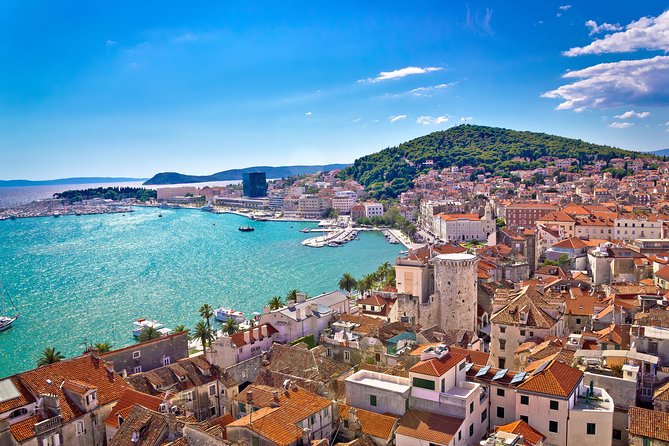
Diocletian’s Palace is the natural place to begin. Built for the Roman emperor Diocletian in the early fourth century, it was designed as both a grand imperial residence and a fortified complex. Today, its walls, lanes, courtyards, shops, homes, and cafés form the center of Split.
That combination is what makes the tour worthwhile. You are not just looking at a preserved monument from behind a barrier. You are walking through streets that people still use. A doorway may lead to a restaurant, a Roman wall may support a modern building, and a narrow lane may open suddenly into a sunlit square.
The tour starts at the main waterfront, the Riva, unless another pickup has been arranged. Cruise ship passengers can be met at the port, and visitors staying in the Old Town can arrange pickup at their hotel or apartment. If you are staying outside the Old Town, the Riva is the usual meeting place.
Because this is a private tour, the start time is arranged on request. That matters if you arrive by cruise ship or have a short stop in Split. It also gives you a chance to avoid the hottest part of the day, though the final time depends on the arrangement you make.
A few more Split half-days to weigh up
- Split: Krka Waterfalls Trip with Boat Cruise and Swimming
★ 4.8 · 10,519 reviews - From Split: Krka Waterfalls, Food & Wine Tasting Tour
★ 5.0 · 9,326 reviews - Blue cave, Mamma Mia and Hvar, 5 islands speedboat tour
★ 5.0 · 7,150 reviews
Beginning Below Ground in the Palace Substructures
The first major stop is the Diocletian Palace substructures, and this is a smart introduction to Split. The underground rooms mirror much of the layout above them, helping you understand the palace before you begin weaving through its streets.
The substructures were used as support spaces for the imperial apartments. Some rooms served practical purposes, while others reflect the scale and order of the original Roman plan. A guide can point out how the underground structure relates to what you will see later at the Peristyle, the Vestibule, and the former mausoleum.
Admission to the substructures is included. That makes this one of the clearest parts of the tour in value terms, since you receive more than an exterior walk through the palace. Allow about 45 minutes here, though a private guide may spend more or less time depending on your questions.
The underground setting is also a practical consideration. Expect stone surfaces, uneven ground, and narrow passages in parts of the complex. Most people can take part, but comfortable shoes are sensible. If someone in your group walks slowly or uses a cane, tell the guide at the start. The guides have shown patience with visitors managing knee problems, a baby, and young children.
The Vestibule and the Imperial Route
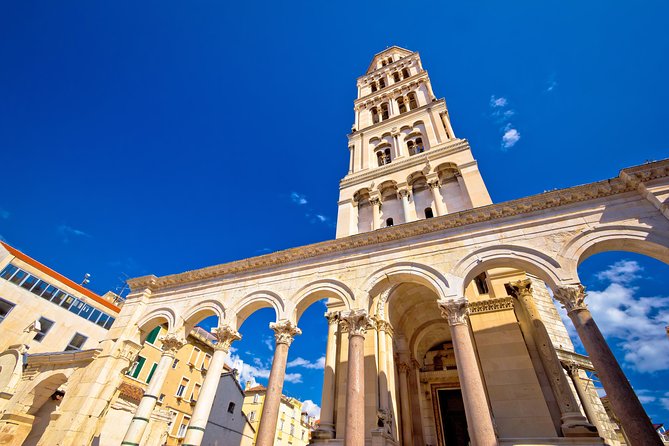
From the substructures, the route continues toward the Vestibule, the round entrance hall that led to Diocletian’s private apartments. In Roman times, this was a ceremonial approach. Visitors to the emperor would not have simply wandered in from the street.
Today, the Vestibule is a compact but striking space. Its circular form and open roof make it easy to imagine the procession from the palace entrance toward the imperial rooms. The visit lasts about 15 minutes and costs nothing beyond the tour price.
This is where a private guide can add useful context. Without explanation, the Vestibule may look like another old stone chamber. With the Roman ceremonial purpose explained, its shape and position make more sense.
Saint Domnius Cathedral Inside Diocletian’s Mausoleum
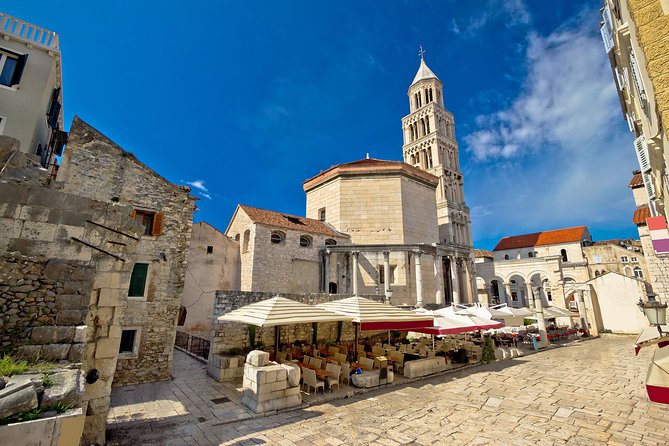
The Cathedral of Saint Domnius occupies Diocletian’s former mausoleum. That reuse tells you a great deal about how Split changed over time. An imperial tomb became a Christian cathedral, while the Roman building remained at the center of city life.
The mausoleum rises about 24 meters and is built from massive stone blocks. From the outside, its circular form is one of the defining features of the palace. Inside, the building combines Roman structure with later Christian decoration and use.
The standard tour schedule allows about 15 minutes here. Admission to the mausoleum is not included, and the optional combined entry for the mausoleum and Jupiter’s Temple costs €8 per person. That extra charge is easy to miss when comparing prices, so budget for it if you want to go inside.
I would ask your guide how much time is available before deciding. If you are especially interested in Roman architecture or religious history, the added entry may be worthwhile. If you have only a short time in Split, the exterior explanation and the nearby Peristyle may be enough.
Same stretch of coast, a completely different day out:
- From Split: Krka Waterfalls, Food & Wine Tasting Tour
★ 4.9 · 6,598 reviews - Split/Trogir: Blue Cave, Mamma Mia, Hvar and 5 Island Tour
★ 4.6 · 6,320 reviews - Blue Lagoon & 3 Islands Cruise with Lunch from Split
★ 4.5 · 5,756 reviews - Split: Old Town and Diocletian Palace Walking Tour
★ 4.9 · 4,727 reviews
The Peristyle, Split’s Great Roman Stage
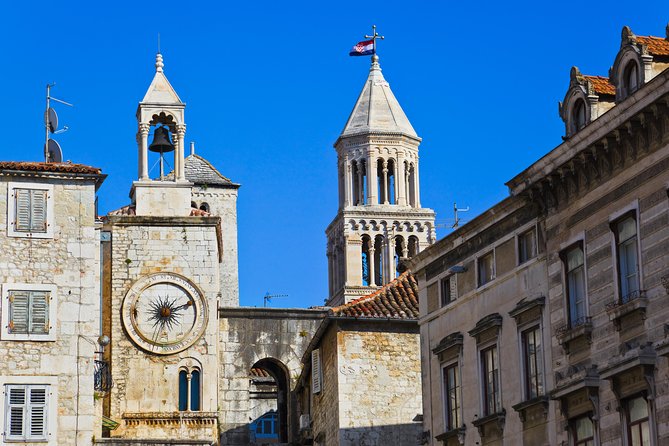
The Peristyle is the palace’s grand ceremonial court, framed by monumental columns and arcades. It is one of the places where the original imperial ambition is easiest to see.
The square was designed as an approach to the emperor’s apartments and is oriented toward the imperial loggia. Stand near the center and look at the stonework, the columns, and the way the surrounding buildings press close to the ancient court. The setting is unusually compact for such a formal space.
Only about 10 minutes are scheduled here, but the Peristyle often becomes a natural pause for questions and photographs. Your guide can help you read the space as a Roman ceremony rather than just a picturesque square.
You will also notice how old and new overlap. The square remains part of the city’s daily rhythm, not a silent museum courtyard. That is a recurring theme throughout the tour.
Markets, Gates, and Small Pieces of Split
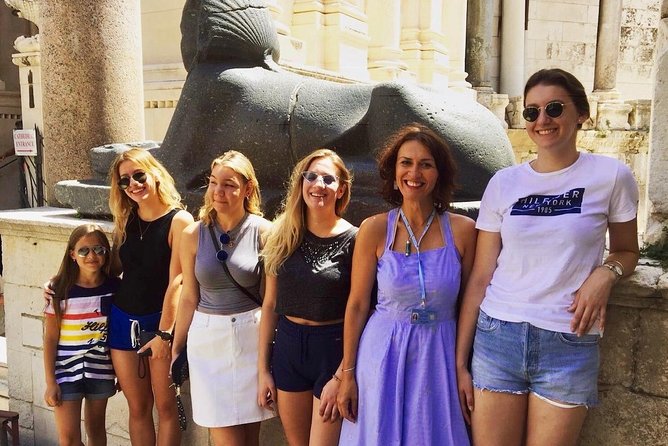
The route then leaves the most formal parts of the palace and moves through places that show how Split works today.
At the Green Market, you get a quick look at local food shopping. Fruit, vegetables, cheese, and prosciutto are part of the scene, and the market offers a useful change of pace after the palace rooms. The stop lasts about 10 minutes, so do not expect a full food tour or a long tasting session. Still, it gives you a sense of where local residents buy everyday produce.
The Golden Gate is the most prominent of the palace’s four gates. This was the northern entrance, and a small church dedicated to Saint Martin was built into the gate in the fifth century. The mix of Roman defensive design and later Christian use is typical of Split, where each era reused what came before.
Nearby, the Grgur Ninski statue provides a lighter moment. Created by Croatian sculptor Ivan Meštrović, it depicts Grgur Ninski, a bishop from the early tenth century. Touching the statue’s toe is said to bring good luck. You get five minutes here, which is plenty of time for the custom and a photograph.
The City Clock, built into the western gate, is another short stop. It is now one of Split’s best-known landmarks, though its appeal comes partly from its setting among the palace walls and later buildings.
These stops are brief, but they keep the walk from becoming a lecture about only one monument. You see how Roman gates, medieval churches, Croatian figures, and modern city habits share the same few blocks.
Fruit Square and the Venetian Chapter
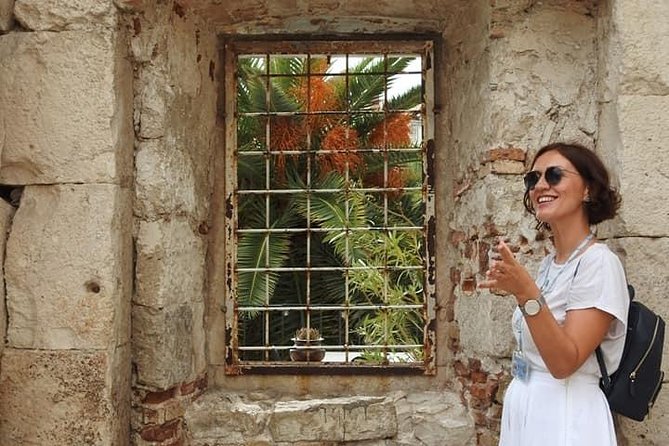
Fruit Square, officially Trg Braće Radić, sits just outside the palace. It is one of Split’s most attractive small squares, with the statue of Marko Marulić at its center. Marulić is remembered as the father of Croatian literature.
The square also contains the remains of a fifteenth-century Venetian castle tower. This is a useful reminder that Split’s story did not end with Rome. Venetian influence shaped the city’s buildings and politics, and the route connects that period with the Roman foundations beneath your feet.
The scheduled visit lasts about five minutes, so think of this as a focused introduction rather than a full examination of the square. If you want more time for photographs or questions about Marulić and Venetian rule, a private tour gives you a better chance of asking for it.
Prokurative and the Open Waterfront
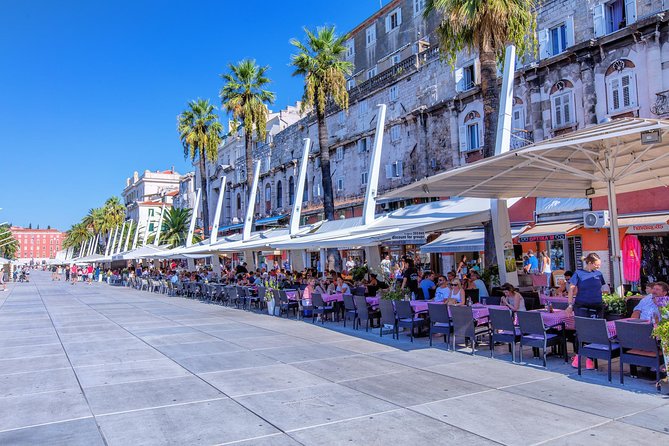
The walk continues to Prokurative, officially Republic Square. Its Neo-Renaissance buildings and repeated arches recall Venice’s Saint Mark’s Square. The square opens toward the south, giving you a view toward the harbor and the Riva.
This is one of the places where the tour shifts from ancient history to the city’s more recent architectural identity. The palace may dominate Split, but Prokurative shows how later rulers and styles left their mark.
The final stop is the Riva, the waterfront promenade where the tour begins and ends. It is a practical meeting point and a good place to finish because the Riva connects the Old Town with the harbor, cruise port, restaurants, and everyday public life.
Several stops on the route are only five or ten minutes long. That keeps the tour moving, but it also means you should not expect long periods to sit, shop, or explore each site independently. The focus is orientation and explanation. You can return to the places you like best afterward.
What the Private Format Adds
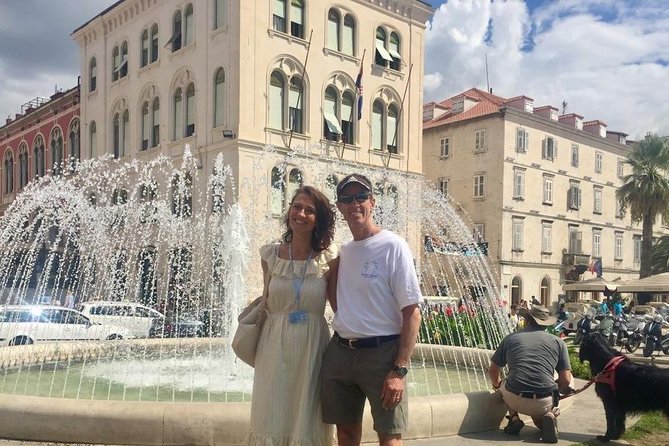
The strongest reason to choose this experience is the guide, not just the route. Split’s Old Town is easy to enter but not always easy to understand. A private guide can explain why a Roman palace became a medieval town, where Venetian traces appear, and how people use the same spaces today.
The guides named in the feedback include Jelena, Vinka, Kristina, Vicencija, Ana, Sanda, and Lea. Jelena is particularly praised for clear explanations, an even pace, local food suggestions, and the ability to make Roman, Venetian, and Austro-Hungarian influences easy to follow. Vinka is noted for meeting cruise passengers at the port, answering questions, and adding personal knowledge of growing up in Split.
Kristina is described as energetic and good at connecting old history with modern Croatian culture. Vicencija has been especially accommodating with families, including groups with a baby and three generations. These details matter because a private tour works best when the guide responds to the people in front of her.
You can also ask for practical advice at the end. Guides have suggested places for lunch, local shops, and food to try. One guide even purchased typical local food for a group to sample. That kind of help can be more useful than another list of dates, especially if Split is your base for only a day or two.
Price, Pace, and Who Gets Good Value
At $199.62 per person, this is not a budget walk. Its value depends heavily on the size of your party and how much you want individual attention. A private tour can make sense for families, couples, cruise passengers, and groups with mixed interests because you are not tied to a large group’s pace or questions.
For a family, the cost may buy patience and flexibility. A child can ask questions, take a short break, or move on from a site without holding up strangers. For older adults or anyone with knee trouble, the guide can slow the pace and find places to rest. That flexibility has real value, though the streets and stone surfaces still require care.
The advertised duration is about two hours and 30 minutes. One past booking described a two-hour version, while another took three hours, so the exact length may vary with the pace and arrangements. You should clarify the expected duration when booking, particularly if you have a cruise departure, restaurant reservation, or museum visit afterward.
The tour is offered in English, includes a licensed local guide and the palace substructures, and provides a mobile ticket. Pickup is available in the Old Town, at the cruise port, or at the Riva according to the stated arrangements.
Free cancellation is available up to 24 hours before the start time. Cancellations or changes made later are not refunded or accepted, and the cutoff uses local time.
Should You Book The Best of Split Private Tour?
Book it if you want Split explained rather than simply photographed. The tour gives you a solid first look at the palace, cathedral, gates, markets, Venetian remains, and Riva, while the private format leaves room for questions and local advice.
I would choose it for a first morning in Split, a cruise stop, or a family group that needs a flexible pace. I would think twice if you are traveling alone on a tight budget, since $199.62 per person is high for a short walk. Also remember that the mausoleum and Jupiter’s Temple cost an additional €8 if you choose to enter.
The best booking request is simple: ask for the guide and pace that fit your group, mention mobility needs in advance, and confirm the meeting place and duration. If you want history, food suggestions, and a human sense of how modern Split fits inside an ancient palace, this private walk is a strong choice.
FAQ
Where does the tour start?
The usual meeting point is at 23 Obala Hrvatskog narodnog preporoda, by the bronze city map on the Riva waterfront in Split.
Where does the tour end?
The tour ends back at the meeting point on the Riva.
Can cruise ship passengers be picked up?
Yes. The guide can meet cruise ship passengers at the port.
Is hotel or apartment pickup available?
Yes. Pickup can be arranged at hotels or apartments located in Split’s Old Town. Visitors staying outside the Old Town generally meet at the Riva.
How long does the tour last?
The listed duration is approximately two hours and 30 minutes. The exact length can vary according to the arrangement and pace.
Is the tour private?
Yes. Only your group participates in the activity.
What language is offered?
The tour is offered in English.
Is admission to Diocletian’s Palace substructures included?
Yes. Admission to the palace substructures is included in the tour price.
Do the mausoleum and Jupiter’s Temple cost extra?
Yes. Entry to the Mausoleum and Jupiter’s Temple is optional and costs €8 per person.
Can the tour accommodate people with mobility concerns?
Most people can participate, and the private format allows the guide to adjust the pace. Service animals are allowed, and you should mention mobility needs when arranging the tour.
Can I cancel for a full refund?
Yes. You can cancel at least 24 hours before the experience start time for a full refund. Late cancellations and changes made within 24 hours are not refunded or accepted.
Just added around Split
- From Trogir, Seget, Okrug: Krka Waterfalls & Šibenik Culture Tour★ 5.0 · 10 reviews
- Krka Waterfalls & Primošten from Trogir, Seget, Čiovo & Kaštela★ 5.0 · 18 reviews
- Island Hopping Boat Excursion with Lunch (Trogir,Blue Lagoon, Šolta)★ 3.5 · 6 reviews
- From Split & Trogir: ATV Quad Tour on Island Čiovo★ 5.0 · 21 reviews
- Slatine – Island Hopping Excursion (Trogir/Blue Lagoon/Shipwreck)★ 4.0 · 24 reviews
- Split: Blue Lagoon Boat Trip with Lunch, Wine and Snorkeling★ 5.0 · 3 reviews
- Split Sunset Stand Up Paddle Tour★ 5.0 · 16 reviews
- Split: Sunset Guided Kayaking Tour★ 4.8 · 71 reviews
Split Tours, compared.

Krka Waterfalls Trip with Boat Cruise and Swimming
Read our review →

Blue cave, Mamma Mia and Hvar, 5 islands speedboat tour
Read our review →
Blue Cave, Mamma Mia, Hvar and 5 Island Tour
Read our review →
Blue Lagoon & 3 Islands Cruise with Lunch from Split
Read our review →