

Reviewed · SPLIT TOURS
Walking Tour of Split and Diocletian’s Palace
Diocletian’s Palace is not a freestanding monument you simply walk around. It is the living center of Split, with homes, cafés, shops, lanes, and church towers tucked inside the former Roman complex. This 90-minute tour gives you a useful first look at how the emperor’s residence became the city itself.
I like the route for two clear reasons: it combines the palace with nearby old-town sights, and it keeps the history moving through real streets rather than trapping you in a museum. Guides such as Antonella, Anton, Mario, Marino, and Antonio have been praised for their humor, clarity, and love of Split. The main drawback is sound: groups can swell toward 20 people, and without headsets, a soft-spoken guide may be hard to hear in crowded squares.
Key points to know before booking
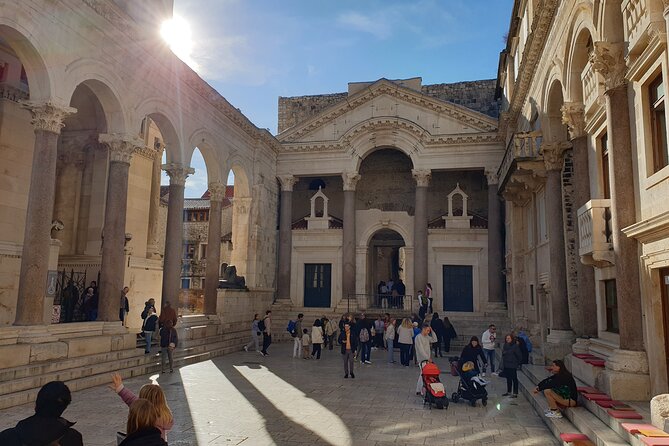
- The palace is still part of daily life: You walk through working streets, courtyards, and public squares rather than an isolated archaeological site.
- The Peristyle is the tour’s anchor: This grand Roman courtyard helps you understand how the palace was arranged.
- The route covers more than Roman ruins: You also see Riva Harbor, Fruit’s Square, the Golden Gate, and Split’s old synagogue.
- Paid palace sections are separate: The tour does not include admission to the museum area of the substructures or other paid sections.
- Guide quality matters: Antonella, Anton, Antonio, Mario, and Marino have all been singled out for strong storytelling and clear explanations.
- Plan for uneven steps: High and irregular stairs make this a poor choice if you have trouble with steps.
Why Diocletian’s Palace works best with a guide
At first glance, Split’s old center can seem like a maze of stone alleys. That confusion is part of the fun, but it can also leave you seeing attractive walls without understanding what they once did.
A guide gives those walls a purpose. You learn how Emperor Diocletian built a huge retirement residence at the edge of the Roman world, then see how later generations reused its gates, courtyards, underground rooms, and streets. The palace is not preserved in one neat historical period. Roman, medieval, Venetian, religious, and modern Split overlap in a very compact area.
That makes this tour a good first activity, especially if you have only one day in town. You get a map in your head, a short lesson in local history, and enough orientation to decide where to spend more time afterward.
The 90-minute length is also practical. It is long enough to cover the main sights without taking over your day. Several people have found the tour a little shorter than advertised, while one poorly paced experience ran much longer. In other words, allow around an hour and a half, but do not schedule your next activity so tightly that a modest delay causes trouble.
More walking tours in Split:
- Split: Old Town and Diocletian Palace Walking Tour
★ 4.9 · 4,727 reviews - Krka Waterfalls tour with Trogir Walking tour and Krka panoramic boat cruise
★ 5.0 · 1,659 reviews - Split & Diocletian’s Palace Walking Tour
★ 5.0 · 1,125 reviews
Starting at the Peristyle
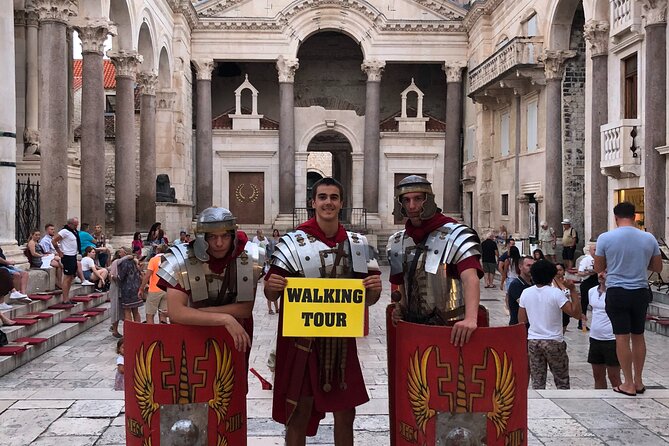
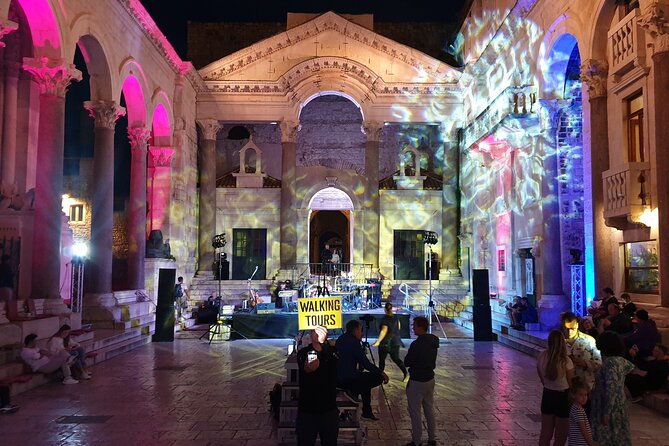
The meeting point is on Peristil Street, at the Peristyle, the palace’s central square. This is the most important place to begin because many palace routes lead from here.
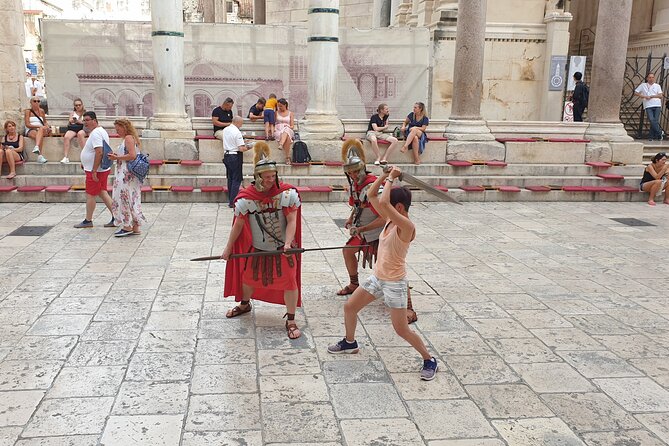
The Peristyle was designed as a ceremonial space, and its scale still gives you a sense of imperial ambition. Tall columns and stone walls frame the square, while later buildings press in around the Roman remains. Your guide explains how the emperor’s palace was organized and why this court was such an important approach to the imperial apartments and religious spaces.
You will spend about 15 minutes here. That may sound brief, but the square is visually dense. A good guide uses the time to point out what belongs to Diocletian’s era, what came later, and how to read the palace without treating every old stone as Roman.
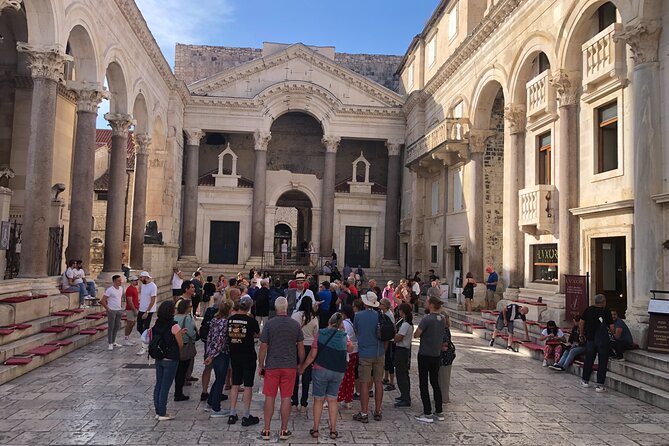
The setting can be noisy. The Peristyle attracts several tour groups at once, and competing guides can make it hard to follow a speaker. I would position yourself close to the guide and ask for a repeat if you miss a key detail. This is also the place where the lack of audio headsets is most noticeable.
The Vestibule and the sound of Dalmatian singing
The next stop is the Vestibule, a round entrance space that once led toward the emperor’s private apartments. You spend roughly five minutes here, learning about its original function and later use.
This is a small stop, but it gives the palace a more personal scale. The Peristyle feels public and ceremonial. The Vestibule helps you picture the transition into the emperor’s residential world.
You might hear traditional Dalmatian singing here. The acoustics can make the sound memorable, though it is not presented as a separate concert. Treat it as a possible bonus rather than a guaranteed performance.
The palace substructures and what lies below

The substructures are among the most useful parts of the route because they show how the palace was built. You pass through the lower rooms while the guide explains their construction and how their function changed over time.
These underground spaces once supported the upper level of the palace. Their layout helps explain why the streets and rooms above follow such a purposeful plan. They also show how later residents reused ancient spaces instead of clearing them away.
The tour spends about 10 minutes in the substructures. It does not include the museum portion, and admission tickets are not included. That distinction matters if you want a more extended look at the archaeological remains. You can visit the museum section after the walk, but you will need to arrange and pay for that separately.
Watch your footing. High steps and uneven stone appear along the route, and the palace was not designed for modern ease. Comfortable shoes are sensible, and anyone with trouble managing steep or irregular stairs should think carefully before booking.
A few more Split half-days to weigh up
- Split: Krka Waterfalls Trip with Boat Cruise and Swimming
★ 4.8 · 10,519 reviews - From Split: Krka Waterfalls, Food & Wine Tasting Tour
★ 5.0 · 9,326 reviews - Blue cave, Mamma Mia and Hvar, 5 islands speedboat tour
★ 5.0 · 7,150 reviews - From Split: Krka Waterfalls, Food & Wine Tasting Tour
★ 4.9 · 6,598 reviews
The Golden Gate and Gregory of Nin
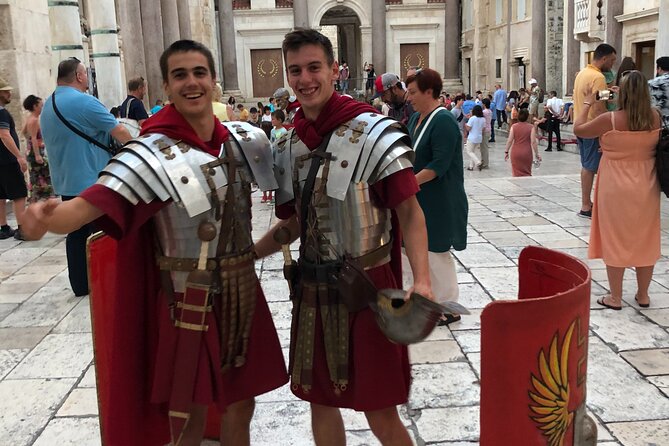
The Golden Gate is the palace’s main northern entrance and one of the clearest places to understand its defensive design. The guide explains how people entered the complex and how the gate fitted into the original plan.
Outside the gate, you see the statue of Gregory of Nin, a major figure in Croatian history and language. The stop is not just a photo opportunity. It connects the Roman palace to later Croatian identity and gives you a glimpse of how national history is remembered in public spaces.
You spend about 10 minutes here. It is a useful pause after the enclosed substructures because the open setting lets you see how the palace relates to the wider city.
The Golden Gate can also be a busy meeting area. Keep your group in sight, especially if several walks are forming nearby. The starting point at the Peristyle can be difficult to spot at first, so arrive with extra time rather than trying to find it at the last minute.
Riva Harbor and Split’s waterfront life
From the palace, the tour heads toward Riva Harbor, Split’s broad waterfront promenade. You see a bronze model of Diocletian’s Palace and hear how the harbor and promenade fit into the city’s story.
This stop matters because it changes your view of the palace. From inside, the complex can feel like a maze. From the waterfront, you get a clearer sense of its position beside the sea and how Split grew around it.
About 15 minutes are spent here. The pace gives you time to take in the harbor and connect the Roman residence with the modern city. You can also use the bronze model as a visual reference. After the tour, it may help you retrace the route or decide which sections deserve a closer visit.
I like this portion because it keeps the walk from becoming a nonstop sequence of ancient stones. Split is not only about Diocletian. Its character comes from the way Roman foundations, later buildings, waterfront life, and local streets occupy the same small area.
Fruit’s Square and the Venetian chapter
Fruit’s Square, or Trg Braće Radić, adds another period to the story. Here you learn about a 15th-century Venetian citadel and the role of Marko Marulić, often called the father of Croatian literature.
This is a good example of the tour’s wider approach. You are not being shown only the best-known imperial remains. The route explains how Split changed under later powers and how literature and local identity fit into the city’s past.
The stop lasts around 10 minutes. Fruit’s Square is also a pleasant place to pause and absorb the layout of the old town. The square’s later Venetian character helps you see that Split’s story did not stop when Roman rule ended.
Split Synagogue and the city’s Jewish past
The final listed stop is Split Synagogue, where you pass by a 16th-century synagogue and learn about the history of the city’s Jewish community.
You do not receive admission to the synagogue as part of the tour. The stop is primarily an outside look and a short historical explanation, lasting about 10 minutes.
I value this addition because it widens the tour’s focus. A quick visit to Roman ruins can easily leave out the people and communities that shaped the city later. This stop gives you a more complete picture of Split’s old center, even though it is brief.
The activity ends back at the meeting point. That makes the route easy to fit into a day of sightseeing, since you do not need to arrange transport from a distant finish.
The guide can make or break the experience
The strongest part of this walk is the guide’s ability to turn dates and stones into a story. Antonella has been praised for being organized, funny, clear in English, and especially good at making the palace approachable. Anton, Antonio, Mario, and Marino have also been described as engaging and generous with explanations.
Several guides have teaching backgrounds, and that can be an advantage when the subject is as layered as Split. A good explanation helps you understand not just what you are seeing, but why the palace still shapes the city.
There is some variation in delivery. One guide was described as difficult to understand because he spoke softly and English was his second language. Another tour drifted away from the palace and ran far beyond the expected length. These are not reasons to dismiss the activity, but they are reasons to keep expectations realistic. The experience depends heavily on who leads your departure.
The operator limits the group to 20 people, which is smaller than many mass-market city walks. Still, 20 people can form a crowd in a narrow Roman lane. If hearing is important to you, stay near the front and avoid booking at a time when you know the old center will be especially crowded.
What $48.37 buys you
At $48.37 per person, this is not the cheapest way to walk through Split. You are paying for an English-speaking guide, a planned route, and historical context across several parts of the old center.
The value is strongest if you are new to Split, visiting for only a day, or unsure how the palace fits together. You receive a useful overview without paying separately for every major stop. The tour also reaches beyond the palace itself, adding the Riva, Fruit’s Square, Gregory of Nin, and the synagogue.
The value is weaker if you prefer to explore slowly on your own or want extensive interior access. No admission tickets are included, and the museum section of the substructures is not part of the walk. You may need to spend more later if you want to see the paid areas.
Group discounts may reduce the per-person cost for larger parties. Mobile tickets make the booking simple, and multiple departure times help you fit the tour around a cruise stop or a short stay. Check the exact departure time carefully, since one scheduled time has been changed with only about a day’s notice in at least one case.
Practical advice for a smoother walk
Meet at the Peristyle and give yourself extra time to find the exact spot. The old center has many similar-looking stone lanes, and the opening square can be crowded with several groups.
Wear shoes that handle uneven stone and stairs. The activity is a walking tour through an old palace, not a flat promenade. Most people can participate, and service animals are allowed, but high steps are a stated concern.
Stay close enough to hear. The guide may not use an audio system, and several groups can speak at the same time. A small group helps, but it does not remove the sound problem in a busy square.
Book this near the start of your time in Split if possible. The tour gives you a working outline of the old center, making it easier to return to the substructures, waterfront, squares, or palace lanes that interest you most.
The tour is offered in English. Confirmation is sent when you book, and free cancellation is available up to 24 hours before the start time. Cancellations or changes within 24 hours are not refundable, and the activity may be canceled if the minimum number of participants is not reached.
Who should book this Split walking tour?
I would choose this tour if you want a short historical orientation rather than a full archaeological visit. It suits first-time visitors, cruise passengers, couples, families, and anyone who wants a guide to explain the palace before exploring alone.
It is especially useful for people who enjoy stories about how cities change. You get Roman architecture, medieval and Venetian chapters, Croatian literary history, Jewish heritage, and modern waterfront life in one compact walk.
I would hesitate if you need guaranteed quiet listening, dislike stairs, or want every paid palace interior included. In those cases, an audio-equipped tour or a longer specialist visit may serve you better.
Should you book it?
Book it if you want a lively introduction to Split and Diocletian’s Palace, with a guide who can connect the Roman complex to the city around it. The very high overall rating and repeated praise for guides such as Antonella, Anton, Antonio, Mario, and Marino point to a strong experience when the guide is clear and engaged.
Just keep the limitations in mind: the meeting point can be tricky to find, the route includes uneven steps, paid sections cost extra, and no headsets may make hearing difficult in crowded places. For a first look at Split, the tour offers solid value. For a detailed palace excavation visit, use it as an introduction and plan a separate visit to the paid museum areas.
FAQ
Where does the walking tour start?
The tour starts at Peristil ulica, at the Peristyle in Split, Croatia.
Where does the tour end?
The activity ends back at the meeting point.
How long does the tour last?
The scheduled duration is approximately 1 hour and 30 minutes.
What language is the tour offered in?
The tour is offered in English.
Are admission tickets included?
No. Admission tickets are not included.
Can I visit the palace substructures museum?
The tour passes through the substructures but does not include the museum section. You can visit that part after the tour, with separate admission.
How large is the tour group?
The maximum group size is 20 people.
Is the tour suitable for people with mobility issues?
Most people can participate, but the route includes high steps and uneven surfaces. It is not recommended if you have trouble with high steps.
What is the cancellation policy?
You can cancel up to 24 hours before the start time for a full refund. Cancellations or changes made less than 24 hours before the experience are not refunded.
Just added around Split
- From Trogir, Seget, Okrug: Krka Waterfalls & Šibenik Culture Tour★ 5.0 · 10 reviews
- Krka Waterfalls & Primošten from Trogir, Seget, Čiovo & Kaštela★ 5.0 · 18 reviews
- Island Hopping Boat Excursion with Lunch (Trogir,Blue Lagoon, Šolta)★ 3.5 · 6 reviews
- From Split & Trogir: ATV Quad Tour on Island Čiovo★ 5.0 · 21 reviews
- Slatine – Island Hopping Excursion (Trogir/Blue Lagoon/Shipwreck)★ 4.0 · 24 reviews
- Split: Blue Lagoon Boat Trip with Lunch, Wine and Snorkeling★ 5.0 · 3 reviews
- Split Sunset Stand Up Paddle Tour★ 5.0 · 16 reviews
- Split: Sunset Guided Kayaking Tour★ 4.8 · 71 reviews
Split Tours, compared.

Krka Waterfalls Trip with Boat Cruise and Swimming
Read our review →

Blue cave, Mamma Mia and Hvar, 5 islands speedboat tour
Read our review →
Blue Cave, Mamma Mia, Hvar and 5 Island Tour
Read our review →
Blue Lagoon & 3 Islands Cruise with Lunch from Split
Read our review →

Blue Lagoon Boat Party with DJs, Shots & After Party
Read our review →Browse the lists this tour appears in