
Reviewed · SPLIT TOURS
Split: Private Walking Tour with Diocletian’s Palace
Split’s old center is not a museum behind velvet ropes. It is a living city built into a 1,700-year-old Roman palace. You walk through the Golden Gate, pass cafés and shops tucked into ancient walls, then reach Peristil, where Split’s past feels close enough to touch. I like the private format and the freedom to set the pace. I also like that guides such as Slavko, Antonia, and Vinka have been praised for personal attention, local tips, and a strong feel for Split’s story.
The main consideration is the tour’s flexibility. The advertised duration ranges from 90 minutes to five hours, so you need to confirm the option you want when booking. Some lanes and old stone surfaces can be awkward, and the tour is not suitable for wheelchair users.
Key Points to Know Before You Book
- A Roman palace became Split’s city center: You will walk through streets, squares, homes, shops, and cafés built among Diocletian’s remains.
- Your guide can shape the walk: The private format lets you set your tempo and focus more on history, architecture, local life, or family interests.
- Peristil and Saint Domnius anchor the tour: These are the essential ancient sights, with the cathedral built on the site where Emperor Diocletian was buried.
- The route mixes many eras: Roman ruins sit beside Romanesque churches, medieval fortifications, Gothic palaces, and Renaissance and Baroque buildings.
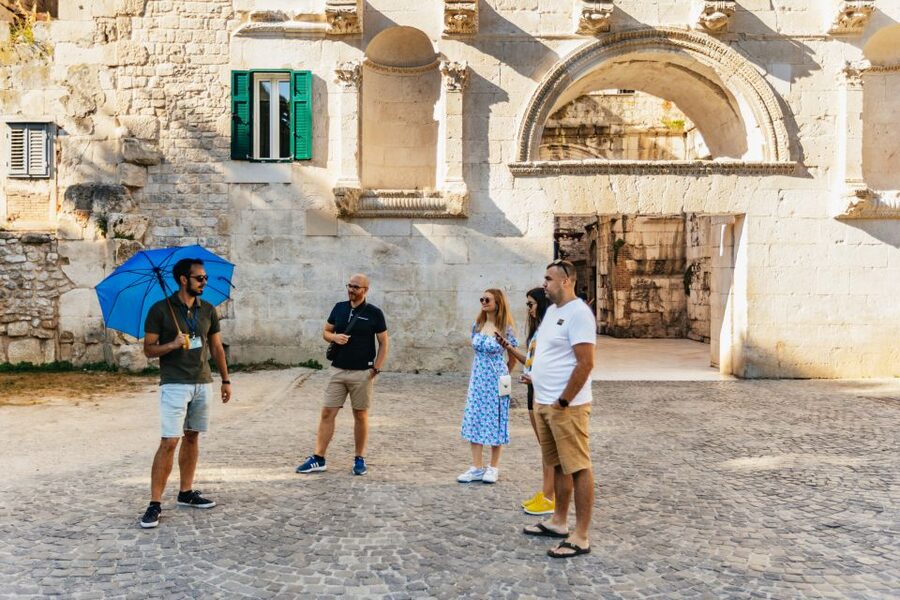
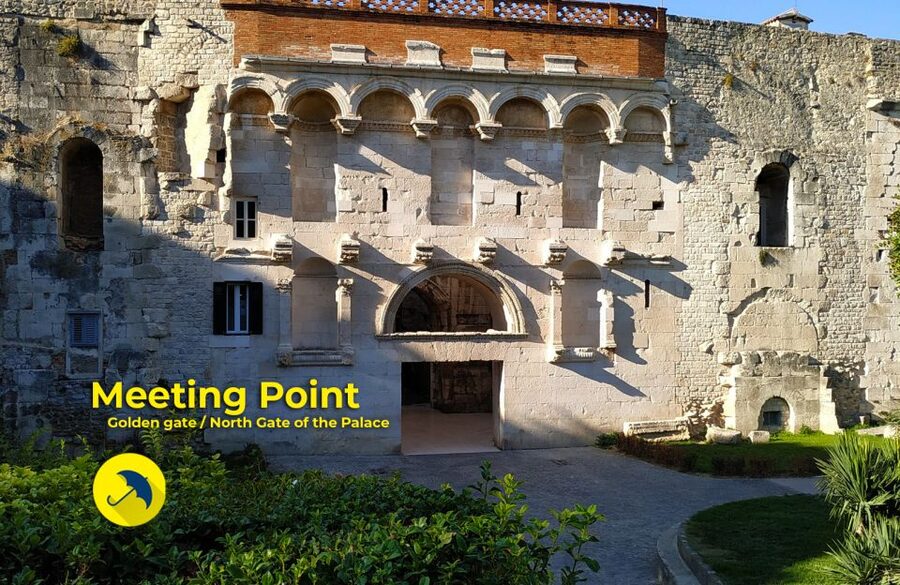
- You meet at the Golden Gate: Look for a guide carrying a blue umbrella at the north entrance to Diocletian’s Palace.
- The price works best for two people: At $117 per private group of up to two, you are paying for personal guiding rather than a seat in a large group.
Why Diocletian’s Palace Feels Like a City, Not a Ruin
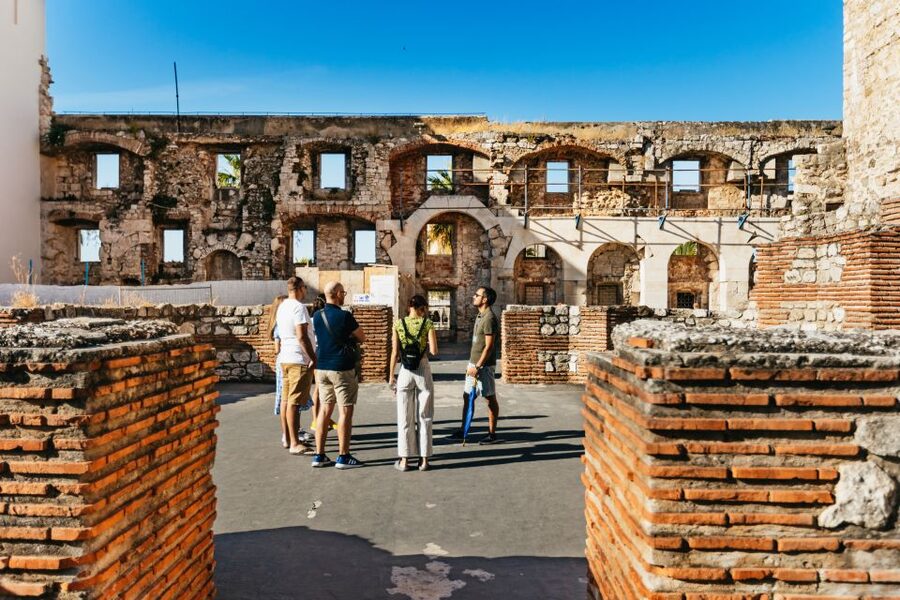
I love that this walk gives you the right setting for understanding Split. Diocletian’s Palace is not simply a grand ancient building you enter and leave. Its Roman walls and rooms became the framework for the old city, so the tour moves through ordinary city life as much as through archaeology.
That changes how you read the streets. A narrow passage may follow the lines of the old palace. A medieval building may lean against Roman stone. A busy square may occupy space first planned for an emperor nearly 1,700 years ago.
Your guide’s job is to connect those layers without turning the walk into a list of dates. The strongest guiding here appears to come from people who know Split personally. Slavko, described as born and raised in the city, brought local perspective as well as historical context. Antonia was praised for answering questions carefully and explaining the palace, architecture, and Split’s unusual place in European history. Those details matter because a private guide can stop when you are curious instead of moving on with a crowd.
The route is scheduled around a series of short stops, but the entire experience can be adapted. A 90-minute version should give you the main sights. A longer option, lasting up to five hours, gives you more room for questions and a slower look at the old center. Confirm the exact duration and start time when you check availability.
More walking tours in Split:
- Split: Old Town and Diocletian Palace Walking Tour
★ 4.9 · 4,727 reviews - Walking Tour of Split and Diocletian’s Palace
★ 5.0 · 2,588 reviews - Krka Waterfalls tour with Trogir Walking tour and Krka panoramic boat cruise
★ 5.0 · 1,659 reviews
Meeting at the Golden Gate
The tour starts at the Golden Gate, the north gate of Diocletian’s Palace. Look for the guide with a blue umbrella. This is a useful meeting point because it places you directly beside one of the palace’s most important entrances.
The gate is a good introduction to the scale and purpose of the complex. You are not beginning on a detached archaeological site. You are starting at a real city threshold, where the Roman plan still shapes movement through Split.
The guided stop lasts about 10 minutes in the listed route. Your guide can explain the gate’s role and help you get oriented before the walk turns into the medieval and modern center.
You also pass the Gregory of Nin statue, one of Split’s best-known public monuments. The itinerary does not assign it a separate timed stop, but it is part of the old-center experience near the Golden Gate. The medieval Croatian bishop’s statue is a natural place to pause for a quick look while hearing about Split’s later history.
From the Game of Thrones Museum to People’s Square
The next stop is the Game of Thrones Museum, with about five minutes of guided time. This is a brief, pop-culture counterpoint to the older layers around it. If the show interests you, it gives the walk a modern reference point. If ancient history is your priority, it is short enough not to take over the tour.
From there, the route moves to People’s Square, known locally as Pjaca. The planned stop lasts around 10 minutes. This square helps show how Split grew beyond the original Roman palace and developed a public civic center in the medieval and later periods.
You will also hear about architecture from several periods during this part of the walk. Split’s center includes 12th- and 13th-century Romanesque churches, medieval defenses, 15th-century Gothic palaces, and later Renaissance and Baroque buildings. I find this mixture more useful than seeing isolated monuments because you can compare the styles within a few minutes on foot.
This is also where a private guide earns the fee. You can ask why one façade looks Gothic, how a church differs from a palace, or how the old city expanded. In a large group, those questions can be difficult to fit in. Here, the guide can adjust the explanation to your interests.
Fruit Square and the Social Side of Split
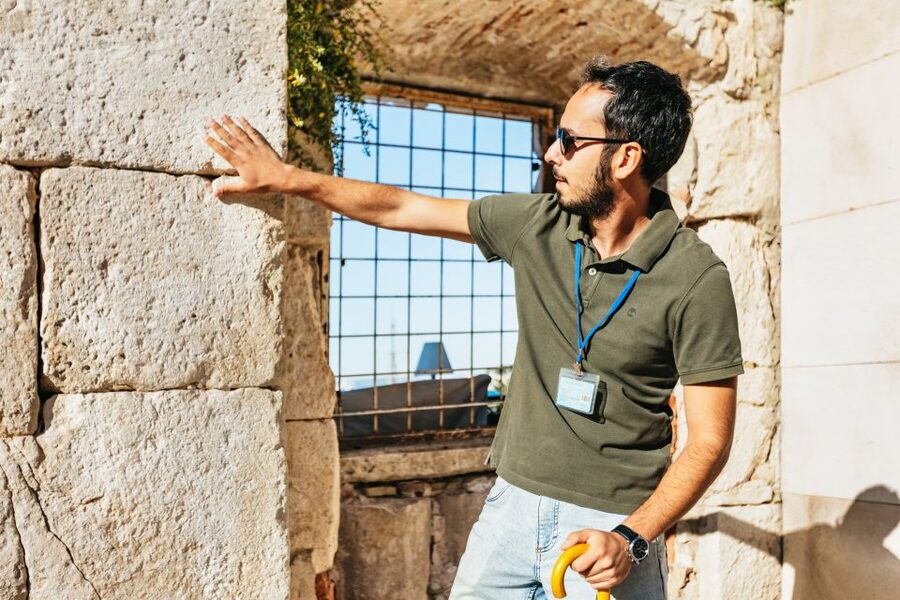
Fruit Square, or Voćni trg, is scheduled for another 10-minute stop. Its name points to the market life that once took place here, and the square remains a good place to notice how Split’s old center works as a daily neighborhood rather than a preserved stage set.
I like this section because it balances imperial history with local life. The palace is famous, but Split is not only about emperors and columns. Squares such as Fruit Square help you see the city as a place where people meet, shop, eat, and pass through.
The private format is especially helpful for families and mixed-age groups. One person may want architecture, another may care about food and daily life, and children may need the pace to change. The guide can respond without forcing everyone through the same fixed script.
A practical note: wear comfortable shoes. The tour is on foot, and old-center paving can be tiring. Sunglasses and a sun hat are sensible additions, particularly during a bright daytime walk.
A few more Split half-days to weigh up
- Split: Krka Waterfalls Trip with Boat Cruise and Swimming
★ 4.8 · 10,519 reviews - From Split: Krka Waterfalls, Food & Wine Tasting Tour
★ 5.0 · 9,326 reviews - Blue cave, Mamma Mia and Hvar, 5 islands speedboat tour
★ 5.0 · 7,150 reviews - From Split: Krka Waterfalls, Food & Wine Tasting Tour
★ 4.9 · 6,598 reviews
Riva Harbor and Split’s Open-Air Front Room

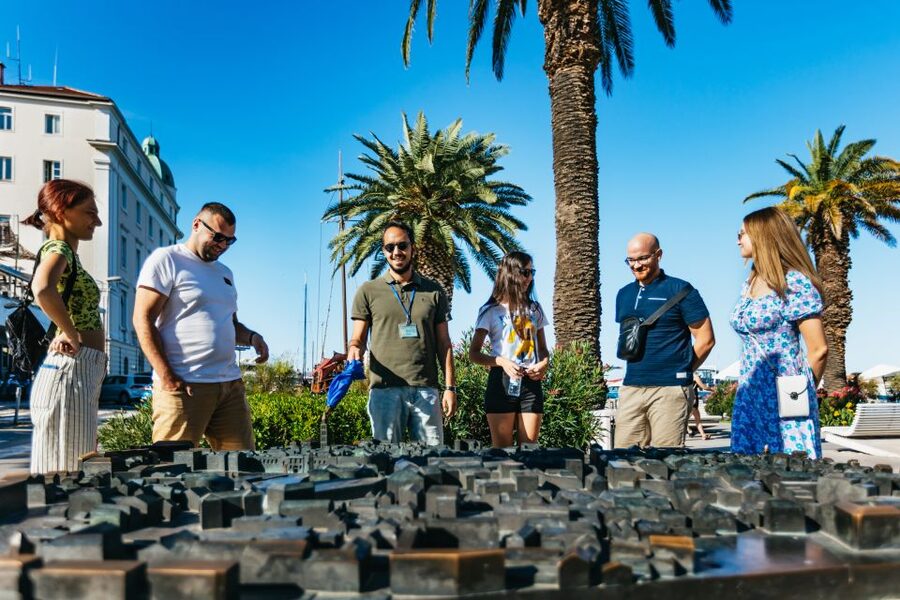
The route then reaches Riva, Split’s waterfront promenade, for about 10 minutes. Riva Harbor gives you a change of mood. After narrow lanes and enclosed palace spaces, you get an open view and a chance to watch the city’s public life unfold along the water.
Your guide can place the promenade within the larger story of Split, then share practical local suggestions. Gudrun specifically praised receiving individual tips, and that is one of the useful benefits of a private walk: you can ask where to continue, what areas suit your interests, or how to spend the rest of your time in town.
Riva is also a natural breathing space during the tour. If you have children or someone who tires quickly, the guide can keep the pace comfortable. The overall experience is designed around your tempo rather than a fixed group schedule.
Do not expect a long waterfront excursion. The listed stop is about 10 minutes, and the core purpose remains the old center and palace. If Riva is your main interest, tell the guide early so the route can reflect that.
Diocletian’s Cellars: The Palace Below Your Feet
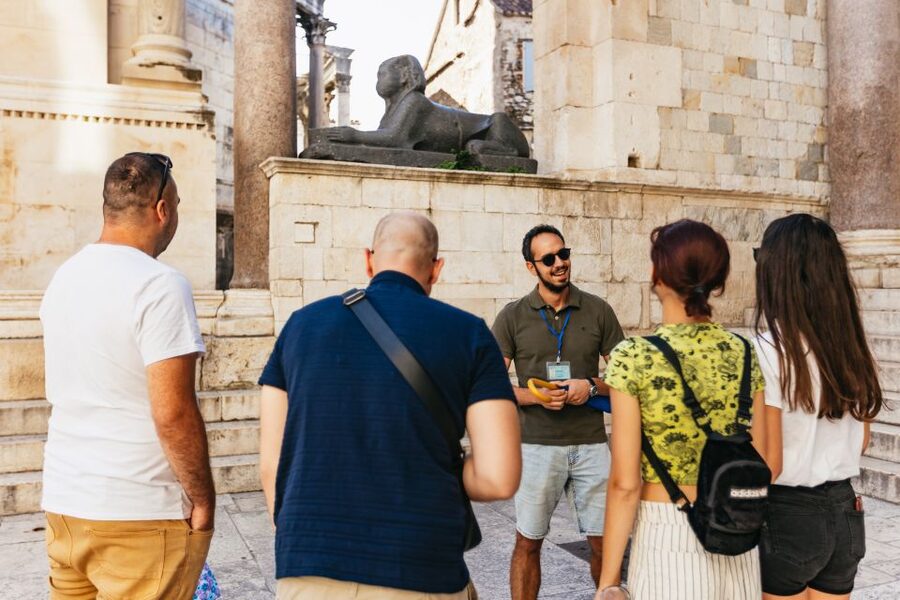
The walk next goes to Diocletian’s Cellars, with roughly 15 minutes of guided time. This is the longest stop on the scheduled route, and for good reason. The lower rooms help you understand the palace’s scale and layout from the inside.
The cellars are not just a basement to tick off. They reveal how the upper palace was supported and organized, and they offer a clearer sense of the Roman construction than some of the later streets do. Your guide can explain what you are seeing and connect the lower spaces with the buildings above.
This is one place where the flexible duration matters. Fifteen minutes may be enough for a brisk orientation, but a longer private tour allows more questions and a slower look. Ask the guide to explain how the cellars relate to the imperial apartments and the wider palace plan.
The supplied details do not state that admission tickets to every interior are included. The included items are the professional local guide, private sightseeing, and taxes, fees, and handling charges. If you want to enter a paid section, ask what is covered before you book.
Peristil, the Palace’s Great Central Stage
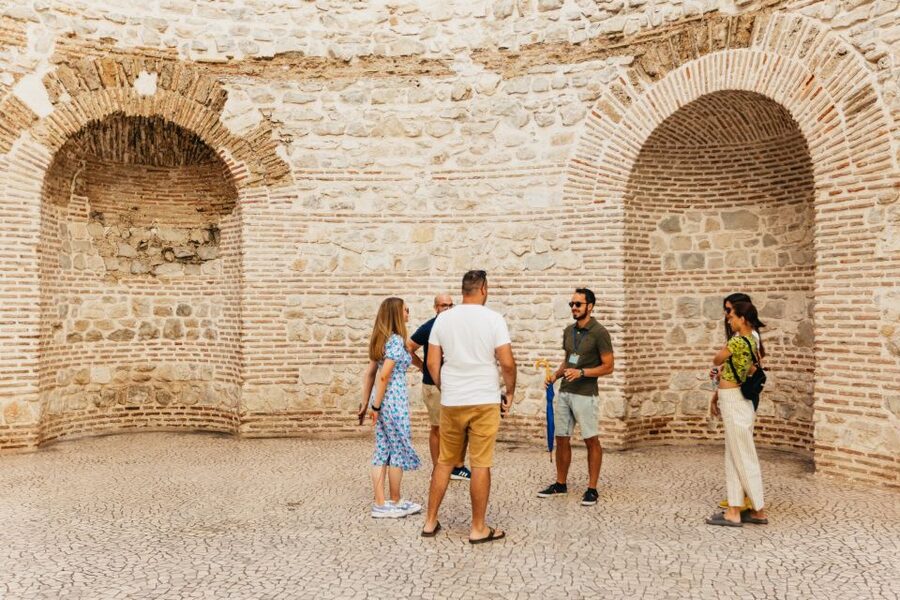
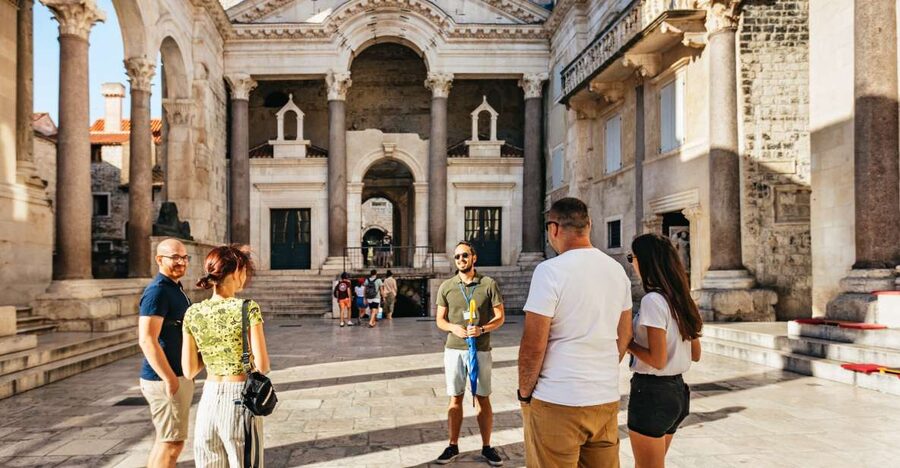
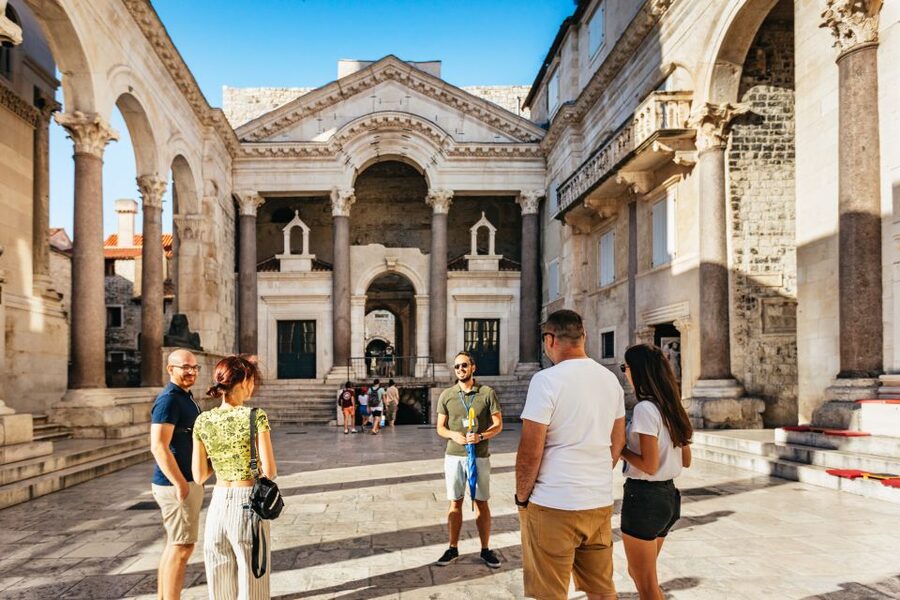
From the cellars, the route reaches Peristil, the palace’s central square, for about 10 minutes. This is the visual heart of the walk. It is the place where the Roman plan becomes easiest to grasp, with monumental stonework and later buildings gathered around an open space.
Peristil also shows why the palace feels alive. Ancient forms remain in use beside modern activity. The square is not sealed away from Split; it is part of the city’s movement and daily rhythm.
A good guide will do more than identify columns and dates. You can ask how the square was used, why it was placed where it is, and what changed after the palace stopped functioning as an imperial residence. The private setting makes it easier to pause for photographs or return to a point you missed.
If your tour lasts only 90 minutes, Peristil is one of the stops I would prioritize. It gives you the clearest single view of the palace’s grandeur and its later life as a city.
Saint Domnius and the Roman Emperor’s Tomb
The Cathedral of Saint Domnius, called St Duje locally, receives about 10 minutes on the planned route. It is one of the most unusual stops because the building began as Diocletian’s mausoleum. The emperor, known as the last famous persecutor of Christians, was interred there in 311 AD.
The cathedral was later adapted for Christian worship, which makes it a strong example of Split’s layers changing over time. You are not looking at a Roman monument in isolation. You are seeing an ancient imperial structure given a new religious role.
The cathedral is described as one of the best-preserved ancient Roman buildings still standing. That claim helps explain why this short stop carries so much weight. It ties the emperor, the palace, the city’s Christian identity, and the later cathedral together.
If religious buildings matter to you, say so at the start. The guide can give more context about Saint Domnius and the medieval development of Split. If you are mainly interested in Roman engineering, ask for that angle instead.
Vestibul and the Return to the Golden Gate
The final listed stop is the Vestibul, with about 10 minutes of guiding. This circular entrance space once led toward the imperial apartments and offers another chance to see how the palace was designed for ceremony and controlled access.
The Vestibul is easy to appreciate after the cellars and Peristil because you have already learned the basic plan. Rather than seeing one more old room, you can now understand its place within the palace.
The tour then returns to the Golden Gate. Ending where you began is practical, especially if you are catching a ship, meeting friends, or planning lunch nearby. It also gives you a familiar point from which to continue exploring on your own.
The route includes City Hall, the Fish Market, the medieval quarter, the clock tower, and other historic buildings as part of the broader walk, even though they are not each listed as timed stops. The Fish Market is described as a focal point of life in Split, so ask the guide to point out how it fits into the city’s daily routine.
Guides, Languages, and the Value of a Private Walk
The tour is offered in English, German, Spanish, and French. The guide is described as a professional local who is passionate about Croatia and can tailor the sightseeing to your interests.
Specific guides connected with this experience include Vinka, Slavko, and Antonia. Vinka was singled out for professionalism. Slavko brought a personal connection to Split and avoided getting trapped among large tour groups. Antonia took time with questions and explained the history and architecture with clear enthusiasm. Those details suggest that the guide’s personality will shape your experience, as it should on a private walk.
The price is $117 per group of up to two people. For one person, that is a substantial charge. For two people, it is $58.50 each before considering any added value from the flexible route and private questions.
I would consider it good value if you care about context and dislike being hurried. A private guide can adjust the pace, give family-friendly explanations, and offer local suggestions. It is less compelling if you only want a quick orientation and are happy to read signs or walk independently.
The tour offers free cancellation up to 24 hours before the start for a full refund, and you can reserve now and pay later. Check the available start times and exact duration before committing, since the experience may run from 90 minutes to five hours.
Who Will Get the Most From This Experience?
This is a good choice for first-time visitors who want Split explained in one sitting. It also suits families, since the guide can adapt the pace and make the stories fit the ages in your group.
History fans will get the most from the Roman palace, cellars, Peristil, Vestibul, and Saint Domnius. Architecture lovers will appreciate the rapid shift from Roman remains to Romanesque, Gothic, Renaissance, and Baroque buildings.
The tour also works well for people with limited time in Split. A 90-minute version can cover the core sights, while a longer option gives you room for the medieval quarter, markets, questions, and local recommendations.
I would not choose it if you need step-free access. The activity is specifically not suitable for wheelchair users. You should also expect a walking tour through an old stone center, so comfortable footwear is essential.
Should You Book the Split Private Palace Tour?
Book this tour if you want a personal explanation of Split rather than a fast checklist of monuments. The Roman palace, Saint Domnius, Peristil, the cellars, Riva, and medieval squares create a strong first look at the city, and the private format lets you decide what deserves more time.
The best match is a couple, family, or small private group willing to pay for direct access to a local guide. Look for the blue umbrella at the Golden Gate, bring sun protection and good shoes, and confirm the duration you want.
Skip it if you prefer exploring alone or if accessibility is a major concern. For everyone else, this is a focused way to understand why Split’s old center works so well: it is not a dead ruin, but a working city built around an emperor’s palace.
FAQ
Where does the private Split walking tour begin?
The meeting point is the Golden Gate, the north gate of Diocletian’s Palace in Split. Look for a guide with a blue umbrella.
How long does the tour last?
The available duration ranges from 90 minutes to five hours. Check the available options for starting times and the exact length when booking.
What sights are included in the route?
The route includes the Golden Gate, Game of Thrones Museum, People’s Square, Fruit Square, Riva, Diocletian’s Cellars, Peristil, Cathedral of Saint Domnius, and Vestibul. It returns to the Golden Gate.
Is this a private group tour?
Yes. The activity is for a private group, with the listed price covering up to two people.
How much does the tour cost?
The price is $117 per private group of up to two people.
Which languages are available?
The live guide can conduct the tour in English, German, Spanish, or French.
Is the Cathedral of Saint Domnius part of the tour?
Yes. Saint Domnius is a scheduled stop with about 10 minutes of guided time.
What should I bring?
Bring comfortable shoes, sunglasses, and a sun hat. The activity is a walking tour through Split’s historic center.
Is the tour suitable for wheelchair users?
No. The activity is listed as not suitable for wheelchair users.
Just added around Split
- From Trogir, Seget, Okrug: Krka Waterfalls & Šibenik Culture Tour★ 5.0 · 10 reviews
- Island Hopping Boat Excursion with Lunch (Trogir,Blue Lagoon, Šolta)★ 3.5 · 6 reviews
- Krka Waterfalls & Primošten from Trogir, Seget, Čiovo & Kaštela★ 5.0 · 18 reviews
- From Split & Trogir: ATV Quad Tour on Island Čiovo★ 5.0 · 21 reviews
- Slatine – Island Hopping Excursion (Trogir/Blue Lagoon/Shipwreck)★ 4.0 · 24 reviews
- Split: Blue Lagoon Boat Trip with Lunch, Wine and Snorkeling★ 5.0 · 3 reviews
- Split Sunset Stand Up Paddle Tour★ 5.0 · 16 reviews
- Split: Sunset Guided Kayaking Tour★ 4.8 · 71 reviews
Split Tours, compared.

Krka Waterfalls Trip with Boat Cruise and Swimming
Read our review →

Blue cave, Mamma Mia and Hvar, 5 islands speedboat tour
Read our review →
Blue Cave, Mamma Mia, Hvar and 5 Island Tour
Read our review →
Blue Lagoon & 3 Islands Cruise with Lunch from Split
Read our review →

Blue Lagoon Boat Party with DJs, Shots & After Party
Read our review →Browse the lists this tour appears in