
Reviewed · PULA TOURS
Pula Private 2-Hour Guided Walking Tour
Pula’s old town packs an astonishing amount into a small area, and this private walk gets you from its famous Roman arena to ancient gates, a working market, and the harbor-facing Venetian Fortress in about two hours. Guide Sinisa, also called Sini, can arrange quick arena tickets and shape the route around your interests.
I like the one-group format, which means you can ask questions without waiting for a large tour to catch up. I also like the mix of major sights and easy-to-miss places, especially the Roman floor mosaic and the market. The main consideration is the pace: you will cover a couple of miles, with a few hills, and the arena entrance fee costs extra.
Key points to know before booking
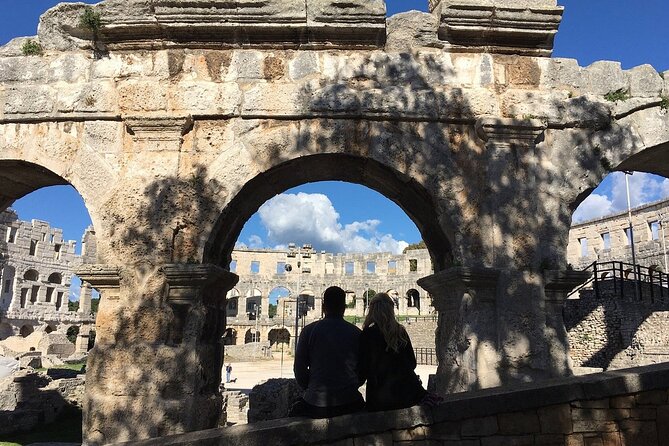
- The Roman arena is the headline stop: Spend about 30 minutes learning about Pula’s first-century amphitheater, inside or from the outside.
- The route covers nine historic sights: You see the fortress, cathedral, Roman forum, mosaic, market, and three old city gates.
- Your guide can adjust the walk: This private tour lets you choose what to see and slow down when the heat or hills call for it.
- The local advice adds value: Sinisa or Sini can suggest olive oil and Istrian dishes for after the tour.
- The price works best for a full group: The $145.50 rate covers up to 15 people, while the arena ticket is €10 per person.
- Plan for active walking: The route takes about two hours and covers a couple of miles, so comfortable shoes and water make sense.
Pula Arena gives the tour its Roman opening
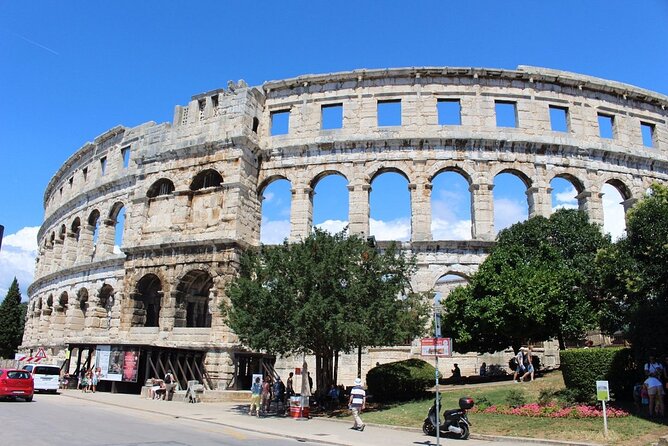
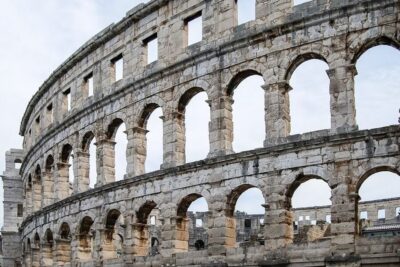
Meet your licensed guide at Pula Arena on Flavijevska ul. The location is hard to miss, and starting here gives you an immediate sense of Pula’s importance under Rome. The first-century AD amphitheater is the biggest sight on the route, so it makes sense to begin with the city’s grandest monument.
You have two choices. You can stay outside while the guide explains the arena, its purpose, and its place in Pula’s story. Or you can pay the €10 admission and go inside, with the guide leading you through the monument.
I would choose the interior if the extra fee fits your plans. Thirty minutes is enough to add useful context without turning the tour into a long museum visit. The guide can buy the entry tickets at the entrance, which helps you avoid a wait, though the admission cost is not part of the tour price.
The arena is also where the private format first proves useful. If your group wants photos, more background, or a slower look at the structure, you can ask for it. A large group tour usually has to keep moving.
More walking tours in Pula:
- Pula: Historic Walking Tour with Local Guide & City Views
★ 4.8 · 143 reviews - Pula walking tour
★ 5.0 · 96 reviews - Pula: Historic Sites Guided Walking Tour
★ 4.8 · 78 reviews
The Venetian Fortress brings a harbor view
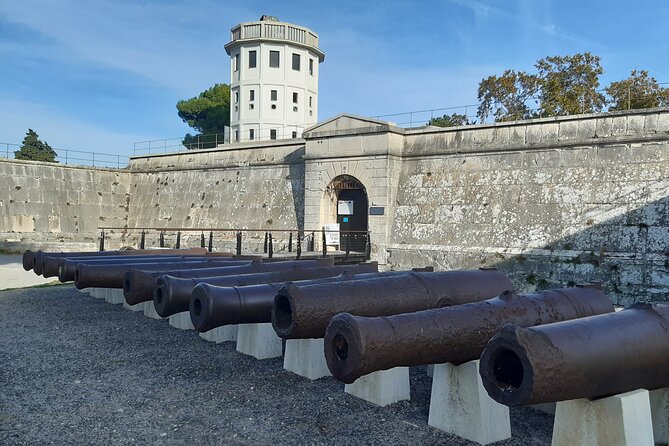
From the arena, the route continues to the 17th-century Venetian Fortress. The guide explains the fortress from outside and points out the view toward Pula harbor.
This is a shorter stop, around 15 minutes, and the value comes less from an interior visit than from seeing how later defensive buildings fit into the older city. You get a change of period after the Roman arena, along with a broader view of Pula.
There is no promise of entering the fortress, and admission is not included. That keeps the stop simple and efficient. If your main goal is to see the old town rather than tour every building inside, this outside explanation works well.
The walk also introduces the physical side of Pula. The route is not flat from start to finish, and the tour covers roughly a couple of miles. Sinisa has been careful with walking pace, which matters on a hot day or for anyone who prefers not to hurry.
Pula Cathedral adds a quieter pause
The cathedral dates from the fifth century AD and is described as Pula’s most important church. You walk around it while the guide explains its place in the city, and you may go inside if it is open.
This is a welcome change from the large arena and open streets. A church visit also gives the tour a more personal feel, showing that Pula is not simply a collection of Roman remains. It is a living city with religious buildings still part of daily life.
Because opening depends on the day and hour, treat the interior visit as a possibility rather than a guarantee. The stop itself remains useful from outside. Your guide can explain the building and its setting even if the doors are closed.
The cathedral stop lasts about 10 minutes. That is enough for orientation, not a full architectural study. If you want a longer church visit, tell your guide early so you can decide where to trim the route.
The Roman Forum links Augustus to city hall
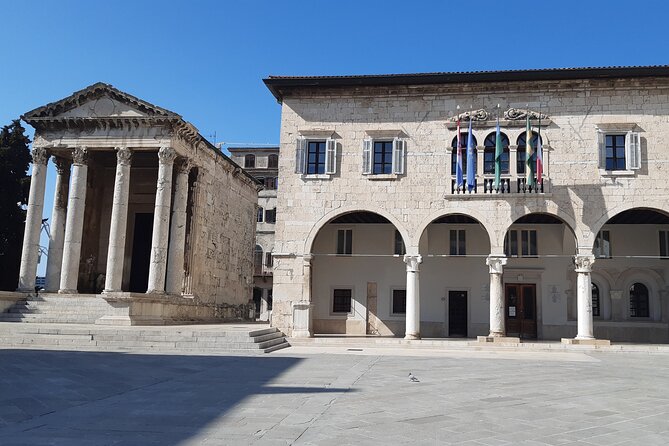
The route then reaches the Roman Forum and the Temple of Augustus, both from the first century AD. Here, the guide also points out the city hall, built in 1396.
This is one of the most rewarding stops because several layers of Pula sit close together. You see Roman religious architecture beside a medieval civic building, all in the same public square. The guide’s role is important here: without explanation, the stones can blur together, but the date contrast gives the forum more meaning.
The stop lasts about 15 minutes and takes place around the buildings. The information provided does not promise entry into the Temple of Augustus or city hall, so expect an exterior visit.
I like this part of the route for the way it connects monuments to public life. The forum was not just a scenic square, and the later city hall shows that the area continued to matter long after Rome. You do not need a long lecture to understand that shift, but a good local guide can make it memorable.
A few more Pula half-days to weigh up
- Omiš: 2-Hour Cetina River Boat Tour and Nature Park Visit
★ 4.5 · 293 reviews - Dubrovnik: 3h Morning or 2h Afternoon Kayaking & Snorkeling
★ 5.0 · 162 reviews - Dubrovnik 2-Hour Uncertified Divers Introductory Dive
★ 4.7 · 118 reviews - Private Transfer from Dubrovnik to Split with 2 hours for sightseeing
★ 5.0 · 50 reviews
The Punishment of Dirce is the tour’s special find
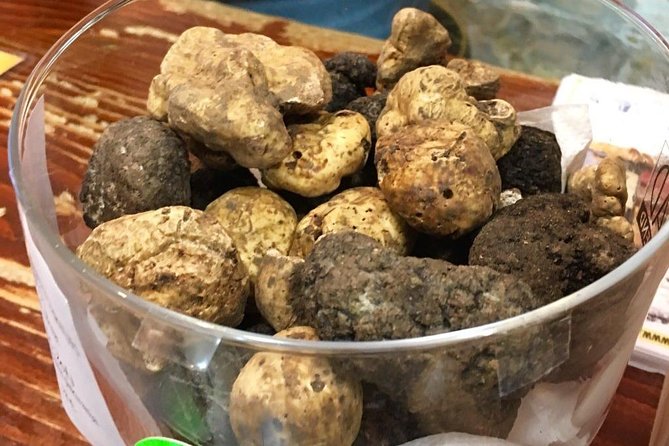
One of the most unusual stops is a second-century AD Roman floor mosaic depicting The Punishment of Dirce. The guide takes you to see it and explains what you are looking at.
This is precisely the sort of sight that can slip past you when you explore alone. It is not as obvious as the arena or the triumphal arch, yet it gives you a close look at the art and private life of Roman Pula.
The mosaic visit takes about 10 minutes and has no admission charge. Since it is a short stop, it fits neatly into a tight schedule. You get something distinctive without sacrificing the main monuments.
I would pay close attention here and ask questions. A mosaic on the floor can seem modest after the arena, but that contrast is part of the charm. The tour does not only collect famous buildings. It also points you toward details that reward a bit of guidance.
The Arch of the Sergii opens the old-town walk
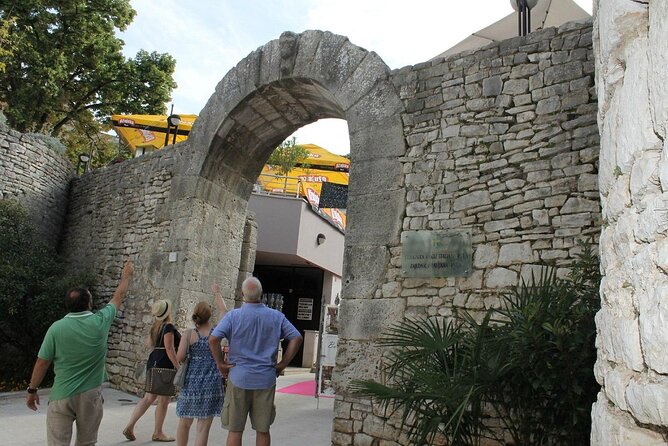
The Arch of the Sergii is a first-century BC Roman city gate. You walk under and around it while the guide explains its decorations and inscriptions.
This stop is brief, about 10 minutes, but it gives you a clear sense of how ancient Pula was organized. The arch is not simply a photo stop. The inscriptions and carved details help explain who commissioned it and how public monuments worked in Roman society.
Because the arch sits in the middle of the modern city, you experience one of Pula’s best features here: ancient remains are part of the ordinary street scene. You are not always walking through a separated archaeological park. At times, the past is right beside shops, traffic, and daily errands.
The stop is free, and no special ticket is needed. That makes it an easy addition even for a group trying to keep costs under control.
The 1903 market shows Pula as a working city
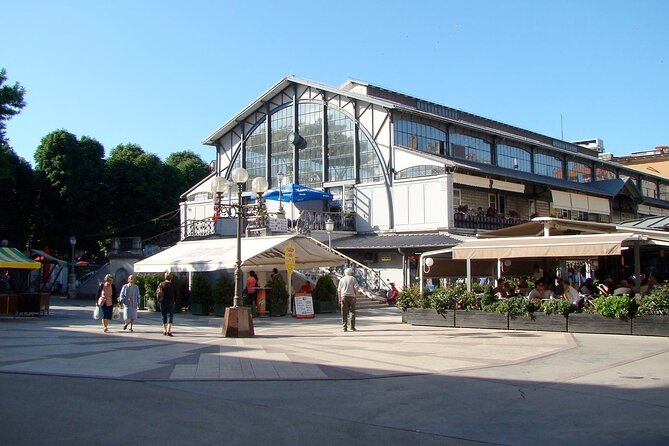
The walk continues to Gradska Trznica Pula, the city market building from 1903. You go around and through the market, with an explanation of the building and its role. If open, the fish market is included as well.
This is one of the strongest choices on the route. Ancient monuments tell you where Pula came from, but the market shows how the city functions now. The fish market, when open, adds a local, everyday note that you will not get from a sequence of monuments.
The visit lasts around 15 minutes. That is enough to look around without turning the tour into a shopping trip. If you want to return later for produce or seafood, ask the guide for suggestions and opening details while you are there.
The market also gives you a break from formal sightseeing. You can see the contrast between a 1903 public building and the Roman remains visited earlier. For me, this kind of stop makes a city walk feel more grounded.
Three Roman gates finish the route
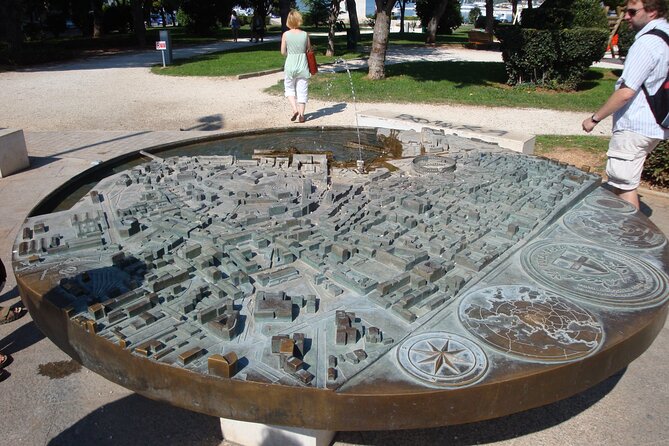
The final stretch includes the Gate of Hercules and the Twin Gates of Pula. The Gate of Hercules is a first-century BC Roman city gate, and the visit lasts about five minutes. The guide explains its setting and points out what remains.
The Twin Gates date from the second century AD. You walk around them for another five minutes before the tour ends at Carrarina ul. 8.
These stops are short, so do not expect long independent visits. Their value comes from the sequence. After seeing the Arch of the Sergii, you begin to understand how entrances and defenses shaped ancient Pula. The gates also make a practical endpoint because the route ends within the old town rather than returning you to the arena.
The end point is not the same as the start. That is useful if you plan to continue exploring on foot, but you should note it when arranging the rest of your day.
Why the private format matters in Pula
The tour costs $145.50 per group of up to 15 people. That price is not cheap for one or two people, but it becomes more reasonable as your group grows. A group of 10, for example, brings the guiding cost to about $14.55 per person before the arena ticket.
The private setup is the main value. You are not paying only for a checklist of sights. You are paying for a licensed guide who can answer questions, adjust the pace, explain local customs, and change the emphasis if your group has particular interests.
For a pair, the price requires a clearer decision. If you want an efficient introduction and local advice, it may be worthwhile. If you prefer wandering slowly and reading signs on your own, the cost may feel high, especially after adding €10 per person for the arena.
For a larger family or group of friends, the calculation improves quickly. The tour can also help you avoid spending your limited time working out where the mosaic, gates, cathedral, and market are located.
Heat, hills, and timing deserve attention
The scheduled walk runs from noon to 2 p.m. That timing can be demanding in hot weather, especially with several outdoor stops. One group took time to find shade during an extremely hot walk, and that is sensible advice for everyone.
Wear comfortable walking shoes and carry water. The route includes a few hills and covers a couple of miles, so a moderate level of physical fitness is expected. You can ask the guide to control the pace, but this is still an active city walk rather than a short stroll around one square.
The tour is offered in English and uses a mobile ticket. Confirmation is sent within 48 hours of booking, subject to availability. It is also near public transportation, which helps with reaching the start or continuing after the finish.
The experience has a five-star rating from 10 reviews, with 100 percent recommending it. That is encouraging, though the sample is small. The strongest praise centers on the guide’s English, humor, care with pace, local knowledge, and ability to cover the important sights in a short time.
Local food advice can extend the value
Sinisa or Sini can suggest olive oil and local dishes to try after the walk. That small detail matters because the tour ends with you already oriented to the old town and market area.
I would save a few minutes at the end for questions about where to eat or what to buy. The guide’s advice is not a meal or tasting, and food costs are not included. Still, a local recommendation can help you make better use of the hours after the tour.
The market stop is the natural moment to ask about Istrian products. Keep your expectations practical: the tour gives you recommendations, not a food-focused itinerary. If you want a full tasting experience, this is not the right product.
Who should book this Pula walk?
I would recommend it most strongly to:
- First-time visitors with only a few hours in Pula
- Cruise passengers or day visitors who want a clear route through the old town
- Families and friend groups who value a flexible pace
- History fans who want Roman monuments explained rather than simply photographed
- People who enjoy adding markets and local food advice to major sights
It is less suited to anyone who dislikes walking, struggles with hills, or wants long interior visits at each monument. The itinerary moves quickly because it tries to cover nine stops in two hours.
The private format also works well for people who want to ask direct questions. You can request more detail at the arena, spend less time at a gate, or ask for help choosing a later meal. That freedom is harder to get on a fixed group tour.
Should you book the Pula private walking tour?
Book it if you want a fast, well-organized introduction to Pula that combines headline sights with smaller discoveries. The arena, Temple of Augustus, cathedral, market, mosaic, fortress, and city gates give you a strong first look at the city, while Sinisa or Sini adds local context and practical food advice.
Before booking, make sure the timing and walking level suit you. Noon can be hot, the route covers a couple of miles, and arena admission costs an extra €10 per person. For a group of several people, the $145.50 price is easier to justify. For two people, choose it only if a private guide and efficient sightseeing matter more to you than keeping costs low.
FAQ
How long does the Pula private walking tour last?
The tour lasts approximately two hours.
Where does the tour begin?
The tour begins at Pula Arena on Flavijevska ul., 52100, Pula, Croatia.
Where does the tour end?
The tour ends at the Twin Gates at Carrarina ul. 8, 52100, Pula, Croatia.
Is the Pula Arena admission included?
No. Entry to the amphitheater costs €10 per person. You can also choose to hear the explanation from outside without entering.
How many people can join the private tour?
The price covers one private group of up to 15 people.
Is cancellation free?
Yes. You can cancel at least 24 hours before the experience start time for a full refund. Cancellations or changes made less than 24 hours before the start are not accepted for a refund.
Just added around Pula
- Kamenjak Nature Park: Kayak Tour with Snorkeling & Cave Exploring★ 5.0 · 15 reviews
- Dolphin & Sunset tour with Brijuni panorama★ 5.0 · 119 reviews
- Transfer Pula – Poreč★ 5.0 · 5 reviews
- Kayaking to Island Saint Jerolim with snorkeling activitie★ 4.5 · 26 reviews
- Clear Kayak Glow Night Tour★ 5.0 · 69 reviews
- Pula / Pješčana Uvala: Sunset SUP Tour – Explore & Chill★ 5.0 · 16 reviews
- Scuba Diving for Beginners in Pula★ 5.0 · 29 reviews
- Pula Kayak Tour-Cliff jumping,snorkeling& free GoPro pictures★ 5.0 · 94 reviews
Pula Tours, compared.
Kamenjak 5h boat trip with lunch & drinks on Sandra Boat
Read our review →
Full-Day Boat Tour of the Medulin Archipelago from Medulin
Read our review →
3hours all inclusive Sunset&Dolphin Tour from Medulin on Sandra
Read our review →
Dolphin Watching & Sunset Boat Tour With Dinner and Drinks
Read our review →
Kayaking,Snorkeling, Cliff jumping Tour with Wetsuit
Read our review →
BOAT & KAYAK! Sea Adventure – Snorkeling & Cliff Jumps
Read our review →
National Park Brijuni Island Visit & Dolphin Cruise
Read our review →Browse the lists this tour appears in