
Reviewed · PULA TOURS
Pula: Historic Sites Guided Walking Tour
Pula’s story comes at you in layers, beginning with the 2,000-year-old Arena and continuing through Roman temples, medieval churches, Venetian defenses, and a lively town market. This 90-minute walk gives you a fast, well-organized way to see how those periods fit together.
I like the route’s variety, from the grand amphitheater to small Roman mosaics and the Arch of Sergii. I also like the guides’ teaching style, especially Sini, who is praised for clear English, humor, and thoughtful answers. The main drawback is the brisk format: you see many major places, but you do not get a long visit inside each one, and entry tickets are not included.
Key points at a glance
- The Roman Arena starts the story: Get an informative introduction to Pula’s most famous monument before walking into the old town.
- The castle brings the best views: The 17th-century Venetian fortress offers a useful look over Pula and its setting.
- Roman remains appear along ordinary streets: Mosaics, arches, temples, and fragments are woven into the modern city.
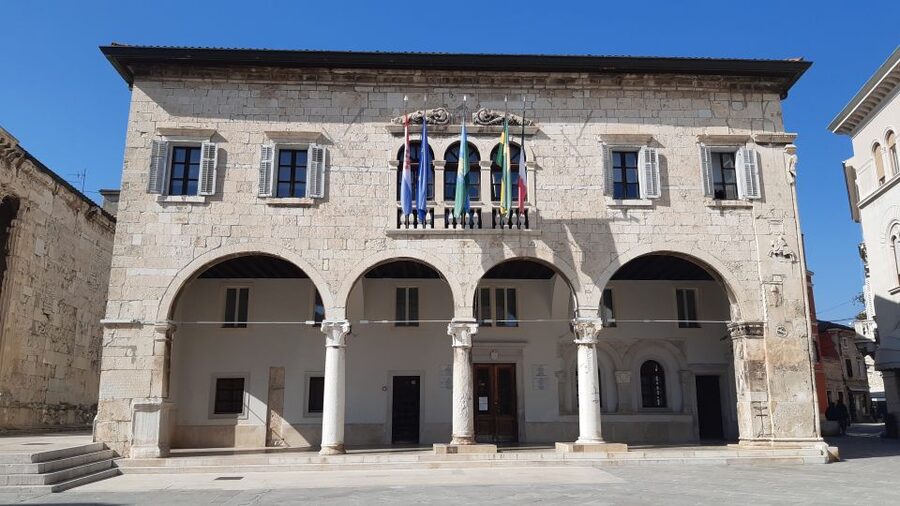
- The Forum gathers several eras in one place: See the Augustus Temple, City Hall, and Cathedral close together.
- The route ends at Twin Gate: You finish near the ancient Gate of Hercules and the edge of Pula’s historic core.
- It is strong value at $20: You get a local English-speaking guide and a broad introduction without paying for a long excursion.
Why Pula’s Roman Arena is the right starting point
Meet in front of the Amphitheater entrance on Istarska ul. 50. Your guide wears a blue card around the neck and carries an umbrella, a useful detail when several walking groups gather near the Arena.
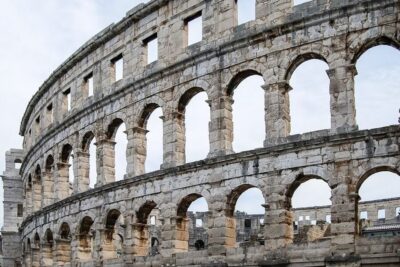
The tour begins with a short explanation of the amphitheater. That opening matters because the Arena is not just a dramatic photo stop. It gives you the scale of ancient Pula and sets up the Roman story that continues throughout the walk.
You can expect the guide to explain the monument before moving on rather than spending the entire 90 minutes there. That makes sense for a city tour, since the route also includes the castle, Cathedral, Forum, temple, market, mosaics, and old gates.
The Arena is one of the tour’s strongest points, but there is a practical limit. Entry tickets are not included, so this experience should not be treated as an Arena interior visit. If you want to go inside, plan that separately and check the opening details for your date.
More history-led days in Pula:
- Pula: Historic Walking Tour with Local Guide & City Views
★ 4.8 · 143 reviews - Olive Oil Guided Tasting and History in Pula
★ 4.5 · 34 reviews - Pula Roman Heritage Walking Tour
★ 5.0 · 12 reviews
The Venetian castle and views across Pula
From the Arena, the route continues to Pula Castle, built by the Venetians in the 17th century. Here, the focus shifts from Roman power to the later military and political history of the town.
The guide explains the castle’s past and the people who occupied it. That background gives the fortress more meaning than a quick climb for a photograph. You begin to see Pula as a port city shaped by several rulers, not simply as a Roman archaeological site.
The castle is also the route’s best viewpoint. You get panoramic views that help you understand Pula’s layout, especially after walking through streets where the larger shape of the city can be hard to grasp.
I like this part because it breaks up the line of ancient monuments. The Arena and temples are heavy with Roman symbolism, while the castle shows how later powers reused Pula for defense and control.
The walk is not suitable for people with mobility impairments. The route includes historic streets and a castle setting, so you should be comfortable walking for 90 minutes and handling the surfaces and changes in level that may come with an old town route.
The Cathedral and the Roman Forum
The next section takes you to the Cathedral before reaching the Roman Forum. The Cathedral adds a religious layer to a tour that otherwise leans strongly toward ancient Rome.
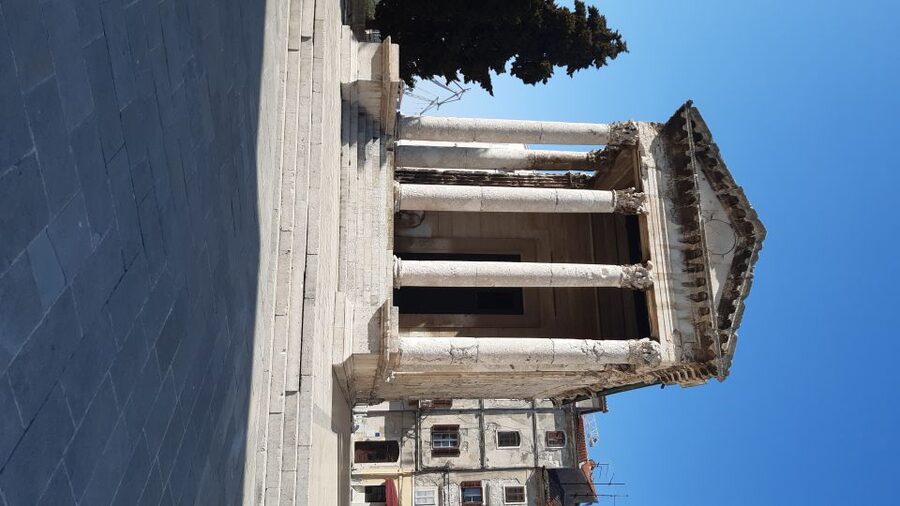
At the Forum, several important sights sit close together. You see the Augustus Temple and City Hall, giving you a compact lesson in how Pula’s central public space changed over time.
The Augustus Temple is the key ancient monument here. At around 2,000 years old, it gives you a direct connection to Roman public life and worship. Your guide provides the historical and architectural context, helping you read the building rather than simply photograph its columns.
City Hall adds a later civic note beside the ancient remains. That contrast is one of the most useful parts of the route: Pula’s old center is not a preserved Roman park separated from daily life. Modern government, worship, cafés, shops, and old stones share the same streets.
The Cathedral and Forum are close enough to visit at a comfortable pace, according to the route description and past tour experience. Still, remember that 90 minutes goes quickly. The guide must keep the group moving if everyone is to reach the final gates.
Roman mosaics, the Arch of Sergii, and traces in the streets
One of the better features of this walk is its attention to smaller Roman remains. You see Roman mosaics along the way, along with the Arch of Sergii.
These details reward careful looking. A huge arena is easy to spot, but a mosaic or reused stone can tell you how Roman Pula survived inside the later town. The guide’s role is especially useful here, since you might otherwise walk past a fragment without knowing what it is.
The Arch of Sergii brings another major Roman marker into the route. It is a clear reminder that ancient Pula was a functioning city with public monuments, families, and civic ambitions, not only an arena for spectacles.
Several people who took the walk praised the guide’s stories and answers as much as the sights themselves. Sini is especially noted for broad ancient-history knowledge, friendly humor, and excellent English. One tour also used the name Sinsije, and another referred to Sinisha, so the exact guide name may vary by departure, but the experience is built around a live local guide rather than an audio recording.
That human element makes a difference in Pula. You can read dates and names on a sign, but a good guide can connect the temple, arch, mosaic, and Forum into one understandable picture.
More walking tours in Pula:
- Pula walking tour
★ 5.0 · 96 reviews - Pula Essentials Walking Tour
★ 4.8 · 64 reviews - Pula Essentials Walking Tour
★ 5.0 · 62 reviews - Pula Food Walking Tour
★ 4.5 · 22 reviews
Pula Market and the Gate of Hercules
The route then reaches Pula Market, established in the early 1900s. This stop moves you out of the ancient world and into the town’s more recent daily life.
A market is a useful addition to a historical tour because it shows that Pula is more than its monuments. You get a glimpse of how the old center functions as a living town, not just an archaeological display.
The final historic stop is the ancient Gate of Hercules. This modest-looking gate gives the walk a fitting close, bringing you back to Roman Pula after the later castle, Cathedral, market, and civic buildings.
The tour finishes at Twin Gate. Ending there creates a practical route through the old center instead of sending you back to the starting point. You can continue exploring on your own from this point, though the supplied details do not specify nearby transport connections or additional stops.
What the 90-minute format feels like
Ninety minutes is a good length for an orientation walk. You cover the central historic sights without giving up half a day, and the route is short enough to fit before or after another Pula activity.
The tradeoff is depth. You will learn about many places, but you should not expect extended free time at the Arena, castle, Cathedral, Forum, or market. If you want detailed interior visits or quiet time for photographs, add those after the walk.
Past tour experiences describe the pace as leisurely and comfortable, with the monuments fairly close together. That is encouraging, but you should still wear comfortable shoes and bring water, particularly in warm weather. The tour runs rain or shine, so a light rain jacket is sensible even if the forecast looks uncertain.
The guide can answer questions, and the strongest feedback centers on clear explanations, a friendly manner, and the ability to make ancient history understandable. I would use the walk early in a Pula stay, when the overview can help you decide where to return for a longer visit.
Is $20 good value for Pula?
At $20 per person, this is a good-value introduction to the city. The price covers a local expert guide and a route that includes the Arena, castle, Cathedral, Roman Forum, Augustus Temple, City Hall, mosaics, Arch of Sergii, market, and ancient gates.
You are paying for interpretation and structure, not admission to paid sights. That distinction matters. If you only want to wander around and read signs, you can see many exterior monuments independently. If you want the sites connected by stories about architecture, culture, rulers, and Roman life, the $20 adds useful context.
The value is strongest for first-time visitors, people on a short stay, and anyone who wants to get oriented quickly. It is also a sensible choice before exploring the Arena or other sites independently, since you will know what you are looking at.
The price is less compelling if you have already spent time studying Pula’s history or want a specialist archaeology tour. The available information does not promise a small group, private guiding, or access to restricted interiors, so book it for a well-led city overview rather than a highly specialized visit.
Who should book this walking tour?
I would recommend it to adults and older children who enjoy history but do not want a long lecture. The route has enough variety to hold your attention: a huge Roman amphitheater, castle views, a church, a temple, civic buildings, mosaics, a market, and gates.
It suits first-time visitors especially well. You get the town’s basic shape and a clear list of places worth revisiting. The tour also works for cruise or short-stay schedules because it lasts only 90 minutes.
English speakers have the clearest fit, since the live guide language is English. The guides have received repeated praise for clear English and for encouraging questions.
I would hesitate if you have mobility limitations, since the activity is specifically not suitable for people with mobility impairments. I would also choose another format if your main goal is to spend a long time inside the Arena or museums, since entry tickets are separate and the route keeps moving.
You cannot record video during the tour. You can still listen, take notes, and take photographs as allowed, but plan on being present for the guide’s explanations rather than filming the whole walk.
Should you book the Pula Historic Sites Guided Walking Tour?
Book it if you want an affordable, focused introduction to Pula with a guide who can explain the links between Roman, Venetian, religious, and modern parts of the city. The repeated praise for Sini and the other named guides centers on the qualities that matter most here: clear English, humor, strong historical command, and willingness to answer questions.
The tour is not a substitute for paid site entry or a full-day archaeology program. It is a smart first look at Pula, with enough detail to make the city’s famous stones meaningful and enough free time afterward to return to the places that catch your interest.
Free cancellation is available up to 24 hours before the tour, and you can reserve now and pay later. Check the available starting time, meet at the Arena entrance with the blue-card guide and umbrella, and plan for rain or shine.
FAQ
Where does the tour start?
Meet in front of the Pula Amphitheater entrance at Istarska ul. 50. The guide will have a blue card around their neck and hold an umbrella.
Where does the tour finish?
The walk finishes at Twin Gate.
How long does the Pula walking tour last?
The guided walk lasts 90 minutes, or 1.5 hours.
What language is the tour in?
The live tour guide speaks English.
Are entry tickets included?
No. Entry tickets are not included in the $20 tour price.
Can I cancel the booking?
Yes. You can cancel up to 24 hours in advance for a full refund.
Is the tour suitable for people with mobility impairments?
No. The activity is listed as not suitable for people with mobility impairments.
Just added around Pula
- Kamenjak Nature Park: Kayak Tour with Snorkeling & Cave Exploring★ 5.0 · 15 reviews
- Dolphin & Sunset tour with Brijuni panorama★ 5.0 · 119 reviews
- Transfer Pula – Poreč★ 5.0 · 5 reviews
- Clear Kayak Glow Night Tour★ 5.0 · 69 reviews
- Pula / Pješčana Uvala: Sunset SUP Tour – Explore & Chill★ 5.0 · 16 reviews
- Kayaking to Island Saint Jerolim with snorkeling activitie★ 4.5 · 26 reviews
- Scuba Diving for Beginners in Pula★ 5.0 · 29 reviews
- Pula Kayak Tour-Cliff jumping,snorkeling& free GoPro pictures★ 5.0 · 94 reviews
Pula Tours, compared.
Kamenjak 5h boat trip with lunch & drinks on Sandra Boat
Read our review →
Full-Day Boat Tour of the Medulin Archipelago from Medulin
Read our review →
3hours all inclusive Sunset&Dolphin Tour from Medulin on Sandra
Read our review →
Dolphin Watching & Sunset Boat Tour With Dinner and Drinks
Read our review →
Kayaking,Snorkeling, Cliff jumping Tour with Wetsuit
Read our review →
BOAT & KAYAK! Sea Adventure – Snorkeling & Cliff Jumps
Read our review →
National Park Brijuni Island Visit & Dolphin Cruise
Read our review →Browse the lists this tour appears in