
Reviewed · DUBROVNIK TOURS
Dubrovnik By Night Walking Tour
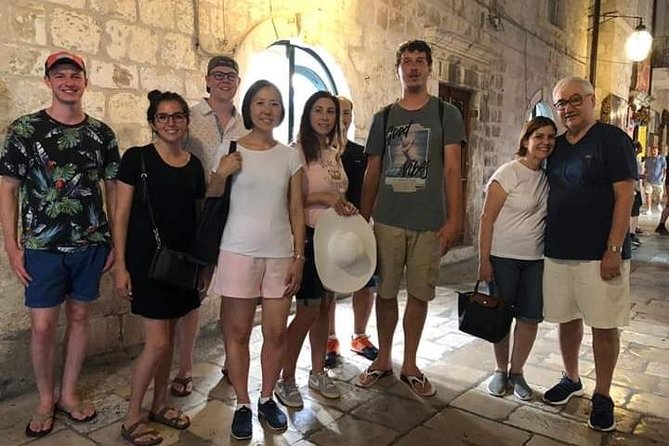
Dubrovnik changes after sunset. The tour takes you from the Amerling Fountain through Pile Gate, along Stradun, and into the Old Town’s quieter lanes while the stone buildings and churches are lit up. It is a good way to get your bearings on your first evening.
I like the cooler timing, especially in summer, and I like the way local guides such as Mihaela, Daniela, Davor, Petra, and Goran bring in personal stories about Dubrovnik and the 1990s war. The main drawback is simple: you do not enter the buildings, so this is an introduction rather than a detailed museum tour.
Key things to know before booking
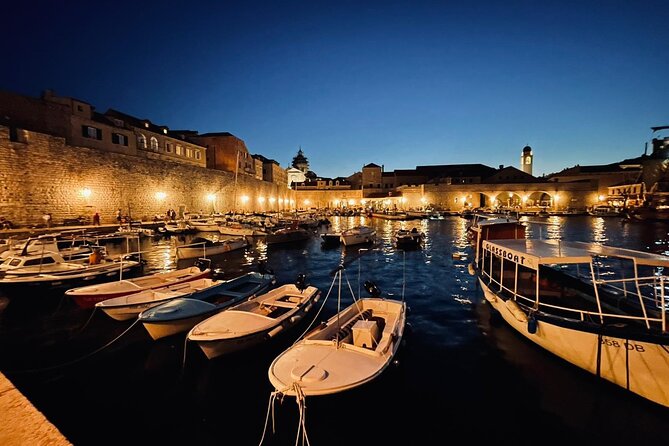
- The evening timing matters: You avoid much of the daytime heat and see the Old Town illuminated.
- The route covers the essential sights: Pile Gate, Stradun, Luza Square, Rector’s Palace, the Cathedral, and Prijeko Street all fit into about 90 minutes.
- Local storytelling is the main attraction: Some guides add family memories, wartime experiences, food advice, and Game of Thrones filming tips.
- The group can include up to 20 people: That is manageable, but listening may be harder if the guide must speak over a large or scattered group.
- The tour ends in Luza Square: You are left near several central Old Town sights and restaurants, rather than returned to your hotel.
- It is a walking overview, not an inside visit: The tour suits first-time visitors who want context and orientation more than deep access to monuments.
Why Dubrovnik works better after dark
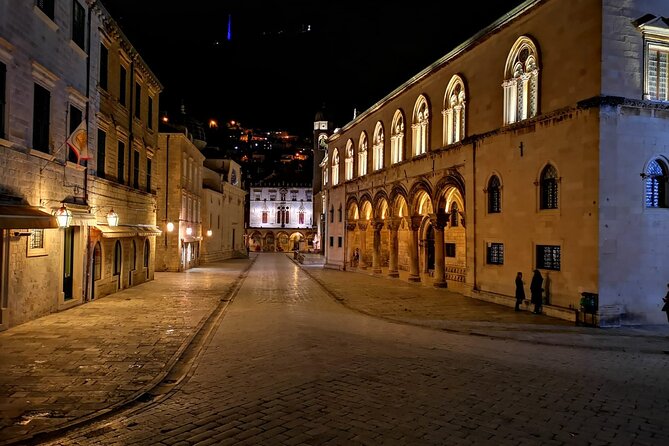
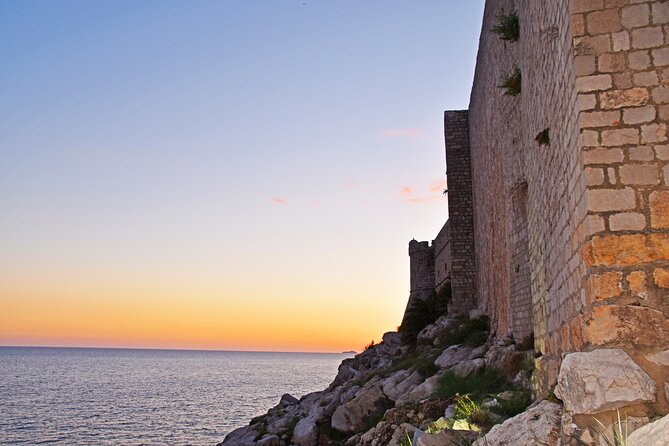
Dubrovnik’s Old Town can feel hot and crowded during the day, especially along the main street. An evening start, often around sunset or later, gives you cooler air and a gentler pace. The city walls and pale stone facades also take on a different look under the lights.
I especially like the tour as a first-night activity. You see the basic shape of the Old Town, learn where the main squares and streets connect, and can return later with a better sense of direction. The 90-minute length is long enough to cover the major sights without taking over your evening.
Do not expect a private stroll through an empty town. Dubrovnik remains popular at night, and Stradun can still have plenty of activity. The quieter atmosphere is most noticeable in the side streets and later in the evening, not necessarily at the busiest square.
The tour is offered in English and is capped at 20 people. That maximum is not tiny, but it is far more practical than a giant coach group. One poor experience involved two groups being combined and a failed radio system, making the guide difficult to hear. That appears to be an operational risk rather than the usual format, but it is worth keeping in mind if you need a very intimate tour.
More walking tours in Dubrovnik:
- Dubrovnik: Old Town Walking Tour
★ 4.8 · 5,174 reviews - Dubrovnik Discovery Old Town Walking Tour
★ 5.0 · 4,458 reviews - Dubrovnik: Game of Thrones Walking Tour
★ 5.0 · 1,732 reviews
Meeting the guide at Amerling Fountain
The meeting point is at Brsalje ul. 2, outside the Old Town near Pile Square. Look for the Amerling Fountain beside the Dubravka gift shop and a guide holding a blue umbrella.
This is a useful meeting point because Pile is the natural western entrance to Dubrovnik’s historic center. Give yourself enough time to locate the fountain, especially if you are arriving from a hotel or coming by public transport. The guide does not provide hotel pickup, drop-off, or transportation, so you make your own way to Pile.
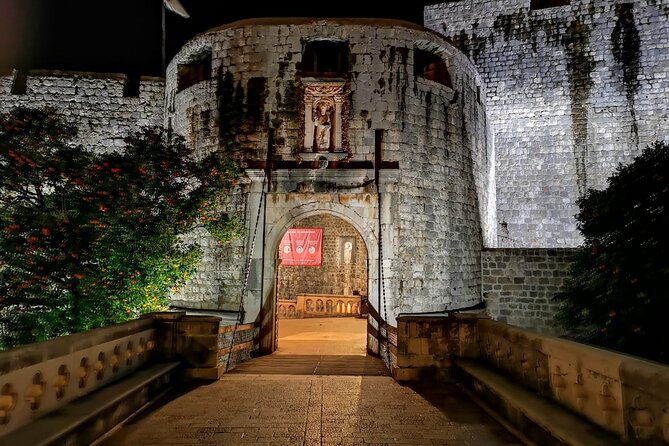
The opening five minutes are used for introductions and gathering the group. You will then move toward Pile Gate, the formal entrance into the walled city.
Pile Gate and the city map
At Pile Gate, the guide uses the city map to explain how Dubrovnik is arranged. This short stop is more useful than it might sound. Dubrovnik’s Old Town is compact, but its gates, main street, squares, stairways, and narrow lanes can be confusing on a first visit.
You get a basic explanation of the city’s development and an introduction to its past before walking farther inside. Guides have also used this early section to explain Dubrovnik as a maritime city-state, giving you a clearer frame for the buildings you see later.
This is orientation rather than a long history lecture. If you already know Dubrovnik well, you may find the map talk familiar. For a first visit, it helps you understand the route and gives the rest of the walk some shape.
The Franciscan Monastery, old pharmacy, and Onofrio Fountain
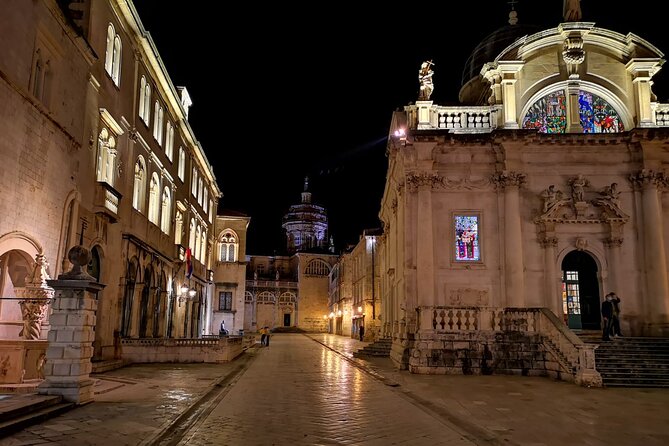
Once inside, the route reaches the Franciscan Church and Monastery near the start of Stradun. The stop lasts about 15 minutes and focuses on the old pharmacy and Dubrovnik’s early water supply, including the Onofrio Fountain.
The pharmacy is a particularly good detail because it connects the large, impressive monastery complex with ordinary city life. The fountain also helps explain how water was brought into the Old Town, a practical issue that shaped daily life in a dense walled city.
You will hear about these places from outside rather than touring their interiors. That distinction matters. The guide can point out architectural details and explain their role, but admission to the monastery, church, or any other attraction is not part of the experience.
More evenings out in Dubrovnik:
- Dubrovnik: Sea Kayaking&Snorkelling Guided Day/Sunset Tours
★ 4.8 · 1,554 reviews - Dubrovnik: City Walls Early Morning or Sunset Walking Tour
★ 4.8 · 1,523 reviews - Sunset Sea Kayaking and Wine Dubrovnik
★ 5.0 · 949 reviews - Dubrovnik: Sunset Zip Line Experience Followed by Wine
★ 4.9 · 921 reviews
Stradun at night
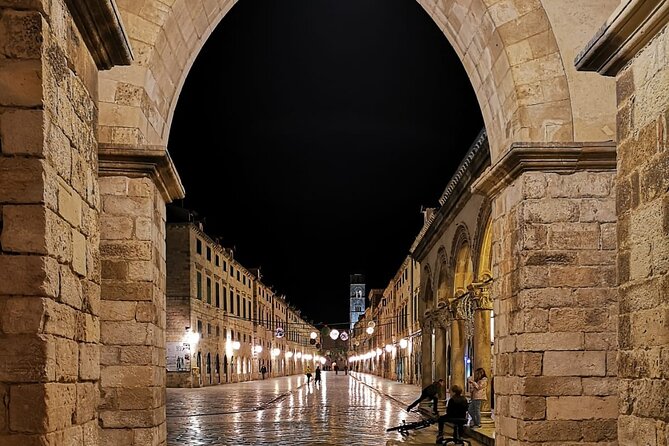
Stradun is Dubrovnik’s main street, running through the heart of the Old Town. The polished stone surface, uniform facades, shops, and evening lighting make it one of the clearest images of Dubrovnik.
The guide spends about 10 minutes here, explaining the street and the buildings along it. You should pay attention to the relationship between Stradun and the side streets. The main road is straight and orderly, while the lanes branching off it quickly become narrow, steep, and maze-like.
This is also a place where the evening schedule pays off. During the day, direct sun and heavy foot traffic can make a short stop feel tiring. At night, you have more comfort for looking up at the facades and listening to the guide.
Still, Stradun is not guaranteed to be quiet. It is the Old Town’s main artery, and restaurants, shops, and evening activity keep it active. The real calm comes later when the walk turns away from the central route.
Luza Square and Dubrovnik’s civic center
The tour continues to Luza Square, the main square at the eastern end of Stradun. The square brings several important buildings together: the patron church, the Bell Tower, and Sponza Palace.
A guide can make this stop useful by showing how religious, civic, and commercial power met in one public space. You will get a short explanation of the square’s role and the buildings around it, rather than a long architectural study.
The Bell Tower is one of the easiest reference points in the Old Town. Once you know where Luza Square is, it becomes much easier to find nearby streets and return to the area for dinner or further exploring.
The stop lasts about 10 minutes. That is enough for a clear introduction, but not enough to study every carving, facade, or historical change. I would treat this as a preview that helps you decide which buildings deserve a separate visit.
Rector’s Palace and stories of power
Rector’s Palace is one of the strongest stops on the route. The guide discusses its structure, past use, and role today, calling attention to the building’s importance in Dubrovnik’s political life.
The palace is valuable because it gives physical form to the old governing system. Rather than hearing only about rulers and dates, you can connect those ideas to the place where civic authority operated.
Guides have different ways of handling this stop. The strongest presentations use the architecture to tell stories about office, power, security, and changing use. Other guides keep the explanation shorter. Your experience will depend heavily on the person leading the group, which is true throughout this tour.
Again, there is no interior visit included. If Rector’s Palace becomes your favorite building, plan a return visit during opening hours and allow time for its museum displays.
The Cathedral and its treasury
The Cathedral of the Assumption of the Virgin Mary is described as Dubrovnik’s largest church. The tour pauses for about 10 minutes to explain the building and its treasury.
This is one of the places where a guide’s context adds real value. From the outside, a church can seem like another impressive stone facade. With an explanation of its place in the city, it becomes part of the wider story of Dubrovnik’s faith, wealth, and public identity.
The treasury is mentioned as part of the site, but entry is not included. You will see the cathedral from the route and hear about what it contains. If religious art and church interiors matter to you, consider setting aside another visit.
The stop is not designed for quiet contemplation or extended photography. The group needs to keep moving, and the guide may need to speak clearly over the surrounding evening activity.
Ivan Gundulic Square and the Jesuit Steps
The monument to poet Ivan Gundulic and the nearby Jesuit Steps provide a more atmospheric section of the walk. Here, the route shifts from broad streets and formal squares toward stairs and tighter urban spaces.
The monument gives the guide a chance to discuss Dubrovnik’s literary and cultural life. The Jesuit Steps are also a memorable visual point, with a strong sense of scale and perspective as you look up and down the stairway.
This section may be less useful if you want only major monuments with long explanations. I prefer it because it shows how Dubrovnik is experienced on foot. The city is not just a collection of grand buildings. Its character also comes from transitions between squares, steps, alleys, and small corners.
The route includes stairs and uneven historic paving. Most people can participate, but you should wear comfortable shoes and be ready for a steady walk through an old city rather than a flat promenade.
Prijeko Street and the local view
Near the end, the group strolls along Prijeko Street and through the maze of narrow side streets. This is where the tour’s title makes the most sense. You move away from the best-known sights and see a more residential-feeling part of the Old Town.
The guide points out details that can be easy to miss when you rush from one attraction to the next. You may hear about local customs, street features, food, daily life, or the way residents use the old buildings. Goran, for example, has been praised for combining stories about food, culture, and history with practical dining advice.
Several guides also bring personal experience into the walk. Daniela has spoken about life inside the Old Town, while Mihaela has connected Dubrovnik’s past with family memories of the war and the years after Yugoslavia. Those stories can make the modern city easier to understand, provided you are comfortable with a more personal approach to history.
This is also the best place to ask questions. If you want advice on where to eat, which sights to visit next, or how to spend the following day, save those questions for the final part of the walk.
What the guides add
The strongest part of this experience is the guide. Petra has been described as detailed and engaging, Davor as a clear storyteller, and Mihaela as warm, sincere, and open to questions. Daniela’s personal accounts and local familiarity have also made the route more vivid.
You should expect variations in style. Some guides provide a lively account from Roman times through the present, while others give a more basic overview. One less successful experience felt too general, with the group simply walking around without enough explanation. Another guide had trouble engaging a family group, including teenagers.
The most useful guide style here combines three things:
- Clear explanations of the city’s political and architectural past.
- Personal stories about modern Dubrovnik and the 1990s war.
- Practical advice on food, customs, filming locations, and places to explore next.
The tour has earned a 4.8 rating from 134 ratings, and 96 percent of participants recommend it. Those figures suggest a strong experience overall, but they should not hide the central fact that a walking tour depends greatly on the individual guide and group conditions.
Price, length, and overall value
At $24.19 per person, this is a fair price for a 90-minute guided orientation in Dubrovnik. You are paying for a licensed local guide, local taxes, and the walking tour itself. You are not paying admission to the cathedral, monastery, Rector’s Palace, or other attractions, and no food, drinks, hotel transfer, or transport is included.
I see the best value if you take it early in your stay. The tour can save you time later by showing where the key squares and streets are located. It can also help you choose which interiors deserve a separate ticket.
Group discounts may improve the price for larger parties. The mobile ticket makes arrival simple, and confirmation is provided when you book. The tour requires a minimum number of participants, so it can be canceled if that number is not reached. In that case, you are offered a new date or a full refund.
Free cancellation is available until 24 hours before the start time. Bad weather can also lead to cancellation, with a different date or full refund offered. Since this is an outdoor walk, that policy is worth noting.
Who should take this evening walk?
I would recommend it to a first-time visitor who wants a clear introduction without committing to a long activity. It also suits anyone trying to avoid the worst daytime heat, families who prefer a short overview, and people who enjoy local stories more than formal museum detail.
It is a good fit for fans of Dubrovnik’s wartime history, food culture, and Game of Thrones connections, since guides have included those topics when relevant. You will get the most from it if you ask questions and treat the guide as a source of local direction, not just a person reciting dates.
I would choose another format if you want extensive time inside monuments, detailed art history, or a private pace. The tour moves through many places in 90 minutes, so each stop is necessarily selective.
Should you book the Dubrovnik by Night Walking Tour?
Book it if you want to understand the Old Town before exploring it on your own. The evening light, cooler air, central route, and personal stories make it a practical first look at Dubrovnik, especially when the guide is as engaging as Mihaela, Daniela, Davor, Petra, or Goran.
Skip it if you already know the Old Town well or want interior access and specialist-level detail. For most first-time visitors, though, $24.19 is a sensible investment in orientation, local context, and a pleasant first evening walk.
FAQ
How long does the Dubrovnik By Night Walking Tour last?
The tour lasts approximately 1 hour and 30 minutes.
Where does the tour start?
It starts at Brsalje ul. 2 in Dubrovnik, near the Amerling Fountain at Pile Square. The guide waits beside the Dubravka gift shop with a blue umbrella.
Where does the tour end?
The tour ends at Luza Square, on Luža ul. in Dubrovnik’s Old Town.
Is the tour offered in English?
Yes. The experience is offered in English.
What is included in the price?
The price includes a local experienced licensed guide, local taxes, and the walking tour. Hotel pickup, hotel drop-off, and transportation are not included.
What is the maximum group size?
The tour can have a maximum of 20 participants. Minimum numbers also apply, and the tour may be canceled if there are not enough participants.
Can I cancel for a full refund?
Yes. You can cancel at least 24 hours before the start time for a full refund. Cancellations or changes made less than 24 hours before the experience are not refunded. If bad weather or insufficient numbers cause the provider to cancel, you are offered another date or a full refund.
Just added around Dubrovnik
- Full- Day Private Speedboat Tour in Dubrovnik on Elaphiti Islands★ 5.0 · 21 reviews
- Wine Lover’s Tour of Peljesac Peninsula★ 5.0 · 150 reviews
- Wine tour peninsula Pelješac★ 5.0 · 3 reviews
- Elaphiti Islands Private Dubrovnik Boat Unique Experience★ 5.0 · 10 reviews
- Dubrovnik at War 1991-1992 Private Walking Tour★ 5.0 · 4 reviews
- PRIVATE Wine Tour to Konavle country side★ 5.0 · 11 reviews
- Walls of Liberty: A Self-Guided Audio Tour of Dubrovnik★ 3.5 · 3 reviews
- Parasailing in Cavtat★ 5.0 · 62 reviews
Dubrovnik Tours, compared.

Blue Cave Small-Group Boat Tour from Dubrovnik
Read our review →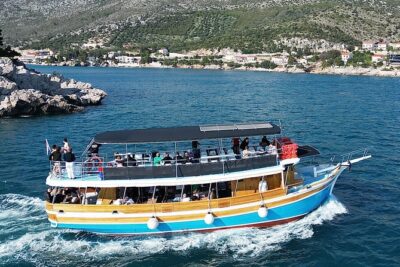
Full-Day Dubrovnik Elaphite Islands Cruise with Lunch and Drinks
Read our review →
Epic Game of Thrones Tour + Lokrum & Saver Option
Read our review →
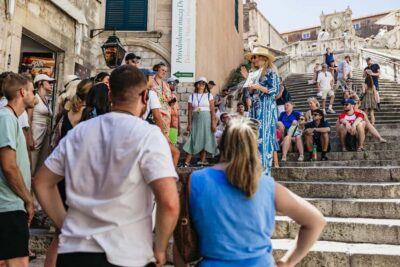
The Original Game of Thrones Tour & Lokrum Option
Read our review →
Dubrovnik Game of Thrones Tour & Optional Lokrum Island Visit
Read our review →
Elaphite Island Cruise w/ Drinks & Optional Lunch
Read our review →Browse the lists this tour appears in