
Reviewed · SPLIT TOURS
Split: city center private walking tour 2 h
Split’s great surprise is that Diocletian’s Palace is not a fenced-off ruin. It is the living center of town, with homes, cafés, shops, lanes, and laundry tucked into a Roman imperial complex. This private walk helps you read the city’s layers, from the palace cellars to Venetian squares and the modern waterfront.
I like the personal format, especially if you want to stop for questions or set the pace to suit your group. I also like the mix of major sights and everyday places such as the Green Market and fish market. The main consideration is that the tour covers a lot in two hours, and one past booking found there was less walking through side streets and alleys than expected.
Key points to know before booking
- A Roman palace is still the heart of town: You walk through an active city rather than a silent archaeological site.
- The private format gives you control: A group of up to 20 can arrange a more personal pace and focus.
- The cellars and cathedral cost extra: Entrance fees are not included in the tour price.
- The route mixes history with local life: Markets, squares, cafés, and the Riva waterfront are part of the experience.
- French, English, and Croatian are offered: Guides such as Zinka, Zrinka, and Yvonna have received particular praise for their clear explanations and friendly manner.
- Wear practical shoes: Expect uneven surfaces, stairs, and plenty of standing and walking.
Why Split makes such a good walking tour
Split is a city built in layers. The Roman emperor Diocletian began constructing his palace around the turn of the fourth century, and later residents adapted its walls, courtyards, halls, and passageways for daily life. That is why you can move from an ancient stone corridor to a café table within a few steps.
A guide is especially useful here because the palace can look confusing at first. It is not arranged like a typical museum, with a clear entrance, exit, and sequence of rooms. The tour gives you a framework for understanding what was imperial, what was religious, what was medieval, and what is simply part of Split today.
This is a private group experience for up to 20 people, priced at $141 per group. For one or two people, that is not a cheap short walk. For a family or larger party, the calculation is better, since the fee does not rise per person. The value also depends on how much you want to ask questions and adjust the pace. A private guide can make more sense than joining a large group if your party has children, older family members, or a strong interest in Roman, medieval, or local history.
The full walk lasts two hours. That is enough time for a useful introduction, but not enough for a leisurely visit inside every sight. Treat it as a strong first look at central Split, not a complete archaeological tour.
More walking tours in Split:
- Split: Old Town and Diocletian Palace Walking Tour
★ 4.9 · 4,727 reviews - Walking Tour of Split and Diocletian’s Palace
★ 5.0 · 2,588 reviews - Krka Waterfalls tour with Trogir Walking tour and Krka panoramic boat cruise
★ 5.0 · 1,659 reviews
Meeting the guide beside the Riva
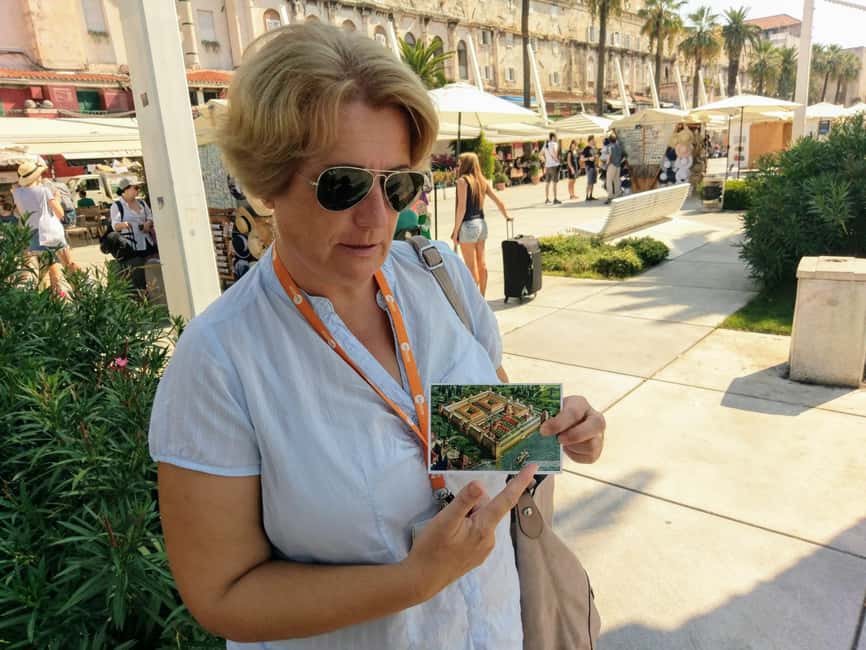
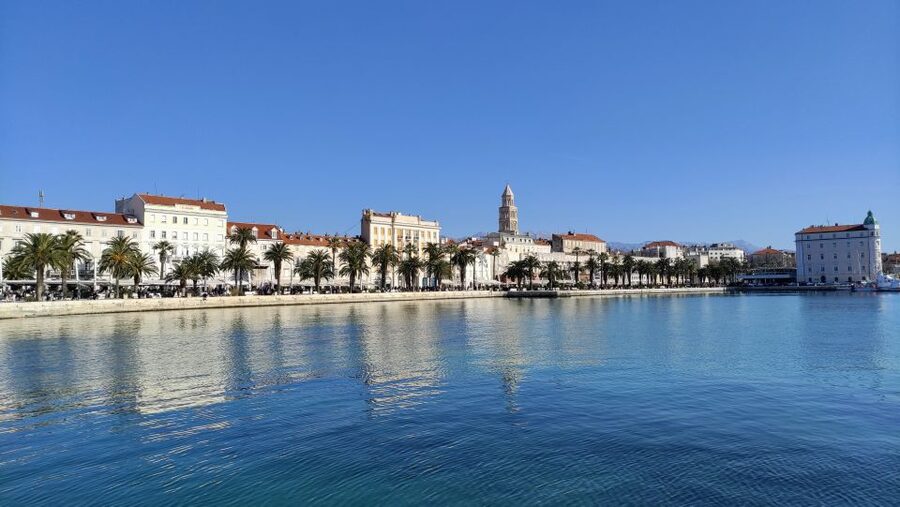
The meeting point is on the Riva promenade, in front of the entrance to the cellars of Diocletian’s Palace at Obala Hrvatskog narodnog preporoda 15b. A model of Split’s historical core is used as the starting location and return point.
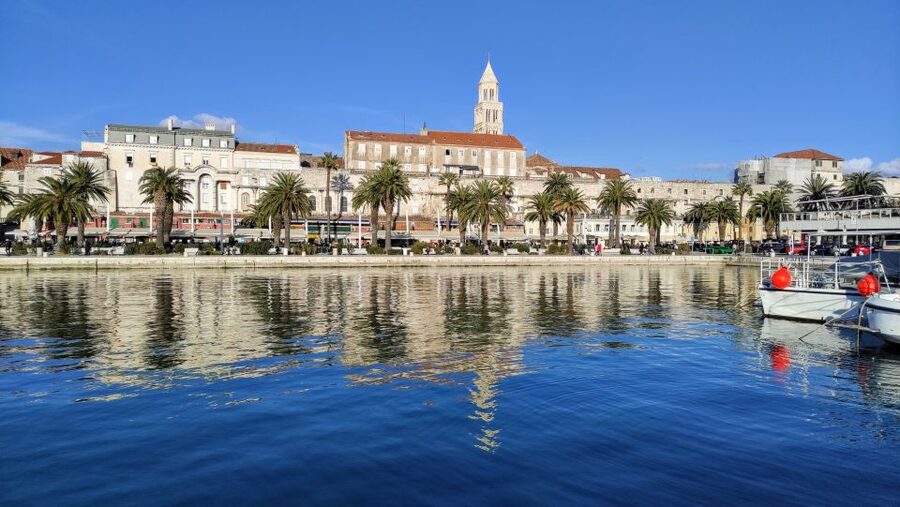
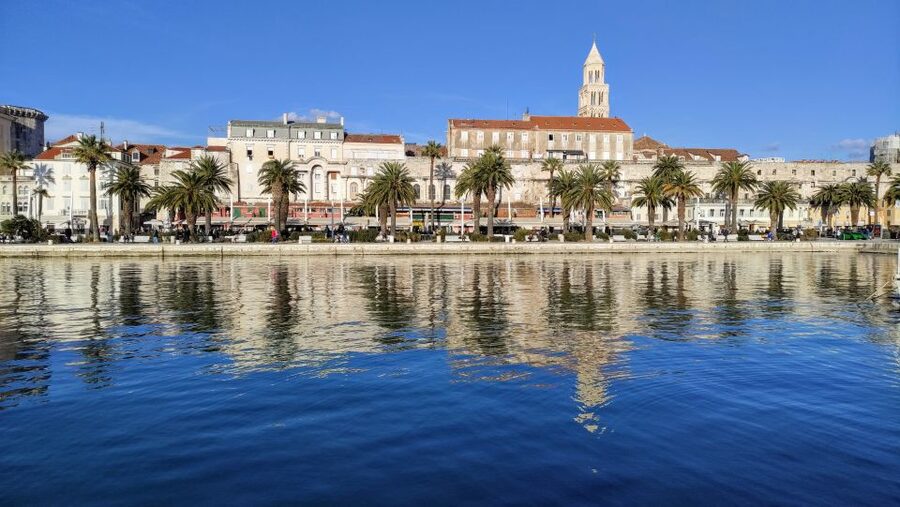
Beginning on the Riva gives the guide a useful opening. You are looking at Split’s modern waterfront, but directly behind it is the massive Roman palace. The contrast makes the city’s layout easier to grasp before you enter the old center.
The Riva is also a practical place to begin or finish. It is lined with cafés and restaurants, so you can continue your afternoon here after the walk. Since the tour does not include transfers, you need to make your own way to the meeting point.
Riva and the Green Market: modern Split at street level
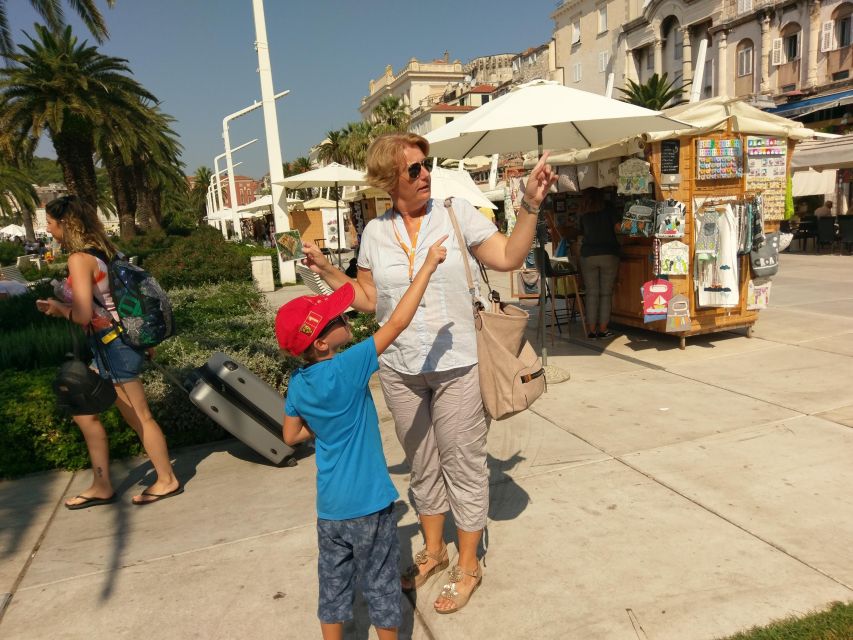
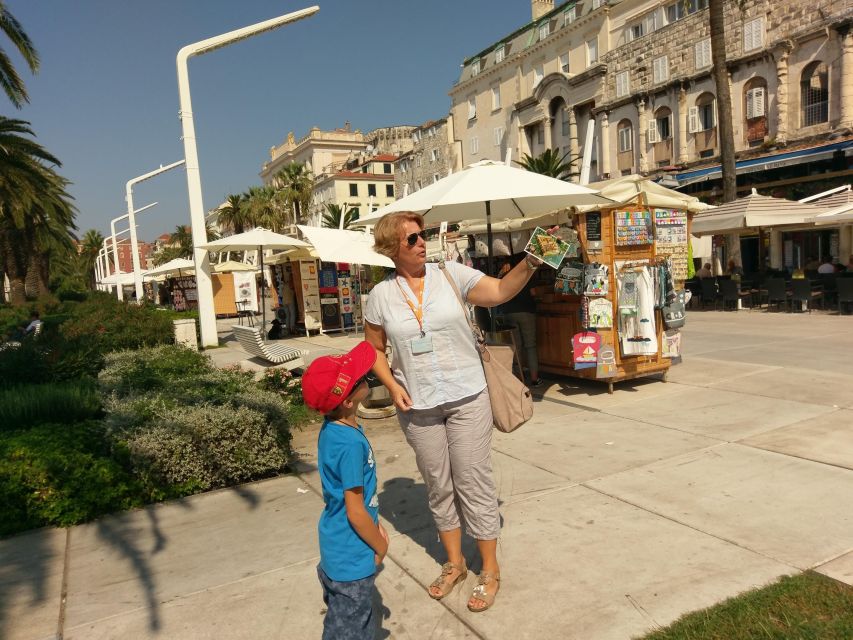
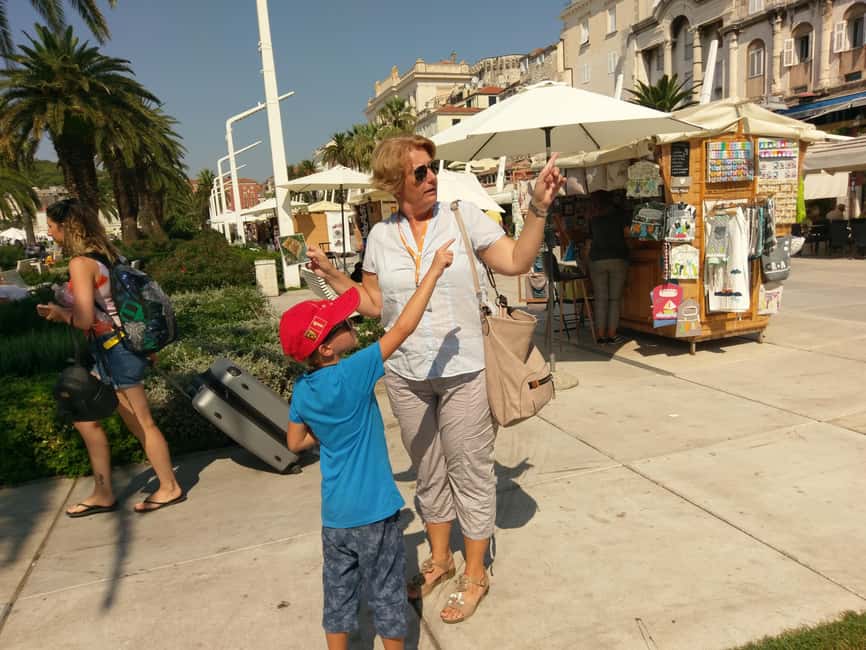
The route includes about 15 minutes on the Riva. This is the city’s social front porch, a broad waterfront promenade used for strolling, sitting, and dining. Your guide can show you how the waterfront relates to the palace and explain why Split is Dalmatia’s main urban and cultural center.
From there, the route reaches the Green Market for about 10 minutes. The market adds a welcome change of pace after the stone monuments. It is a place to see local shopping and ordinary city life, not only grand buildings.
The stop is brief, so do not expect time for a long browse or a serious shopping trip. Still, its presence helps keep the tour grounded. Split is not just an ancient backdrop. It is a working city where people shop, meet, eat, and move through the same spaces used by emperors and later residents.
The itinerary also includes the fish market for around 10 minutes. Together, the two market stops give you a look at local commerce, though the schedule leaves limited time at each one.
Inside Diocletian’s Palace and its working cellars
The main palace visit takes about 45 minutes, followed by 15 minutes around Peristil. This is the historical core of the experience.
The palace was built for Diocletian, a Roman emperor who retired from public life and made this fortified residence his home. Its walls still shape the old city. Rather than simply pointing out stones, a good guide helps you see how the imperial residence once worked and how later generations changed it.
The cellars are one of the most useful places to begin. Their original architectural purpose was to support and raise the imperial residential area above them. They preserve the footprint and structure of the upper palace, giving you a clearer sense of its original plan.
The cellars were also used as a filming location for Game of Thrones. That may be a fun extra if you know the show, but the Roman engineering is the stronger reason to visit. The underground rooms help explain the scale of the palace and show why this is more than a collection of scattered ruins.
Entrance to the cellars is not included in the $141 price. The same applies to the cathedral, so budget for those fees separately. The tour can still explain the setting if you decide not to enter, but the cellars are a central part of the advertised route, making the extra admission worth checking before you book.
A few more Split half-days to weigh up
- Split: Krka Waterfalls Trip with Boat Cruise and Swimming
★ 4.8 · 10,519 reviews - From Split: Krka Waterfalls, Food & Wine Tasting Tour
★ 5.0 · 9,326 reviews - Blue cave, Mamma Mia and Hvar, 5 islands speedboat tour
★ 5.0 · 7,150 reviews - From Split: Krka Waterfalls, Food & Wine Tasting Tour
★ 4.9 · 6,598 reviews
Peristil and the former mausoleum of Diocletian
After the lower levels, you walk up to Peristil, the palace’s grand central court. This is where the imperial character of the complex becomes easiest to picture. Diocletian intended the space for his own use and for ceremonies connected with the cult of the living son of Jupiter.
Peristil is also where ancient and Christian Split meet. The Temple of Jupiter is nearby, and the cathedral occupies what was originally Diocletian’s mausoleum. A guide can explain the change from imperial worship to Christian use without turning the visit into a list of dates.
The Cathedral of Saint Domnius, or St. Duje, is dedicated to Split’s patron saint. It is often described as the oldest cathedral in the world because the building began as Diocletian’s mausoleum and was later converted for Christian worship. That unusual history makes the site more interesting than a standard church visit.
You need to cover your shoulders and knees to enter the cathedral. Admission is not included, and the two-hour schedule means the guide may need to keep the visit focused. If religious architecture is important to you, ask at the start how much time can be given to the interior.
Golden Gate and the statue of Gregory of Nin
The Golden Gate receives about 10 minutes, including a photo stop and explanation. It was one of the main entrances to the palace and remains one of the clearest ways to understand its fortified design.
The route then reaches the statue of Gregory of Nin for another short photo stop. Gregory was a medieval bishop associated with the Croatian language and worship. The statue is a popular meeting point, and its polished toe has become a familiar part of Split’s street scene.
These stops are short, but they give you useful orientation. You move from the Roman imperial period into the medieval and national story of Croatia. The guide’s role is to connect those periods so the old center does not feel like unrelated monuments placed side by side.
Pjaca, the Old Town Hall, and Fruit Square
People’s Square, usually called Pjaca, represents the Venetian period of Split. The square is more open than many of the palace lanes and is surrounded by historic buildings, cafés, and shops. The tour allows about 15 minutes here, including a visit and some shopping time.
The Old Town Hall gets about five minutes and a photo stop. That is enough for a quick explanation and an exterior look, but not an in-depth architectural visit. If you want a longer stop for photographs, tell your guide early.
Fruit Square, or Voćni trg, receives about 15 minutes. Its name recalls the fruit sellers who once used the square, while its buildings show the later urban character of Split. This is a good place to see how the medieval and Venetian town grew beyond the original Roman residence.
The square stops are important because they give you more than imperial history. They show how Split became a town shaped by trade, administration, religion, and daily life. Still, the pace is brisk. You will see several locations, but you should not expect long free time in each one.
What the guide adds to the experience
The strongest part of this tour is the guide-led explanation. Written history can tell you that the palace is about 1,700 years old. A live guide can point to the exact change in stonework, explain why a lane bends, or show how an ancient structure was reused.
The available languages are English, French, and Croatian. Several guides associated with this experience have been praised for their warm style and clear explanations. Zinka is described as engaging, humorous, and helpful with local information. Zrinka is praised for making the walk enjoyable and giving practical advice for the rest of a Split visit. Yvonna is noted for her affection for the city and her ability to share that enthusiasm in French.
Those names are useful when comparing options, but you should confirm which guide is assigned to your date. The important point is that this is a live, licensed guide service rather than an audio route or a self-guided map.
The private format also matters. You can ask for more Roman history, more local life, more Game of Thrones connections, or a gentler pace. The activity is described as tailor-made, but the route still has a set list of major stops. Personalization is most useful in the explanations and timing, not as a guarantee that every lane in the old town will be explored.
Is there enough actual walking?
The experience is called a walking tour, and it does include movement through the Riva, markets, palace, squares, gates, and old town. But the schedule also contains many short visits and photo stops, with time spent standing while the guide explains the setting.
If you want a long, wandering walk through every alley, this may feel too structured. One booking specifically found there was less walking than expected and wanted more streets and side lanes. That is a fair caution. The route is designed to cover the main sights efficiently, not to be a slow ramble through every corner of the old center.
On the other hand, the compact route suits a first visit, a cruise stop, or anyone who wants a clear introduction before exploring alone. Tell the guide if side streets matter to you. The private setup gives you a better chance of shaping the walk than a large scheduled group would.
Wear comfortable shoes. The old center includes uneven surfaces and stairs, and the tour involves a lot of walking and standing. The activity is listed as wheelchair accessible, but the uneven historic surfaces are worth discussing with the provider in advance if mobility is a concern.
The price, timing, and practical tradeoffs
At $141 per private group of up to 20, the price favors families and larger parties. A couple will pay more per person than they would on a shared group tour, but you gain privacy, a flexible pace, and the ability to ask as many questions as the two-hour schedule allows.
The tour is short enough to fit into a busy day, but the number of stops means you should arrive ready to keep moving. There is no included transfer, so plan your own route to the Riva meeting point.
The booking information gives two different cancellation details: one section says you can cancel up to 24 hours in advance for a full refund, while another says cancellation is free up to 14 days before the tour, with no refund after that. Confirm the exact policy shown for your date before paying. Reserve now and pay later is available, which can help if you are still arranging your Split schedule.
Who should book this Split walk?
I would choose this tour for a first visit to Split, especially if you want the main story explained before you explore on your own. It also fits families and groups who value a private guide and can share the flat group price.
It is a good match if you enjoy Roman buildings, medieval squares, local markets, and practical city advice in one compact outing. French speakers may find the language option especially useful, with Zinka, Zrinka, and Yvonna receiving strong praise for French-language guiding.
I would be more cautious if your main goal is a long, unhurried walk through small lanes. The route covers many landmarks, but some stops are short, and the palace visit takes priority over extended wandering. I would also check the cathedral and cellar admission fees before booking, since neither is included.
Should you book it?
Book this private walk if you want a clear introduction to Split’s layers and prefer a guide who can adjust explanations to your group. The best value comes with several people sharing the $141 fee, and the itinerary gives you a sensible overview of the palace, markets, squares, and waterfront.
Skip it if you already know the palace well or want a purely atmospheric stroll with little commentary. For most first-time visitors, though, two hours with a licensed guide is a practical way to understand why Split feels less like an archaeological park and more like a city built inside its own past.
FAQ
How long does the Split private walking tour last?
The tour lasts two hours.
What is the price of the private tour?
The price is $141 per private group of up to 20 people.
Where does the tour meet?
You meet on the Riva promenade in front of the entrance to the cellars of Diocletian’s Palace, at Obala Hrvatskog narodnog preporoda 15b, 21000 Split.
What languages are available?
The live guide is available in English, French, and Croatian.
Are entrance fees included?
No. Entrance fees to the Cathedral of Saint Domnius and the cellars of Diocletian’s Palace are not included.
Is the tour wheelchair accessible?
The activity is listed as wheelchair accessible. You should also note that the route includes uneven historic surfaces and stairs.
What should I wear?
Wear comfortable shoes because the tour involves substantial walking on uneven surfaces. Shoulders and knees must be covered to enter the cathedral.
Can I cancel the tour?
The booking information states free cancellation up to 24 hours in advance in one section, while another section states cancellation up to 14 days before the tour. Confirm the policy attached to your selected date before booking.
Just added around Split
- From Trogir, Seget, Okrug: Krka Waterfalls & Šibenik Culture Tour★ 5.0 · 10 reviews
- Krka Waterfalls & Primošten from Trogir, Seget, Čiovo & Kaštela★ 5.0 · 18 reviews
- Island Hopping Boat Excursion with Lunch (Trogir,Blue Lagoon, Šolta)★ 3.5 · 6 reviews
- From Split & Trogir: ATV Quad Tour on Island Čiovo★ 5.0 · 21 reviews
- Slatine – Island Hopping Excursion (Trogir/Blue Lagoon/Shipwreck)★ 4.0 · 24 reviews
- Split: Blue Lagoon Boat Trip with Lunch, Wine and Snorkeling★ 5.0 · 3 reviews
- Split Sunset Stand Up Paddle Tour★ 5.0 · 16 reviews
- Split: Sunset Guided Kayaking Tour★ 4.8 · 71 reviews
Split Tours, compared.

Krka Waterfalls Trip with Boat Cruise and Swimming
Read our review →

Blue cave, Mamma Mia and Hvar, 5 islands speedboat tour
Read our review →
Blue Cave, Mamma Mia, Hvar and 5 Island Tour
Read our review →
Blue Lagoon & 3 Islands Cruise with Lunch from Split
Read our review →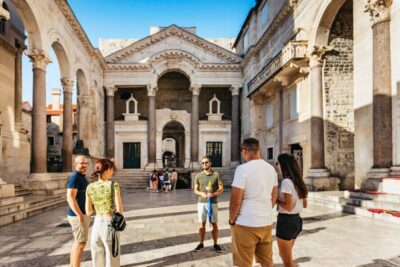

Blue Lagoon Boat Party with DJs, Shots & After Party
Read our review →Browse the lists this tour appears in