
Reviewed · SPLIT TOURS
Split: Diocletian’s Palace Private walking tour
Diocletian’s Palace is not a quiet ruin behind museum glass. It is a 1,700-year-old Roman palace still woven into daily life in Split, with homes, shops, churches, and public paths inside its ancient walls. This private walking tour gives you a useful first look at the old center and explains why the palace feels more like a living neighborhood than a single monument.
I like the small group limit of 10 and the chance to shape the route around your interests. I also like the clear focus on the Peristyle, the former mausoleum that became Split Cathedral, the Vestibule, and the Golden Gate. The main thing to consider is that church services or special events can close some areas, so the guide may need to adjust the plan.
Key points to know before booking
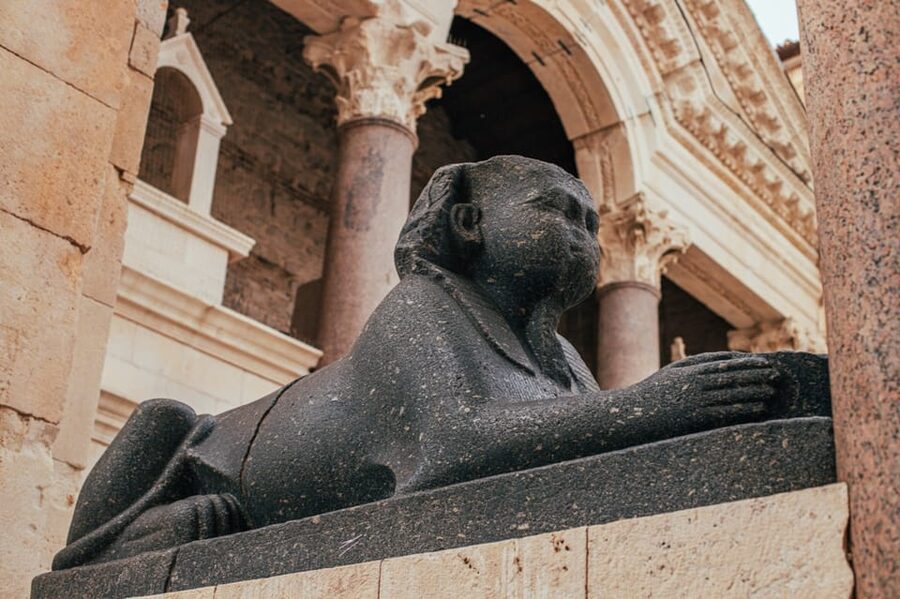
- A living Roman palace: You walk through an ancient structure that remains part of Split’s everyday city life.
- A private group of up to 10: The small size gives you room to ask questions and request a customized focus.
- Five major historical stops: The route features the Peristyle, Split Cathedral, Vestibule, North Gate, and St. Martin’s Church.
- A strong orientation tour: The walk helps you understand the old center quickly and get your bearings before exploring alone.
- Three language choices: Tours are available in English, German, or French.
- A flexible booking policy: You can reserve now and pay later, with a full refund available when you cancel at least 24 hours ahead.
Why Diocletian’s Palace works best on foot
The palace is easier to understand when you walk through it rather than view it from a distance. Its ancient walls are not an isolated archaeological site. They frame streets and courtyards where modern Split continues around you.
That mixture is the heart of the experience. You may be looking at a Roman column one moment and walking past an occupied building the next. The guide’s job is to connect those details, showing how the emperor’s residence changed over time and how the old structure still shapes the city center.
The tour begins at the bronze model of Split at the eastern end of the Riva promenade. This is a practical meeting point because it gives you a clear starting landmark before you enter the palace area. The walk ends back at the same place, making it easy to continue along the waterfront or return to your accommodation.
I would use this tour early in a Split visit. One five-star rating describes it as a good way to see the main sights quickly, learn a lot, and get the lay of the land in the city center. That is exactly where a guided walk earns its keep: it gives you a framework, then lets you explore with more confidence afterward.
More walking tours in Split:
- Split: Old Town and Diocletian Palace Walking Tour
★ 4.9 · 4,727 reviews - Walking Tour of Split and Diocletian’s Palace
★ 5.0 · 2,588 reviews - Krka Waterfalls tour with Trogir Walking tour and Krka panoramic boat cruise
★ 5.0 · 1,659 reviews
The Peristyle, where the emperor played a god
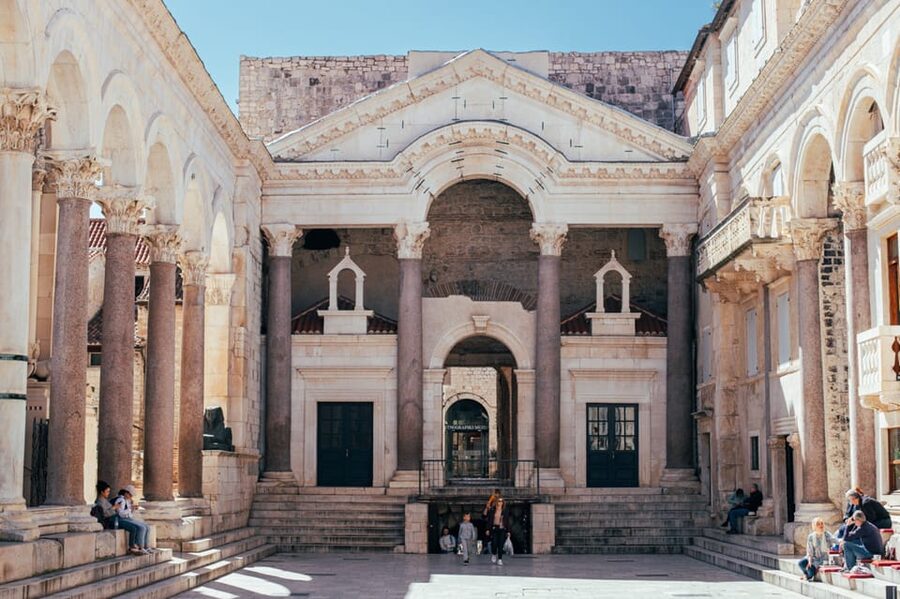
The Peristyle is the ceremonial heart of the route. In Diocletian’s time, this open meeting area helped present the emperor as a divine figure, worshipped as the son of Jupiter.
That detail changes how you read the space. This was not simply a pretty courtyard. It was a carefully staged setting where architecture, religion, and imperial power came together. The emperor’s position was reinforced by the surrounding stone, the formal approach, and the public ceremonies held here.
Today, the Peristyle offers one of the clearest links between the palace’s original purpose and its current role. It remains a place people pass through and gather around, but the imperial ceremony has given way to ordinary city life. You can appreciate both layers at once.
This stop is especially useful if you are not familiar with Roman imperial architecture. A guide can point out how the courtyard functioned and explain the symbolism behind Diocletian’s public image. Without that context, you might see only a handsome old square. With it, the Peristyle becomes a stage built to make power visible.
Split Cathedral, a mausoleum with a second life
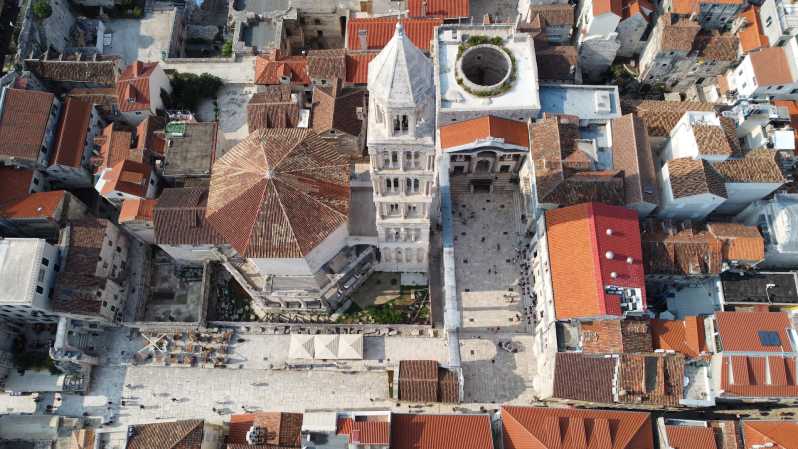
One of the tour’s most striking stops is Split Cathedral. The building began as the mausoleum of Emperor Diocletian, a reminder that this palace was designed not only as a home but also as a final resting place for its ruler.
Christianization changed the building’s purpose. Diocletian’s remains disappeared, and the mausoleum was converted into a cathedral. That shift gives the site an unusual story: a structure made for imperial burial became a Christian place of worship.
The outside alone is worth careful attention, and the guide can explain how the building’s original role differs from what you see today. If a service is taking place, access may be limited. The program can then change slightly, so do not treat the exact order of stops as fixed.
I like this part of the tour because it shows that old buildings are rarely frozen in one period. The cathedral is Roman, imperial, and Christian at the same time. You are not just checking off another church. You are seeing how a powerful pagan monument was given a new meaning.
The Vestibule and the emperor’s private quarters
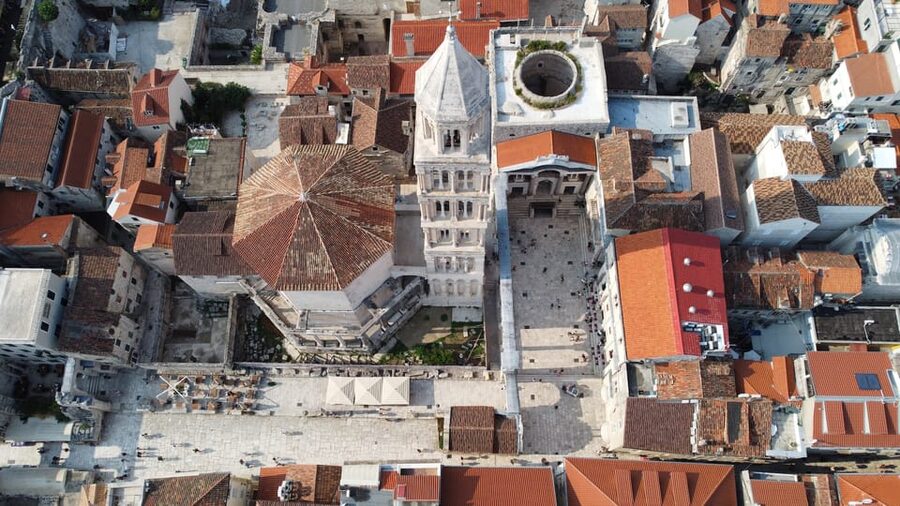
The Vestibule was the grand entrance to Diocletian’s private chambers. It served as a gateway into the emperor’s personal area and a formal reception point for dignitaries from far beyond Split.
That makes the Vestibule an important contrast to the Peristyle. The Peristyle presented the emperor to the public. The Vestibule controlled access to his private world and helped create a sense of ceremony for those who were allowed inside.
As you pass through, listen for the difference between public and private space. The guide can help you picture the palace as a working imperial residence, not merely a collection of old walls. The layout was designed around movement, status, and controlled access.
The supplied information does not give a precise tour duration, so I would not plan another timed activity immediately afterward. Allow yourself room to stop, ask questions, and adjust if a church service or event changes the route.
A few more Split half-days to weigh up
- Split: Krka Waterfalls Trip with Boat Cruise and Swimming
★ 4.8 · 10,519 reviews - From Split: Krka Waterfalls, Food & Wine Tasting Tour
★ 5.0 · 9,326 reviews - Blue cave, Mamma Mia and Hvar, 5 islands speedboat tour
★ 5.0 · 7,150 reviews - From Split: Krka Waterfalls, Food & Wine Tasting Tour
★ 4.9 · 6,598 reviews
The Golden Gate and the small church inside it
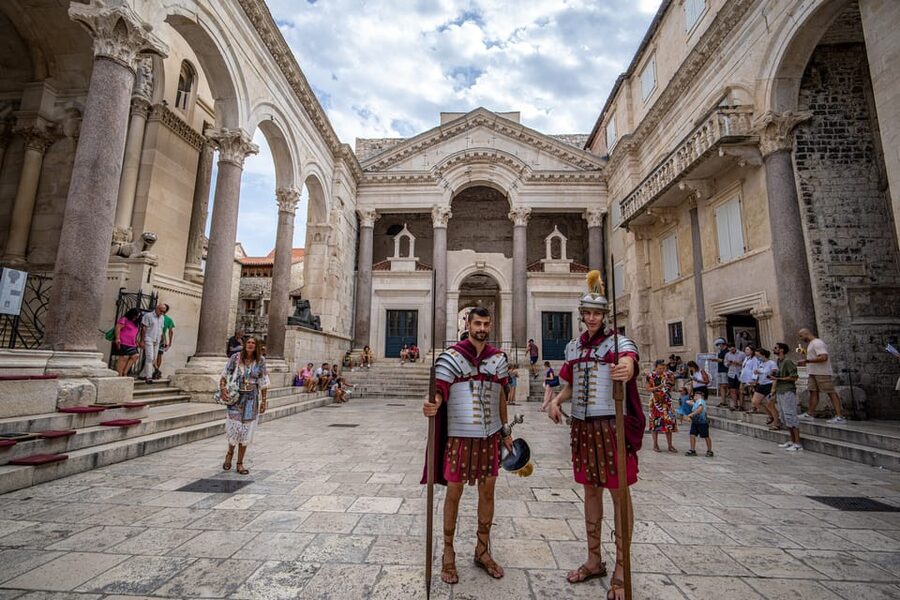
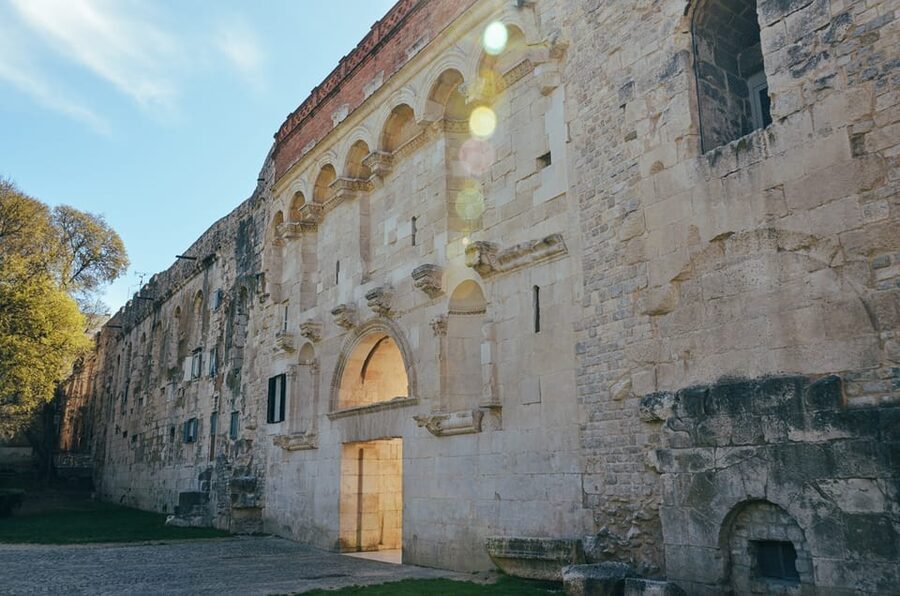
The North Gate, also called the Golden Gate or Porta Aurea, was the most important city gate in the Roman period. Its position and name reflect its role as a major entrance into the palace and the city.
Gates tell you a great deal about how a Roman complex was organized. They were points of arrival, control, and display. The Golden Gate was not just a practical opening in the wall. It helped define the palace’s connection with the world beyond it.
Inside the former guard corridor is the Church of St. Martin, described as the smallest church in Split. This is the kind of detail that can easily disappear if you explore without a guide. The church occupies a space once linked to military protection, adding another layer to the gate’s story.
I find this pairing particularly effective. The Golden Gate gives you the broad Roman picture, while St. Martin’s Church brings the scale down to a narrow, human-sized space. Together, they show how the palace changed as the centuries passed.
A customized route instead of a fixed script

The tour is individually customizable, which matters more than it may sound. You can ask for extra attention to imperial history, architecture, religious change, or the way modern Split fits inside the old palace.
The group limit is 10 participants. That is large enough for a small family or a few friends, but still much more personal than a large city walk. You should have a better chance to hear the guide clearly and ask questions without holding up a crowd.
Dana receives particular praise in the available ratings. One five-star assessment calls her the best guide for visiting Split and describes her as enthusiastic, with a private tour that created an unforgettable experience. I would take that as a reason to value the guide match, especially if Dana is available for your date, though the information does not promise that every booking will be led by her.
The tour is offered in English, German, and French. Choose the language in which you can comfortably follow historical explanations, since the value here comes from understanding how the places connect rather than simply seeing them.
What the $135 price means

At $135 per person, this is not the budget way to glance at Diocletian’s Palace. The value depends on how much you want from a guide and how many people share the booking.
For a private group, the price can make sense if you want a tailored introduction to Split, especially when you care about asking questions and setting the pace. You are paying for interpretation, orientation, and a route that can be adjusted to your group, not just entry into a monument.
The price is harder to justify if you prefer to wander independently or only want exterior views. Much of the palace is spread through public city space, and an independent visitor can see the general area without booking a tour. The guided experience becomes more worthwhile when you want the Peristyle’s religious symbolism, the cathedral’s change from mausoleum, and the Golden Gate’s function explained as you walk.
The three available five-star ratings are a small sample, so I would not treat them as proof that every guide or departure will feel identical. Still, the consistent praise points toward the tour’s strongest feature: a quick, focused introduction led with energy and personal attention.
Who will get the most from this walk
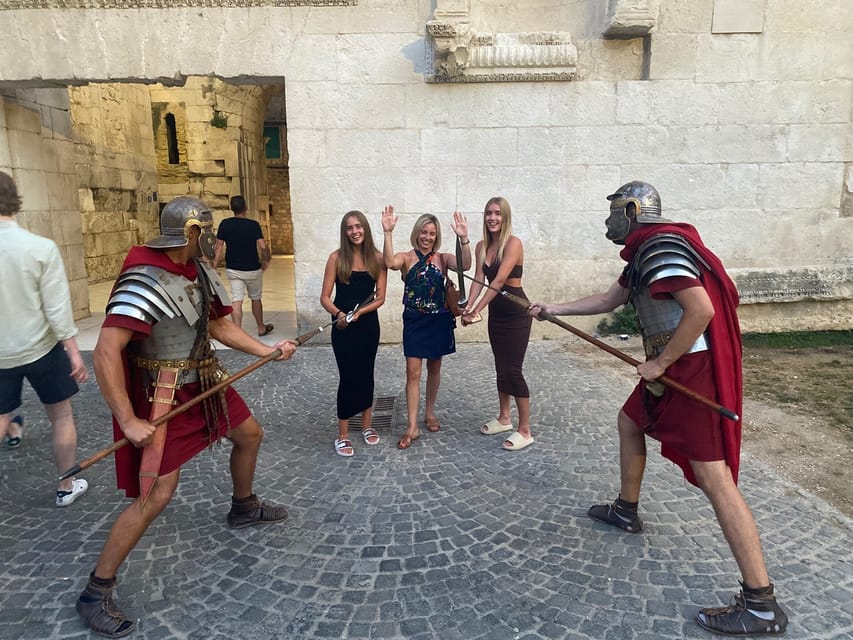
This tour suits first-time visitors who want to understand Split’s center before exploring it alone. It is also a good match for anyone who finds Roman sites confusing without a guide to explain what each space was built to do.
Families and small groups may appreciate the private format. The customized route allows you to keep the focus on the subjects that interest your group, although the available information does not specify a separate children’s program.
History fans will enjoy the connections between pagan Rome, imperial ceremony, Christian worship, military access, and modern city life. You do not need specialist knowledge. The key places provide a clear story, and the guide fills in the meaning.
This may not be the best fit if you need a fully step-free route. The palace is only partly wheelchair accessible, though the tour can be adapted for special needs when you tell the provider in advance. That conversation should happen before booking, not at the meeting point.
Practical details that shape the day
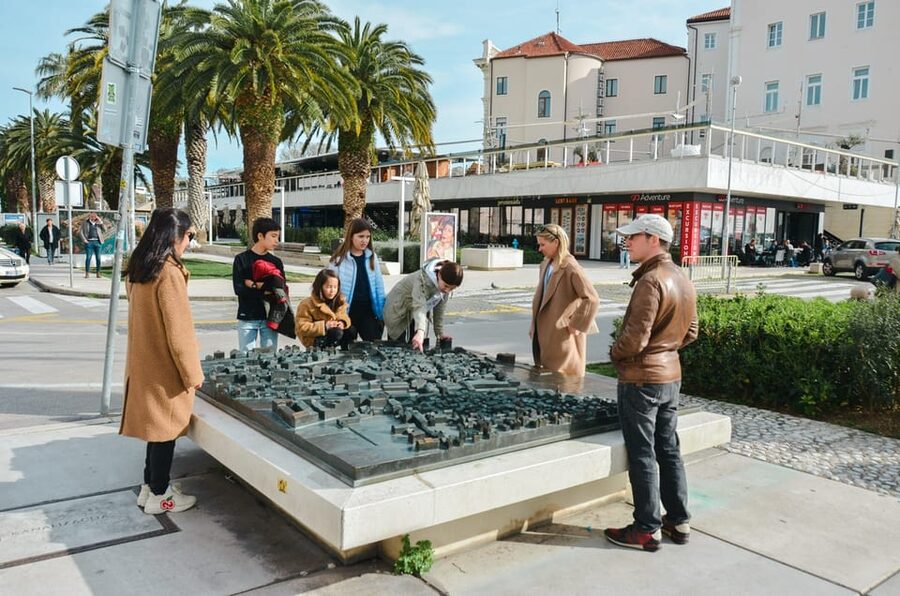
Meet at the bronze model of Split at the eastern end of the Riva promenade. The tour returns to that same point, which keeps the logistics simple.
Some areas may be unavailable because of church services or events. The guide will alter the program when needed, so remain flexible about the order and exact access to each stop.
You can reserve the tour and pay later, which helps if your Split plans are still changing. Cancellation is free up to 24 hours before the tour for a full refund.
Because no duration is provided, check the booking details before pairing this with a ferry, meal reservation, or another timed activity. The walk includes several major sites and is intended to give you a useful understanding of the city center, so rushing it would reduce its value.
What you will remember afterward
The most memorable part is likely to be the palace’s mixed identity. Diocletian built it as an imperial residence and mausoleum, but later generations turned parts of it into churches, streets, homes, and public spaces.
The Peristyle explains imperial theater. The cathedral shows religious change. The Vestibule reveals the controlled approach to private power. The Golden Gate and St. Martin’s Church show how practical Roman spaces gained new uses.
That sequence gives the tour a strong narrative. You move from public ceremony to private access, from burial monument to Christian cathedral, and from city gate to tiny church. It is a compact way to understand why Split’s old center feels so unusual.
Should you book the Diocletian’s Palace private tour?
Book it if you want a short, focused introduction to Split’s old center and prefer a guide to connect the palace’s Roman and Christian layers. The small group, customizable route, multilingual options, and strong praise for Dana all add practical value.
Think twice if you mainly want to stroll independently or avoid paying for places you can view from public streets. Also contact Split Guide in advance if wheelchair access matters to you, since the site is only partly accessible.
For most first-time visitors, I would book this early in a Split stay. It gives you the essential landmarks, helps you understand the city’s unusual layout, and leaves you better prepared to return to the palace on your own.
FAQ
How much does the Diocletian’s Palace private walking tour cost?
The listed price is $135 per person.
Where does the tour begin?
It begins at the bronze model of the city of Split at the eastern end of the Riva promenade.
Where does the tour finish?
The activity ends back at the meeting point.
How many people can join the tour?
The tour is designed for a maximum of 10 participants.
Which languages are available?
The tour is available in English, German, and French.
Can the tour route be customized?
Yes. The tour is individually customizable, so the program can be adapted to the group’s interests.
Is the tour wheelchair accessible?
Diocletian’s Palace is only partly wheelchair accessible, but the tour can be adapted to special needs if you inform the provider in advance.
Just added around Split
- From Trogir, Seget, Okrug: Krka Waterfalls & Šibenik Culture Tour★ 5.0 · 10 reviews
- Island Hopping Boat Excursion with Lunch (Trogir,Blue Lagoon, Šolta)★ 3.5 · 6 reviews
- Krka Waterfalls & Primošten from Trogir, Seget, Čiovo & Kaštela★ 5.0 · 18 reviews
- From Split & Trogir: ATV Quad Tour on Island Čiovo★ 5.0 · 21 reviews
- Slatine – Island Hopping Excursion (Trogir/Blue Lagoon/Shipwreck)★ 4.0 · 24 reviews
- Split: Blue Lagoon Boat Trip with Lunch, Wine and Snorkeling★ 5.0 · 3 reviews
- Split Sunset Stand Up Paddle Tour★ 5.0 · 16 reviews
- Split: Sunset Guided Kayaking Tour★ 4.8 · 71 reviews
Split Tours, compared.

Krka Waterfalls Trip with Boat Cruise and Swimming
Read our review →

Blue cave, Mamma Mia and Hvar, 5 islands speedboat tour
Read our review →
Blue Cave, Mamma Mia, Hvar and 5 Island Tour
Read our review →
Blue Lagoon & 3 Islands Cruise with Lunch from Split
Read our review →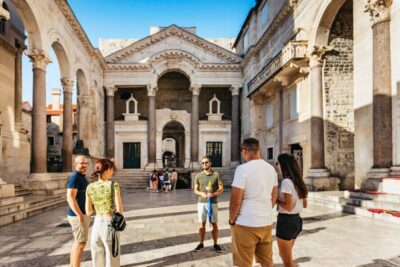

Blue Lagoon Boat Party with DJs, Shots & After Party
Read our review →Browse the lists this tour appears in