

Reviewed · SPLIT TOURS
Split: Group or Private Walking Tour with Art Historian
Split’s Old Town is not a museum set behind ropes. It is a living city built inside and around a Roman palace, with laundry, cafés, shops, stone lanes, and ancient walls sharing the same few blocks. This walking tour makes that unusual mix easier to read, led by Josipa, an art historian connected with ongoing archaeological fieldwork.
I like the way the route covers the major sights while still slipping into less obvious corners. I also like the guide’s flexible approach: Josipa can shape the discussion around your interests, answer questions, and point out details you might otherwise pass without seeing. The main drawback is that this is a walking tour with several unavoidable steps, and it does not include entry to paid sites.
Key points to know
- Roman Split in a compact two-hour route: See the palace gates, Peristyle, Jupiter’s Temple, Vestibule, cellars, waterfront, and Old Town squares.
- A guide who explains how to read the city: Josipa connects worn stone, reused buildings, Roman planning, medieval streets, and modern life.
- Private or small-group choices: Choose private touring for more control, or a small group for an intimate setting with time for questions.
- A route beyond the standard postcard stops: The walk includes St. Martin, Triklinij, Let Me Pass Street, the fish market, and Varoš.
- Useful advice for a longer Split stay: Josipa explains which paid sights you pass and how to visit them later on your own.
- Good value at $32 per person: You get two hours with a licensed local guide, though tickets to attractions are extra.
Starting beside Strossmayer Park
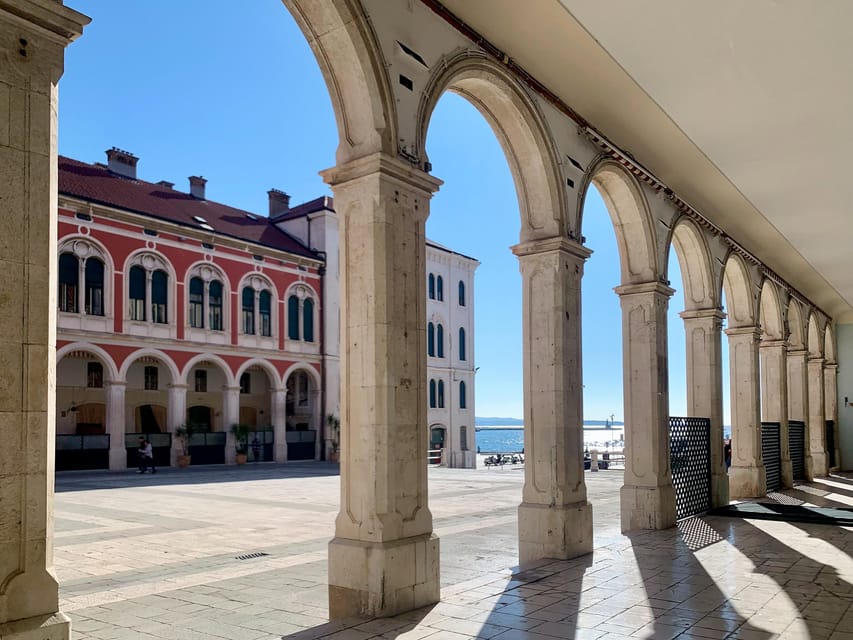
Meet Josipa around the fountain in Strossmayer Park, also called Djardin. The park sits just above the Golden Gate and close to the statue of Gregory of Nin, so search for Strossmayer Park or Strossmayerova Fountain on your map rather than relying on a vague Old Town pin.
Look for the yellow and blue Aspalathos Guided Tours sign. This matters in summer, when traffic near Split can slow arrivals. The group waits a maximum of 10 minutes, so arrive early enough to find the fountain without a last-minute scramble.
The park is a sensible starting point. You begin outside the palace walls, with a little breathing room before entering the tight lanes of the historic center. From there, the story moves through roughly 17 centuries, from the Roman emperor Diocletian to the medieval and modern city that grew inside his residence.
The tour lasts two hours. That is long enough to build a clear picture of Split, but not so long that the stone streets and steps become exhausting for most reasonably mobile walkers. It is also short enough to fit well on a first morning in town.
More walking tours in Split:
- Split: Old Town and Diocletian Palace Walking Tour
★ 4.9 · 4,727 reviews - Walking Tour of Split and Diocletian’s Palace
★ 5.0 · 2,588 reviews - Krka Waterfalls tour with Trogir Walking tour and Krka panoramic boat cruise
★ 5.0 · 1,659 reviews
Gregory of Nin and the Golden Gate
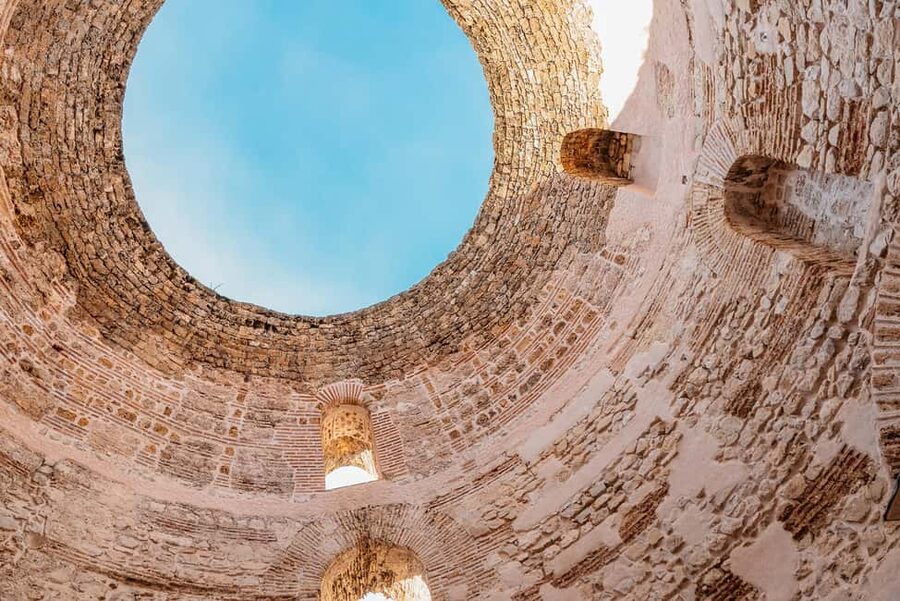
The first major stop is the statue of Gregory of Nin, near the northern entrance to the palace. This gives Josipa a chance to explain the city’s civic identity before the group passes through the Golden Gate, the most imposing of Split’s four Roman entrances.
The Golden Gate is more than a photo stop. It shows how the palace was planned as a fortified residence, with controlled entry points and strong defensive walls. Josipa’s art-history background should be useful here because the focus is not only on dates and rulers. You are encouraged to look at scale, stonework, placement, and the way later buildings have altered the original setting.
The short stop at St. Martin follows. It is easy to rush past smaller churches and tight passages in Split, especially when the main palace spaces attract most of the attention. Including St. Martin helps broaden the picture and shows how sacred buildings became part of the Roman structure rather than existing apart from it.
Silver Gate, Peristyle, and Jupiter’s Temple
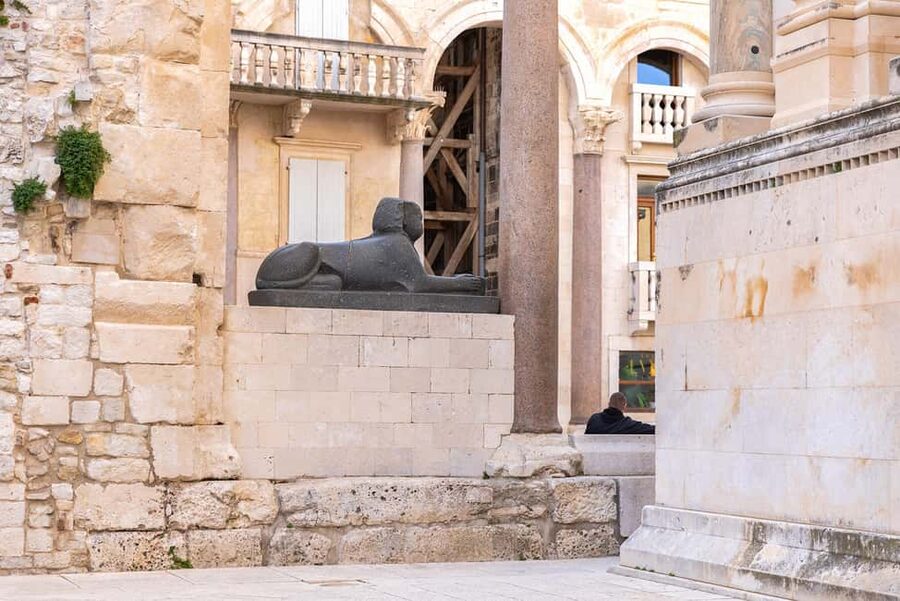
The route then crosses to the Silver Gate and into the central spaces of Diocletian’s Palace. The Silver Gate gives you another view of the Roman plan, while Peristyle provides the grandest open space on the walk.
Peristyle is where the palace feels most theatrical. Tall columns, stone paving, and the surrounding buildings create a strong sense of enclosure. This is one of the places where a guide can add real value, because the visual impact is obvious, but the reasons behind the design are not.
Josipa explains how Roman imperial power was presented through architecture and how the square has changed use over time. You are not simply told what stood here. You are shown how to notice the surviving Roman lines beneath later repairs and additions.
Jupiter’s Temple comes next. The tour passes the temple but does not enter paid sites. That is an important distinction. You receive an explanation of the building and its place in the palace, then get suggestions for returning later if you want to see the interior.
The same approach applies to other ticketed attractions. The tour gives you orientation and context without adding admission costs to the booking. If you want a full visit to the cathedral, temple, or palace substructures, plan extra time and money after the walk.
Small streets with big clues
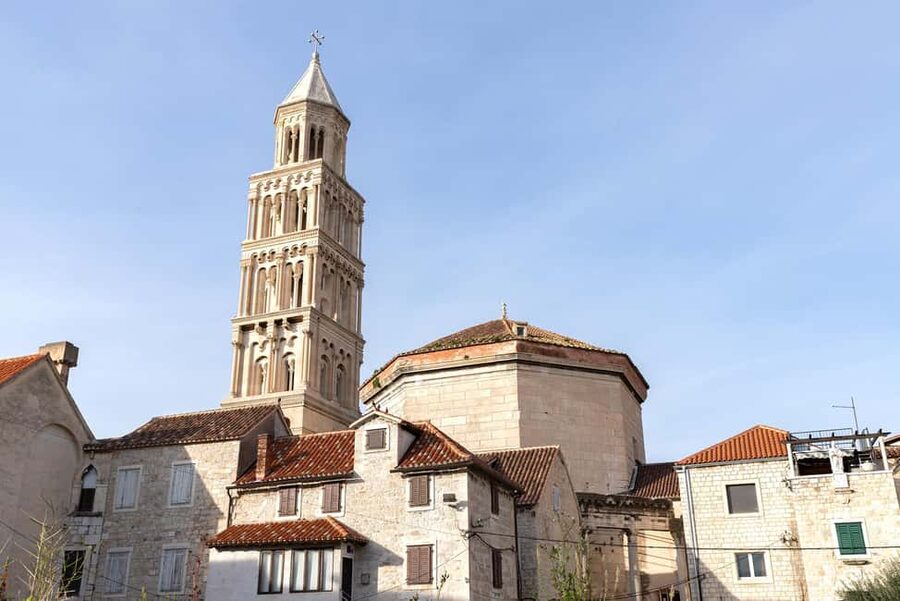
The stop at Let Me Pass Street is a reminder that Split’s best details are often not in its largest squares. A narrow lane can reveal how the old city works as a place where Roman foundations, medieval circulation, and modern daily routines overlap.
The name itself draws attention to the cramped scale of the Old Town. With a guide beside you, you have a better chance of noticing how streets, entrances, walls, and openings fit together. Josipa’s stated aim is to help you read these traces yourself, which is more useful than memorizing a list of construction dates.
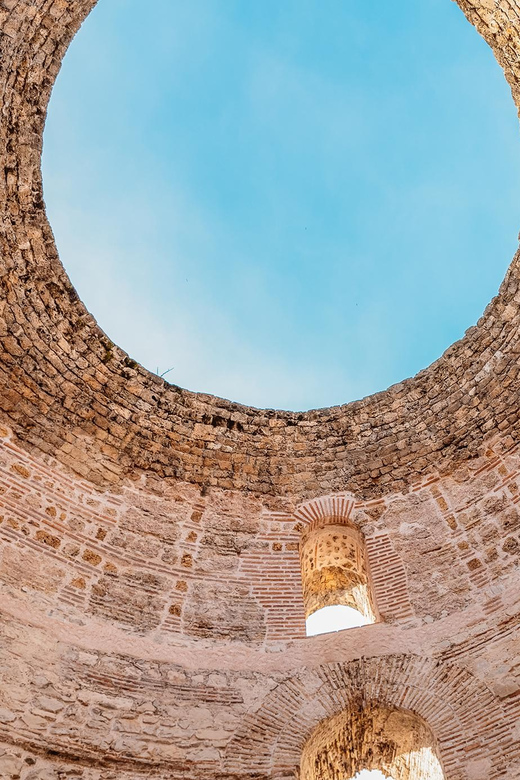
At the Vestibule, expect a photo stop and a closer look at one of the palace’s distinctive spaces. Its rounded form and dramatic acoustics make it a natural place to pause, but the guide’s interpretation gives the space more meaning than a quick photograph can.
The itinerary also includes Triklinij. These less familiar stops are part of what separates this walk from a simple circuit of the most famous landmarks. They give the tour room to discuss how the palace functioned, how spaces were organized, and how buildings were altered or reused through the centuries.
A few more Split half-days to weigh up
- Split: Krka Waterfalls Trip with Boat Cruise and Swimming
★ 4.8 · 10,519 reviews - From Split: Krka Waterfalls, Food & Wine Tasting Tour
★ 5.0 · 9,326 reviews - Blue cave, Mamma Mia and Hvar, 5 islands speedboat tour
★ 5.0 · 7,150 reviews - From Split: Krka Waterfalls, Food & Wine Tasting Tour
★ 4.9 · 6,598 reviews
The cellars and the Roman plan
Diocletian’s Cellars are among the strongest stops for understanding the palace layout. The tour passes the substructures and explains their importance, but does not include entry.
That arrangement works well for first-time visitors who want a broad introduction before choosing which places deserve a separate ticket. The cellars help you connect the underground plan with the streets and rooms above. They also show why Split can feel confusing at first: ancient walls and corridors still shape the city’s movement.
If you already know you want to spend a long time inside the substructures, cathedral, or Jupiter’s Temple, do not expect this two-hour walk to replace those visits. Think of it as a guided map of the historic center, with practical suggestions for exploring paid sites later.
From the Riva to the city squares
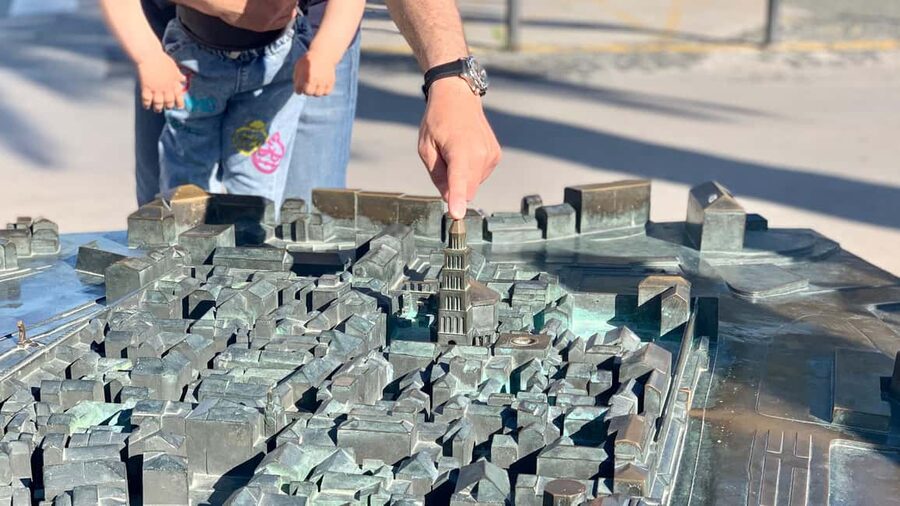
The route eventually leaves the palace core for the Riva, Split’s waterfront promenade. This changes the mood and gives you a chance to see how the old center opens toward the sea.
The stop is useful because Split’s identity is not only Roman. The waterfront connects the enclosed historic center with the city’s public life, and Josipa can place the palace in the context of present-day Split. The walk then continues to a model of Split, which should help you see the relationship between the palace, the later town, and the surrounding streets.
Fruit Square is another compact but telling stop. Its name points to the older market life of the city, while the buildings around it show the gradual shift from Roman imperial residence to medieval and modern urban center.
People’s Square offers a broader civic setting. Here, the tour can help you compare the palace’s formal Roman spaces with later public squares shaped by commerce, administration, and everyday use. The short stop at the Split fish market adds another local note. It is a working part of town, not an ancient monument, and that is precisely why it belongs in a tour about how Split functions today.
Republic Square, sometimes called Prokurative, completes the modern public-space section. Its architecture and open form contrast with the tight lanes inside the palace. The route does not treat Split as a single time period. Instead, it moves between Roman remains, medieval streets, later civic spaces, and ordinary city life.
Ending toward Varoš
The walk is designed to end in Varoš, one of Split’s oldest and most authentic neighborhoods. The area is known for preserved Roman-era structures that have been adapted and reused over time, giving you a final example of the city’s habit of building on what came before.
Ending away from the most crowded palace spaces is a smart choice. You finish with a sense of how people lived in and around the old center, rather than ending only at a famous monument. Varoš also gives you a useful area to explore independently after the tour.
There is a small point to clarify before booking. The route information names Trg Šperun and Republic Square as possible drop-off locations, while the meeting details say the activity ends back at the meeting point. Since the experience is also described as ending in Varoš, confirm the final stopping point with Aspalathos Guided Tours if you need to meet transport or have a tight schedule.
What makes Josipa’s guiding style useful

The strongest feature here is the guide’s role. Josipa is not presented as someone who simply recites a fixed script. Her background in art history and connection with archaeological fieldwork support a closer look at buildings, objects, and layers of change.
That matters in Split because the most interesting evidence is often partial. You may see a Roman column built into a later wall, an old gate still used as a passage, or a modern room fitted into an ancient structure. A good explanation helps you connect these fragments.
The tour also suits people who ask questions. The experience is available as a private tour or a small-group walk, and the route can be adjusted in real time around the group’s interests and background. A private booking should offer the most control over pace and subject matter. The small-group option still aims to keep conversation possible rather than turning the walk into a distant lecture.
A pair of previous ratings gives the experience a 4.9 score from seven reviews. The specific praise focuses on Josipa’s friendly, cheerful, approachable manner, her ability to answer many questions, and her skill at finding an efficient route through Split’s alleyways. That combination is important: a guide can know a great deal and still make a two-hour walk feel stiff. Here, the emphasis is on personal explanation and easy conversation.
Is $32 a fair price?
At $32 per person, the tour is priced reasonably for a two-hour guided walk, especially if you want a strong orientation at the start of your stay. You are paying for a licensed local guide, not for admission tickets or transport.
The value is best if you use the tour as a foundation for the rest of your time in Split. Josipa points out the major paid attractions, explains what they contain, and gives you instructions for visiting them independently. You can then decide where to spend your admission budget instead of paying for a broad package that includes places you may not want to enter.
The private option will usually make more sense for couples, families, or small groups with specific interests. If you want the lower-cost format and enjoy hearing other questions, choose the small group. Either way, $32 buys a compact route through the city’s central sights with access to details that can be hard to spot alone.
Who should book this walk?
I would recommend it to first-time visitors who want to understand Split before exploring on their own. It is also a good fit for people interested in architecture, archaeology, urban history, and the way old buildings continue to serve modern life.
You should be comfortable walking on uneven stone streets and handling several steps. The tour is not suitable for wheelchair users or people with mobility impairments, and the supplied information also says it is not suitable for people with hearing impairments. It runs rain or shine, so bring suitable clothing and footwear.
This is not the right choice if you want lengthy interior visits to the cathedral, Jupiter’s Temple, or the substructures. The tour passes these sites and explains them, but tickets are not included. It is also not a slow, food-focused stroll through Split’s markets. The fish market and squares appear as parts of the city story, not as dedicated tasting stops.
Should you book the Split walking tour?
Book this tour if you want a clear, human explanation of why Split feels different from an ordinary old town. The best reason to choose it is the mix of major sights and smaller stops, guided by Josipa’s art-history perspective and flexible style.
Choose the private format if your group wants to ask many questions or focus on architecture and archaeology. Choose the small group if you want a more affordable walk that still allows conversation. Arrive early at Strossmayer Fountain, wear good walking shoes, and leave time after the tour for any paid sites that catch your interest.
FAQ
How long does the Split walking tour last?
The tour lasts two hours. Starting times vary, so check availability when booking.
What language is the tour conducted in?
The live tour guide speaks English.
Where does the tour start?
It starts around the fountain in the center of Strossmayer Park, also known as Djardin. Search for Strossmayer Park or Strossmayerova Fountain on your map.
How will I recognize the guide?
Josipa will be holding a yellow and blue Aspalathos Guided Tours sign.
Does the price include entrance tickets?
No. The tour does not enter paid sites such as the substructures, cathedral, or Jupiter’s Temple. Josipa passes these places, explains their importance, and gives suggestions for visiting them later.
Is the tour suitable for wheelchair users?
No. The tour includes several unavoidable steps and is not suitable for wheelchair users or people with mobility impairments.
Can I cancel the booking?
Yes. You can cancel up to 24 hours in advance for a full refund. The reserve-now-and-pay-later option is also available.
Just added around Split
- From Trogir, Seget, Okrug: Krka Waterfalls & Šibenik Culture Tour★ 5.0 · 10 reviews
- Krka Waterfalls & Primošten from Trogir, Seget, Čiovo & Kaštela★ 5.0 · 18 reviews
- Island Hopping Boat Excursion with Lunch (Trogir,Blue Lagoon, Šolta)★ 3.5 · 6 reviews
- From Split & Trogir: ATV Quad Tour on Island Čiovo★ 5.0 · 21 reviews
- Slatine – Island Hopping Excursion (Trogir/Blue Lagoon/Shipwreck)★ 4.0 · 24 reviews
- Split: Blue Lagoon Boat Trip with Lunch, Wine and Snorkeling★ 5.0 · 3 reviews
- Split Sunset Stand Up Paddle Tour★ 5.0 · 16 reviews
- Split: Sunset Guided Kayaking Tour★ 4.8 · 71 reviews
Split Tours, compared.

Krka Waterfalls Trip with Boat Cruise and Swimming
Read our review →

Blue cave, Mamma Mia and Hvar, 5 islands speedboat tour
Read our review →
Blue Cave, Mamma Mia, Hvar and 5 Island Tour
Read our review →
Blue Lagoon & 3 Islands Cruise with Lunch from Split
Read our review →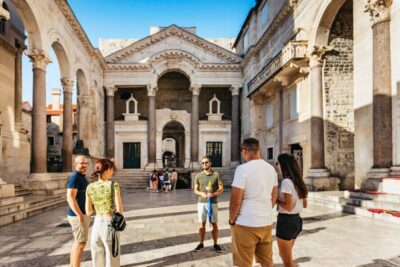

Blue Lagoon Boat Party with DJs, Shots & After Party
Read our review →Browse the lists this tour appears in