
Reviewed · SPLIT TOURS
Split: Private Walking Tour and Diocletian’s Palace
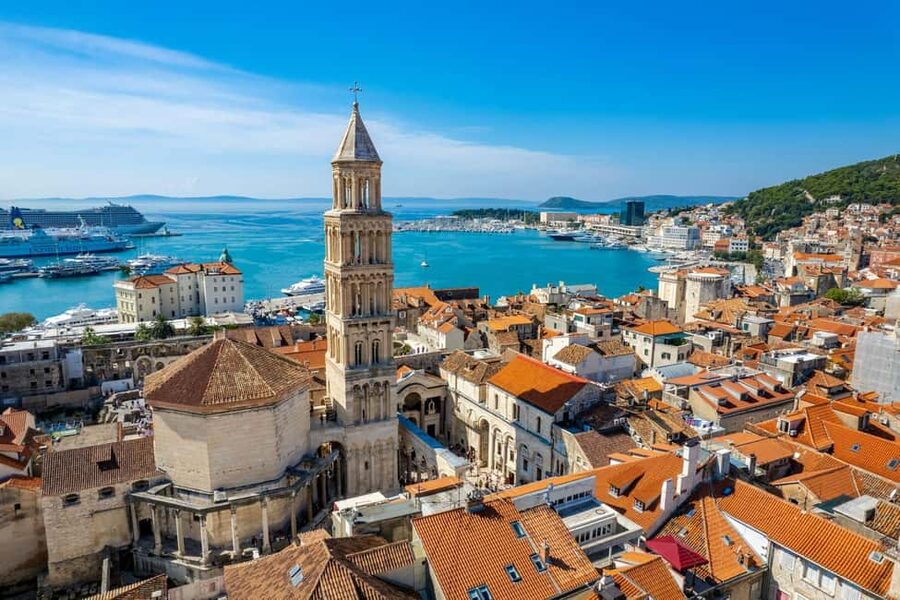
Split’s old town is not simply built around Diocletian’s Palace. Much of it is the palace, with homes, shops, cafés, and lanes fitted into the ancient Roman plan. This private walk gives you a compact way to see the main sights and understand how Emperor Diocletian’s retirement home became the heart of modern Split.
I like the private format, which gives you room to ask questions instead of following a large crowd. I also like the cellar admission, since the preserved underground rooms help you picture the palace above. The main consideration is time: the activity is listed as 90 minutes, although its description also calls it a two-hour walk, so you should confirm the exact starting time and length when booking.
- A 1,700-year-old palace still forms Split’s center, with daily life carried on inside its ancient walls.
- The private group format lets you shape the conversation around Roman history, local landmarks, or practical orientation.
- Diocletian’s cellars are included, giving you access to one of the tour’s most distinctive spaces.
- The route links the major sights, from the Golden Gate and Riva to Peristil, the cathedral, and Vestibul.
- English and Spanish are available, with both a live guide and an audio guide offered in those languages.
- Guide Ana receives especially warm praise for her attentive, friendly approach and strong command of Split’s past.
Why Diocletian’s Palace Is Split’s Best First Walk
The palace dates from the turn of the fourth century, when Roman Emperor Diocletian built a vast residence for his retirement. It was more than a country house. It had ceremonial spaces, defensive walls, religious buildings, living quarters, and underground storage areas.
That matters because Split’s old town can feel confusing at first. A lane that looks medieval may follow a Roman route. A café may occupy part of an ancient chamber. A modern doorway may open into a building with foundations far older than the street outside.
I like this tour as an introduction because it connects the pieces. You are not just ticking off a gate, square, cathedral, and promenade. You are learning how these places fit together, and why the palace remains the city’s main stage.
The walk is short enough to fit into a morning or afternoon, but it covers a lot. You will move through paved streets, open squares, and historic interiors. Wear comfortable shoes, since the old town is best handled on foot and the route is not suited to people with mobility impairments.
Meeting at South Tours on Mrčelina Street
The meeting point is the South Tours office at Mrčelina 1. Plan to arrive 15 minutes before the start. That extra time is useful in a dense old town, where finding the right doorway can take longer than expected.
The experience is designed for a private group. That is a practical advantage if you want to pause for photographs, ask about a particular period, or keep the walk focused on your interests. It can also make the $117 per person price easier to justify for a small group, since you are paying for personal attention rather than simply a seat on a standard group walk.
The guide speaks English or Spanish, and an audio guide is also included in those languages. The live guide is the important part here. The audio option gives you a useful backup, but the real value comes from being able to ask why a building matters or how the Roman palace changed over time.
More walking tours in Split:
- Split: Old Town and Diocletian Palace Walking Tour
★ 4.9 · 4,727 reviews - Walking Tour of Split and Diocletian’s Palace
★ 5.0 · 2,588 reviews - Krka Waterfalls tour with Trogir Walking tour and Krka panoramic boat cruise
★ 5.0 · 1,659 reviews
The Golden Gate and Split’s Roman Entrance
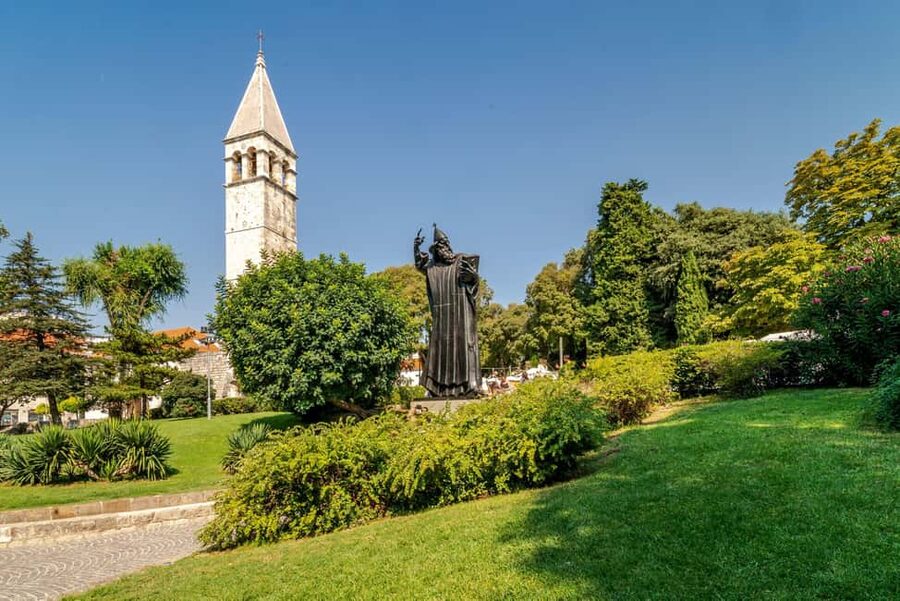
The first major stop is the Golden Gate, one of the palace’s principal entrances. It is a good place to begin because it shows the scale and purpose of Diocletian’s project. This was not an isolated monument placed in an empty field. It was a fortified residence with controlled entrances and a clear Roman plan.
You spend about 10 minutes here with the guide. That is enough for an explanation and photographs, but not so long that the tour gets stuck on the first stop.
The gate also gives you an early lesson in how Split works. Ancient walls, later construction, and present-day city life sit close together. Keep your eyes above street level and around the edges of the entrance. The most interesting details are not always directly in front of you.
A Brief Stop at the Game of Thrones Museum
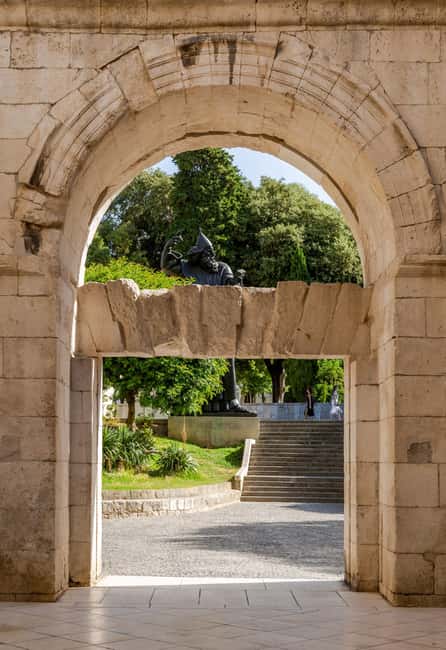
The route includes about five minutes at the Game of Thrones Museum. This is a short guided sightseeing stop, not a full museum visit described in detail, so keep your expectations modest.
Its place on the route reflects modern Split’s screen connection, while the rest of the walk focuses mainly on Roman and later local history. If you are a fan of the show, you may appreciate the connection. If ancient architecture is your main interest, this is simply a quick pause before the historic squares.
The short timing keeps the tour balanced. Split offers plenty of modern pop-culture references, but the palace itself is the real reason to book this walk.
People’s Square and the City Beyond the Palace
People’s Square, known locally as Pjaca, gives you a look at Split as a living city rather than only an archaeological site. The square has its own civic character, and the guide uses around 10 minutes to explain the setting and its place in the old town.
This is one of the useful features of the route: you are not confined to the most obvious Roman remains. You also see how later urban life formed around them. The contrast helps you understand that Split’s center was not frozen in antiquity.
I would use this stop to ask the guide how the palace area changed after Roman rule. The activity promises stories for every street, building, and square, and a private tour gives you a good chance to steer the explanation toward the periods that interest you most.
A few more Split half-days to weigh up
- Split: Krka Waterfalls Trip with Boat Cruise and Swimming
★ 4.8 · 10,519 reviews - From Split: Krka Waterfalls, Food & Wine Tasting Tour
★ 5.0 · 9,326 reviews - Blue cave, Mamma Mia and Hvar, 5 islands speedboat tour
★ 5.0 · 7,150 reviews - From Split: Krka Waterfalls, Food & Wine Tasting Tour
★ 4.9 · 6,598 reviews
Fruit Square and the Shape of Daily Split
Fruit Square is another 10-minute stop. Its name points to the practical life of the city, and it adds a more everyday feel to the walk.
The square is useful in a tour because it breaks up the sequence of grand monuments. You get a sense of how people move through the center, meet friends, shop, and use public spaces. The history here is not only about emperors and stone walls. It is also about the ordinary city that grew around those walls.
The short visit will give you an overview rather than a long architectural study. That is fine if you want orientation. If you prefer a slow tour with extended time at each building, this itinerary may feel brisk.
The Riva Promenade and a Change of Pace
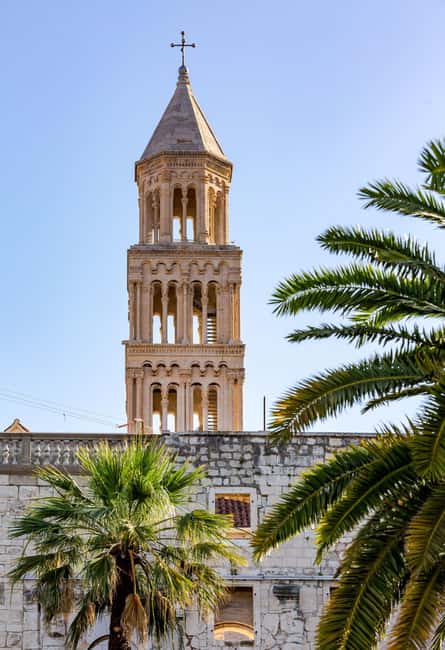
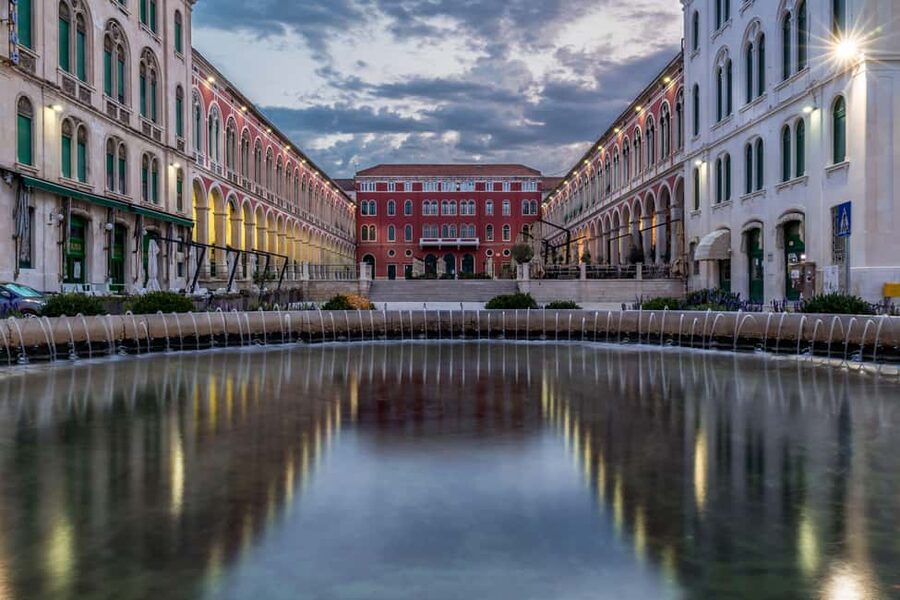
The walk continues to the Riva, Split’s waterfront promenade. After the enclosed lanes of the old town, the open promenade offers a welcome change of pace.
You spend about 10 minutes here. The guide can place the waterfront in the wider story of Split, while you get a chance to look back toward the old center and understand its relationship with the harbor.
The Riva is also a practical orientation point. It helps you see that the palace was not separate from the city’s working waterfront. The sea, the palace, and the later town have always been closely linked.
Do not expect a long café break or meal stop. Food and drinks are not included, and the listed route is focused on sightseeing. If you want time for coffee along the Riva, ask the guide whether the schedule allows it, or plan to return after the tour.
Going Underground in Diocletian’s Cellars
The cellars are the paid interior highlight, and admission is included. The guided visit lasts about 15 minutes, making it the longest single stop on the route.
These underground rooms matter because they preserve the footprint of the palace in a way that is easier to read than some of the upper streets. The cellars supported the residence above, and their layout helps explain how the palace was organized.
This is also where the tour’s historical story becomes more physical. You can see the scale of the construction rather than only hearing dates and names. Look for the relationship between the cellar spaces and the palace plan overhead.
The time is still limited. You will get an introduction and guided sightseeing, not an extended archaeological lecture. That suits visitors who want a strong overview, but history fans may leave wanting to return for a longer look.
Peristil, the Palace’s Ceremonial Heart
Peristil receives about 10 minutes, and it is one of the most important stops. This central square was the ceremonial heart of Diocletian’s Palace.
Here, the Roman design becomes easiest to grasp. The surrounding architecture, the open space, and the route toward the cathedral all help you picture how the emperor’s residence was arranged. The square also shows how old imperial spaces can take on new uses without losing their original power.
I would pay close attention to the guide’s explanation here. Peristil is the kind of place that can look impressive in a photograph but becomes much more meaningful once you understand its role. The private setting should make it easier to pause and ask about the Roman ceremonies, later changes, and present-day use.
Cathedral of Saint Domnius and a Complicated Past

The Cathedral of Saint Domnius is included as a 10-minute guided sightseeing stop. Its location is especially striking because it is tied directly to the palace complex.
The cathedral was built into the former mausoleum of Diocletian, creating one of the clearest examples of Split’s layered past. A Roman imperial structure later became a Christian place of worship. That change tells you a great deal about how power, religion, and city life shifted over the centuries.
The listed experience does not specify a separate interior entry ticket for the cathedral. Treat this as a guided exterior or general sightseeing stop unless your guide tells you otherwise. The included admission specifically covers the cellars.
This is another place where a short explanation can do a lot. Ask the guide about the link between the emperor and the cathedral, since the connection is central to understanding the old town.
Vestibul, a Final Look at Palace Design
The final stop is Vestibul, with about 10 minutes for a photo stop, visit, guided sightseeing, and walk. This rounded entrance space once formed part of the ceremonial approach to the emperor’s apartments.
It makes a fitting end because it brings you back to the palace’s original purpose. After seeing gates, squares, cellars, and the cathedral, you finish with a space designed to impress.
The photo stop gives you time to take in the shape and scale of the building. Keep in mind that the tour has covered many locations in a compact period. You may want to return later if you find one place especially appealing.
What the $117 Price Buys You
At $117 per person, this is not a budget orientation walk. The value depends heavily on the size of your private group and how much you value personal guidance.
You are paying for a live guide, private format, sightseeing across the main center, and entry to Diocletian’s cellars. Food and drinks are extra, and there is no transport because the route is a walking tour.
For a couple or small family, private access can make the price reasonable. You can ask questions, adjust the pace within the schedule, and avoid being one voice in a large group. For a solo visitor, the cost is harder to justify unless you particularly want a private guide or need the tour to fit a specific schedule.
The strong point is coverage. In 90 minutes, you see the principal gates, squares, waterfront, palace interior, cathedral area, and ceremonial spaces. The tradeoff is depth. You receive a well-organized introduction, not a slow study of every corner.
The description also refers to a two-hour walk, while the activity details list 90 minutes. I would confirm the exact duration before paying, especially if you have a ship departure, restaurant reservation, or another timed activity.
The Guide Makes the Difference
The guide is the key variable on any private history walk. Ana is specifically associated with this experience, and the available feedback describes her as attentive, friendly, engaged, and well prepared. Those qualities matter in Split, where a good explanation can turn a maze of stone lanes into a readable city.
The praise is consistent across the three available ratings, all of which give five stars. One Spanish-speaking visitor singled out Ana’s care and command of the subject, while other comments highlight a friendly and engaged guide.
That does not guarantee that Ana will lead every departure. Guide assignments can vary, so ask when booking if her presence matters to you. English and Spanish are the stated languages, and both a live guide and audio guide are available in those languages.
Pace, Footwear, and Access
The route is short but packed. Each stop generally lasts 5 to 15 minutes, so you will move often and should arrive ready to walk rather than linger.
Comfortable shoes are essential. The old town includes historic paved streets, and the experience is specifically not suitable for people with mobility impairments. The supplied information does not give a detailed accessibility route, so ask the provider directly if you have any concern beyond that general restriction.
Bring water if you need it, though food and drinks are not included. Since this is a private group, you may be able to discuss small pacing needs with the guide, but the overall schedule remains compact.
The activity offers free cancellation up to 24 hours before departure and lets you reserve now and pay later. Those terms are useful if your Split plans depend on weather or a changing cruise schedule, but check the booking conditions for your selected date.
Who Should Book This Split Walk
I would recommend this tour to a first-time visitor who wants a clear introduction to Split without spending half a day on a formal history program. It also suits couples, families, and small groups who value direct access to a guide.
It is a good choice if you want to see the famous landmarks in one sweep, especially the Golden Gate, Riva, Peristil, Saint Domnius Cathedral, and the cellars. The private setting is valuable if you enjoy asking questions or want the guide to explain the city in English or Spanish.
I would think twice if you want extensive time inside each monument, a food experience, or a relaxed café stop. The tour is designed for coverage and context. You should plan a second wander through the palace afterward if you want photographs, shopping, or a closer look at the details.
Should You Book It?
Book this private walk if you want a compact, personal introduction to Split’s ancient center, with cellar admission included and a route that covers the city’s major sights. The consistently warm feedback about the guides, especially Ana, strengthens the case.
Before booking, confirm the actual duration, ask who will guide your departure, and consider how many people will share the private price. If those details suit your plans, this is a sensible way to get your bearings and understand why Diocletian’s Palace is not just a monument, but the foundation of modern Split.
FAQ
Where does the tour start?
The meeting point is the South Tours office at Mrčelina 1 in Split. You should arrive 15 minutes before the tour begins.
How long does the tour last?
The activity details list a duration of 90 minutes. The description also refers to a two-hour walk, so confirm the precise timing when booking.
What languages are available?
The live tour guide and audio guide are available in English and Spanish.
Is the tour private?
Yes. The activity is offered for a private group.
Is entry to Diocletian’s cellars included?
Yes. The entry ticket to the cellars of Diocletian’s Palace is included.
Are food and drinks included?
No. Food and drinks are not included in the price.
What should I bring?
Bring comfortable shoes for walking through Split’s historic center.
Is the tour suitable for people with mobility impairments?
No. The activity is listed as not suitable for people with mobility impairments.
Just added around Split
- From Trogir, Seget, Okrug: Krka Waterfalls & Šibenik Culture Tour★ 5.0 · 10 reviews
- Krka Waterfalls & Primošten from Trogir, Seget, Čiovo & Kaštela★ 5.0 · 18 reviews
- Island Hopping Boat Excursion with Lunch (Trogir,Blue Lagoon, Šolta)★ 3.5 · 6 reviews
- From Split & Trogir: ATV Quad Tour on Island Čiovo★ 5.0 · 21 reviews
- Slatine – Island Hopping Excursion (Trogir/Blue Lagoon/Shipwreck)★ 4.0 · 24 reviews
- Split: Blue Lagoon Boat Trip with Lunch, Wine and Snorkeling★ 5.0 · 3 reviews
- Split Sunset Stand Up Paddle Tour★ 5.0 · 16 reviews
- Split: Sunset Guided Kayaking Tour★ 4.8 · 71 reviews
Split Tours, compared.

Krka Waterfalls Trip with Boat Cruise and Swimming
Read our review →

Blue cave, Mamma Mia and Hvar, 5 islands speedboat tour
Read our review →
Blue Cave, Mamma Mia, Hvar and 5 Island Tour
Read our review →
Blue Lagoon & 3 Islands Cruise with Lunch from Split
Read our review →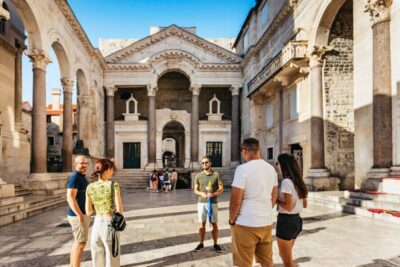

Blue Lagoon Boat Party with DJs, Shots & After Party
Read our review →Browse the lists this tour appears in