
Reviewed · DUBROVNIK TOURS
Dubrovnik Old Town History Walking Tour
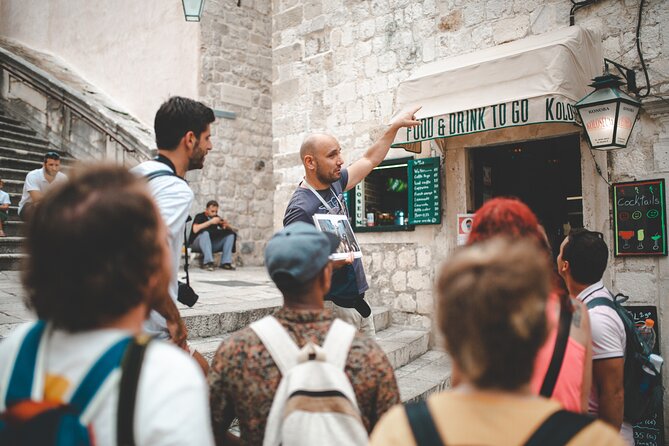
Dubrovnik’s Old Town is compact, but its story is not. In 90 minutes, this walking tour links the city’s key sights with the rise and fall of the Republic of Ragusa, the city’s religious traditions, its seafaring past, and the damage it suffered during the 1990s Homeland War. It is a smart way to get your bearings fast, especially on your first morning.
I like the clear route and the local flavor. You see the Franciscan pharmacy, Stradun, Rector’s Palace, the Cathedral, the Old Port, and Orlando Column without spending time wondering which lane leads where. I also like that guides such as Ivana, Ermina, Jelena, Sara, and Joseph have added family stories, modern context, and practical tips about what to see next.
The main drawback is the pace. The group can include up to 30 people, and the tour spends only a few minutes at several major sights. You get an excellent introduction, not a full visit inside every building, and crowded streets or wet weather can make it harder to hear and keep up.
Key points to know before you book
- Start at Large Onofrio’s Fountain: Meet beside the Hard Rock Cafe, under the red umbrella, at Poljana Paska Miličevića.
- Cover the essential Old Town sights: The route includes Stradun, the Franciscan Monastery, Rector’s Palace, the Cathedral, the harbor, and Orlando Column.
- Expect history with local stories: Guides explain Ragusa’s government, religion, trade, daily life, and the Homeland War rather than simply naming monuments.
- Plan for 90 minutes: The short format works well at the start of a stay, leaving you time to return to places that catch your eye.
- Budget $24.19 per person: For a central introduction to an expensive city, the price is reasonable, though admission to attractions is not included.
- Know the practical limits: The group may reach 30 people, the tour is offered in English, and poor weather can lead to a new date or full refund.
Why this 90-minute walk works so well in Dubrovnik
The best use of a first walking tour is not to rush through every monument. It is to give you a mental map, explain the city’s character, and point out details you might miss alone. This experience does that by moving in a simple line from the western entrance of Old Town toward the harbor, then back to the eastern end of the Stradun.
The route is also useful because Dubrovnik’s streets can feel confusing on arrival. The polished stone lanes, narrow side streets, stairways, churches, and small squares all look inviting, but the city’s layout makes more sense once you understand the Stradun as its main spine.
You will hear about Ragusa, the old maritime republic that governed Dubrovnik from the Middle Ages until 1808. The guide connects its trade, diplomacy, water system, religion, government, and defenses to the buildings in front of you. That connection is the real value here: a fountain becomes part of an aqueduct, a palace becomes a government center, and a harbor becomes evidence of a trading power that reached across the Mediterranean.
The tour has earned a 4.9 rating from 1,684 reviews, with 99 percent of customers recommending it. Those figures suggest a reliable experience, but they should not make you expect a private walk or a museum tour. The strongest appeal is the guide’s delivery. Past guides have included Ivana, Ermina, Jelena, Sara, Joseph, Pero, and others, and the most praised qualities are warmth, humor, clear English, and personal knowledge of Dubrovnik.
More Old Town Walking Tours in Dubrovnik
- Dubrovnik: Old Town Walking Tour
★ 4.8 · 5,174 reviews - Dubrovnik Discovery Old Town Walking Tour
★ 5.0 · 4,458 reviews - Dubrovnik Combo: Old Town & Ancient City Walls
★ 5.0 · 1,019 reviews
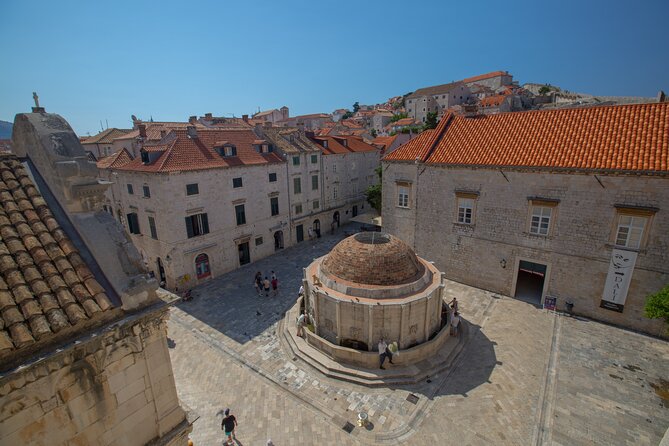
Starting beneath the red umbrella at Onofrio’s Fountain
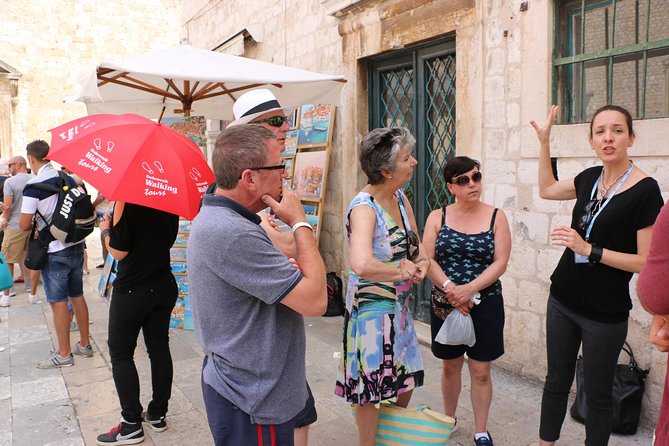
Your meeting point is the Large Onofrio’s Fountain, next to the Hard Rock Cafe. Look for the red umbrella used by Dubrovnik Walking Tours. The guide introduces the group here, then begins the walk.
This is a good opening point because the fountain immediately gives the guide something meaningful to explain. It is not just an ornate structure for photographs. It formed part of Dubrovnik’s innovative aqueduct system, an important achievement for a small city-state that had to protect and manage its water supply.
The first history lesson sets up the rest of the walk. You learn how Ragusa grew as a maritime trading republic and how its success depended on commerce, careful government, diplomacy, and practical city planning. I like this approach because the facts stay tied to the street instead of floating as a list of dates.
You spend about ten minutes at the fountain, including the initial introduction. Since the area can be busy, arrive ready to listen closely and keep an eye out for the red umbrella.
From the Holy Savior Church to the Franciscan Monastery
From the fountain, the group heads down the main street and passes the small votive Church of the Holy Savior. This brief stop gives the guide a chance to explain the role of religion in daily life and city design.
The church is an easy detail to overlook when you are focused on the grander buildings along the Stradun. That is one reason a guide helps. You are encouraged to notice how small religious sites, public rituals, and local traditions shaped the Old Town you see today.
Next comes the Franciscan Church and Monastery, one of the route’s most rewarding stops. The complex includes a church, monastery, library, and pharmacy. The pharmacy dates to 1317 and is described as the third oldest still-functioning pharmacy in the world. The library holds more than 20,000 books, including 1,200 valuable old manuscripts.
The tour allocates about ten minutes here, so you should not expect a long interior visit or time to study the collection. The value is the context. You learn why the Franciscan complex mattered to the city and hear about local customs that have continued across centuries.
If the pharmacy or monastery is high on your personal list, mark it mentally and return after the tour. The walk helps you decide which places deserve more of your time later.
Reading Dubrovnik along the Stradun

The Stradun, also called Placa, is Dubrovnik’s main pedestrian street and public stage. It divides the Old Town into northern and southern sections and serves as a business street, meeting place, and setting for feasts and processions.
This is where the guide explains the city’s layout in more detail. You begin to see the relationship between the main street, the side lanes, the harbor, and the buildings that supported Ragusa’s government and trade.
The historical story then moves forward. You hear about the end of the Ragusa Republic in 1808, followed by more recent events involving Yugoslavia and the Homeland War of the 1990s. Dubrovnik’s beauty can make it easy to treat the city as a preserved medieval set, so the modern history matters. The Old Town is not only an old monument. It is a living city that endured war and rebuilt.
This section is also a reminder of the tour’s limits. Ten minutes is enough for a clear explanation, but not for a full lecture on the region’s complicated political past. If that period interests you, ask the guide for suggestions on what to explore afterward.
More old town walks in Dubrovnik:
- Dubrovnik: Blue Cave Tour with Panoramic Old Town View
★ 4.9 · 884 reviews - Dubrovnik: Old Town Walking Tour
★ 4.9 · 792 reviews - Dubrovnik: Old Town & City Walls Guided Tours Combo
★ 4.8 · 697 reviews - Dubrovnik Cable Car Ride, Old Town Walking Tour plus City Walls
★ 4.5 · 685 reviews
Side streets, religious communities, and Gundulic Square
The route leaves the broad Stradun and turns into narrower inner streets toward the port. This change of scale is welcome. Dubrovnik’s identity is not contained in its grand avenue. It is also found in tight lanes, small churches, markets, and the traces of different communities.
At the Church of the Holy Annunciation, the guide discusses Orthodox Christian, Jewish, and Muslim influences on Dubrovnik. The stop broadens the story beyond the city’s Catholic churches and shows how trade and urban life brought different religious communities into contact.
You then reach Gundulic Square and the Green Market, beside the monument to poet Ivan Gundulic. The market provides a more everyday view of the city. Depending on the time and activity, you might see local produce and hear about food traditions, customs, and stories connected with the square.
I especially like this part of the route because it breaks up the monument-by-monument format. You are not only looking at palaces and churches. You are also getting a glimpse of how public spaces have been used by local people.
The stop lasts about ten minutes. The market is not presented as a separate food tour, so do not book this experience expecting tastings or extended shopping time.
Rector’s Palace and the machinery of Ragusa
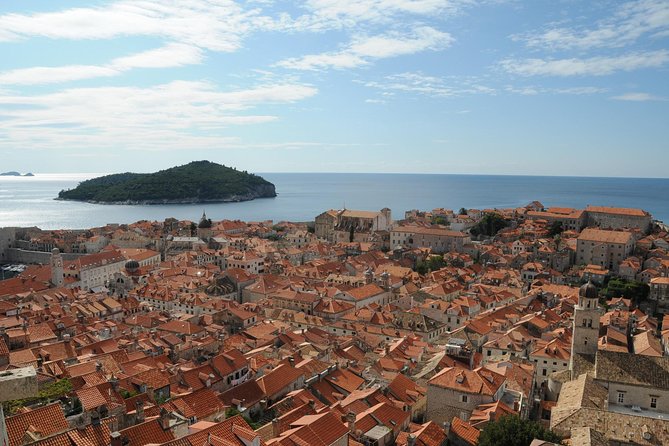
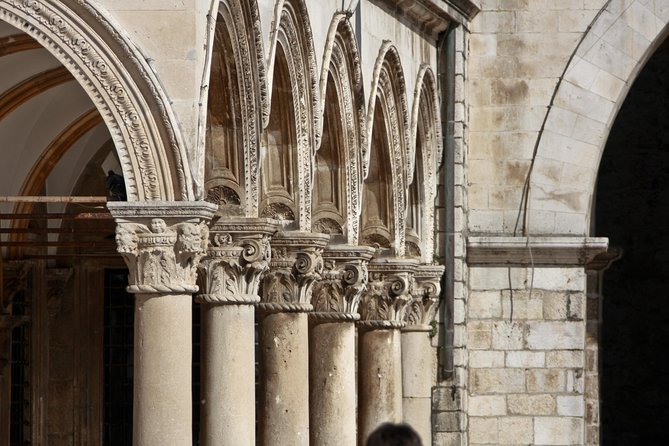
Near Gundulic Square is Rector’s Palace, one of Dubrovnik’s most important civic buildings. From the 14th century until 1808, it served as the seat of the Rector of the Republic of Ragusa. It also housed the Minor Council and the wider state administration.
The palace’s functions tell you a lot about how the republic worked. It contained an armoury, powder magazine, watch house, and prison, alongside its governmental rooms. This was not simply a residence for a ceremonial official. It was part of the machinery that ran the city-state.
The guide’s explanation helps you understand the political system before you see the later monuments near the eastern end of the Stradun. That order matters. Dubrovnik’s buildings are easier to appreciate when you know which ones served religion, trade, defense, or government.
The tour does not include admission to the palace. All scheduled stops are free from the tour’s point of view, but the walk is primarily an exterior orientation with explanations. If you want to enter, plan a separate visit and allow extra time beyond the 90-minute route.
The Cathedral and the legend of Richard the Lionheart
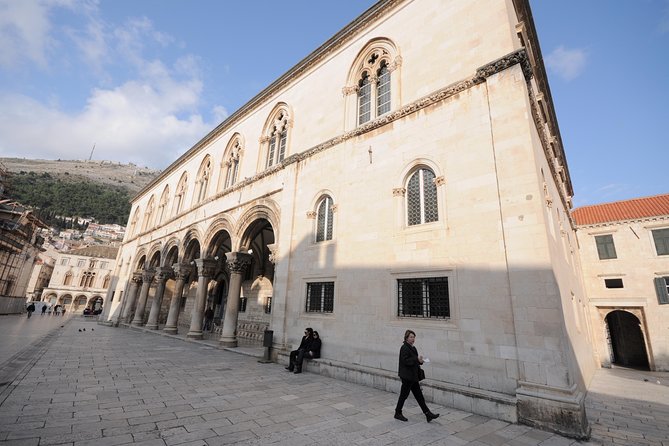
The Cathedral of the Assumption of the Virgin Mary brings the tour back to religious history and local legend. The guide tells the story that Richard the Lionheart was shipwrecked on nearby Lokrum Island in 1192 while returning from the Crusades.
Treat this as a legend attached to place, not as the sole reason to visit the Cathedral. The story works because it connects Dubrovnik to the wider medieval world and to the island visible just beyond the Old Town.
The scheduled time here is about five minutes, one of the shorter stops. You get the essential background, but not an in-depth examination of the Cathedral’s art, treasury, or architecture. Those wanting a detailed religious or artistic visit should return independently.
The Old Port, Arsenal, and quarantine stories
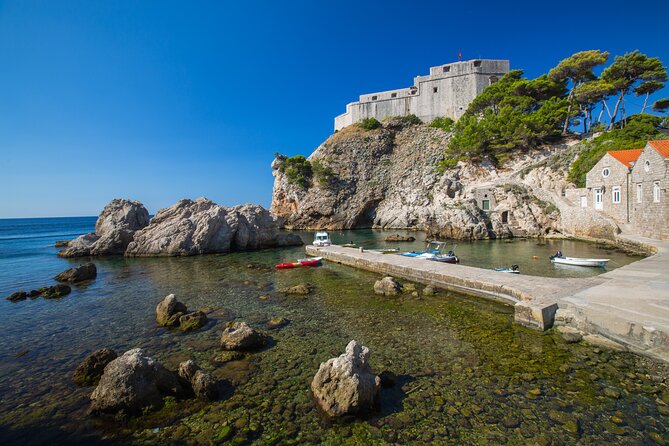
The walk continues to Dubrovnik’s City Harbor, where the guide turns to the republic’s seafaring past. Ships from Dubrovnik sailed across the Mediterranean, and galleons built and loaded at the Arsenal served in navies far beyond the city.
This is one of the places where the old republic’s size can fool you. Dubrovnik is small enough to cross on foot, yet its ships and merchants connected it to a much wider network. The harbor helps make that history visible.
You also hear about the famous quarantine system and the nearby fortresses of St. Luke and St. John. Quarantine was a practical defense against disease brought by arriving ships, and the port’s fortifications show how trade and security had to work together.
The harbor section takes about 15 minutes, the longest single stop. That gives the guide room to connect ships, public health, defense, and city planning. It is also a good point to pause, look outward, and understand why this location made Dubrovnik both prosperous and vulnerable.
Orlando Column, St. Blaise, and the eastern Stradun
Leaving the harbor, the group returns to the eastern end of the Stradun and Luza Square, beneath the City Bell Tower. The final section gathers several important monuments in one compact area.
You see the Church of St. Blaise, dedicated to Dubrovnik’s patron saint, and hear the legend of the knight Orlando. The Orlando Column marks a central point in the city and carries its own mix of civic symbolism and folklore.
The guide also points out Sponza Palace, the Small Onofrio’s Fountain, and the high Bell Tower. This closing cluster is useful because it gives you a final orientation point at the opposite end of the Old Town from where you began.
The tour ends back at the meeting point, so the route forms a practical loop. From there, you can return to a church, palace, market, or side street that interested you. Several past customers used the tour as a first-day introduction, then shaped the rest of their visit around the guide’s suggestions.
Price, group size, and the pace you should expect
At $24.19 per person, this is a fair price for a 90-minute English-language introduction in central Dubrovnik. The city can be expensive, and the tour gives you a local guide, a route through many major sights, and historical context without adding hotel transportation costs.
The value is strongest if you are visiting for the first time or have only a short stay. You get the basic city map in your head and a list of places to revisit. If you already know Dubrovnik well, the tour may feel too broad and familiar.
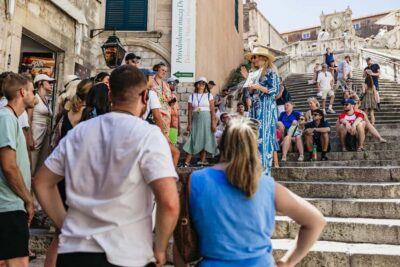
The maximum group size is 30 people. That is not a tiny group, so you should expect some standing around monuments and the need to stay near the guide. The guide’s personality matters here. Names praised for an engaging style include Ivana, Jelena, Sara, Joseph, Ermina, and Pero, but the specific guide for your departure is not stated in advance.
Most people can participate, and service animals are allowed. The route is described as a useful step-free introduction, but Dubrovnik itself has many steps, narrow streets, and busy areas. The tour does not include hotel pickup or drop-off, and it ends at the starting point.
Best time to take the tour
Choose the tour early in your stay if you can. The route gives you useful bearings, and guides have offered advice about food, sights, and places to visit later. It also makes sense to choose a departure time that leaves room for your own exploration afterward.
Weather matters. The experience requires good weather, and if poor conditions cancel it, you are offered another date or a full refund. If you visit in a quieter month such as November, you might find smaller crowds and a calmer walk, though the weather is less predictable.
You can cancel for a full refund up to 24 hours before the start time. Cancellations or changes made within 24 hours are not refunded or accepted.
Who should book this Dubrovnik walking tour?
I would choose it for a first visit, a short stay, or a family group that wants history without committing half a day. The 90-minute length is long enough to cover the city’s main story but short enough to leave energy for the walls, museums, food, or a boat trip.
It also suits you if you enjoy personal stories. Guides have brought in family connections, local memories, daily life, and accounts of the 1991 to 1992 war. Those details help the polished Old Town feel like a real place rather than a collection of postcard views.
I would look elsewhere if you want long interior visits, extensive architectural analysis, or a private pace. A group of up to 30 can feel crowded, and five or ten minutes at a major sight will not satisfy a specialist. Use this as your orientation walk, then return to the buildings that deserve more time.
Should you book it?
Yes, if you want a practical first look at Dubrovnik’s Old Town for $24.19. The route covers an impressive number of important places, and the best part is the way the guide connects fountains, churches, government buildings, markets, ships, and modern war history into one readable story.
Book it early in your stay, wear comfortable shoes, and stay close to the red umbrella. Think of the tour as a well-paced introduction rather than the final word on Dubrovnik. Afterward, you will know where to return, what questions to ask, and why this small walled city mattered far beyond its size.
FAQ
How long does the Dubrovnik Old Town History Walking Tour last?
The tour lasts approximately 1 hour and 30 minutes.
Where does the tour start?
It starts at Large Onofrio’s Fountain, at Poljana Paska Miličevića in Dubrovnik.
How do I find the meeting point?
Look for the red umbrella next to Large Onofrio’s Fountain and near the Hard Rock Cafe.
Where does the tour end?
The tour ends back at the meeting point.
What language is the tour offered in?
The tour is offered in English.
What is included in the price?
The price includes a local guide and all taxes, fees, and handling charges.
Is hotel pickup included?
No. Hotel pickup and drop-off are not included.
What attractions are covered?
The route covers Large Onofrio’s Fountain, the Church of the Holy Savior, the Franciscan Church and Monastery, Stradun, the Church of the Holy Annunciation, Gundulic Square and its market, Rector’s Palace, the Cathedral, City Harbor, Orlando Column, St. Blaise’s Church, Sponza Palace, Small Onofrio’s Fountain, and the Bell Tower area.
How many people can join the tour?
The activity can have a maximum of 30 people.
Can I cancel for a full refund?
Yes. You can cancel at least 24 hours before the start time for a full refund. Cancellations within 24 hours are not refunded, and changes within that period are not accepted. If poor weather cancels the tour, you are offered another date or a full refund.
More Walking Tours in Dubrovnik
- Dubrovnik: Game of Thrones Walking Tour
★ 5.0 · 1,732 reviews - Dubrovnik: City Walls Early Morning or Sunset Walking Tour
★ 4.8 · 1,523 reviews - Dubrovnik: Ancient City Walls & Wars Walking Tour
★ 5.0 · 1,270 reviews - Dubrovnik: Game of Thrones Walking Tour
★ 4.9 · 981 reviews
More Historical Tours in Dubrovnik
- Game of Thrones & History of Dubrovnik Tour
★ 5.0 · 628 reviews - Dubrovnik: Old Town History Walking Tour
★ 4.9 · 474 reviews - Early Bird Dubrovnik History Tour – 7:30 Start
★ 5.0 · 198 reviews - Dubrovnik: Red History Museum Regular Ticket
★ 4.6 · 134 reviews
Just added around Dubrovnik
- Full- Day Private Speedboat Tour in Dubrovnik on Elaphiti Islands★ 5.0 · 21 reviews
- Wine Lover’s Tour of Peljesac Peninsula★ 5.0 · 150 reviews
- Wine tour peninsula Pelješac★ 5.0 · 3 reviews
- Elaphiti Islands Private Dubrovnik Boat Unique Experience★ 5.0 · 10 reviews
- Dubrovnik at War 1991-1992 Private Walking Tour★ 5.0 · 4 reviews
- PRIVATE Wine Tour to Konavle country side★ 5.0 · 11 reviews
- Walls of Liberty: A Self-Guided Audio Tour of Dubrovnik★ 3.5 · 3 reviews
- Parasailing in Cavtat★ 5.0 · 62 reviews
Dubrovnik Tours, compared.

Blue Cave Small-Group Boat Tour from Dubrovnik
Read our review →
Full-Day Dubrovnik Elaphite Islands Cruise with Lunch and Drinks
Read our review →
Epic Game of Thrones Tour + Lokrum & Saver Option
Read our review →
The Original Game of Thrones Tour & Lokrum Option
Read our review →
Dubrovnik Game of Thrones Tour & Optional Lokrum Island Visit
Read our review →
Elaphite Island Cruise w/ Drinks & Optional Lunch
Read our review →Browse the lists this tour appears in