
Reviewed · SPLIT TOURS
Split Walking Tour with Professor of History
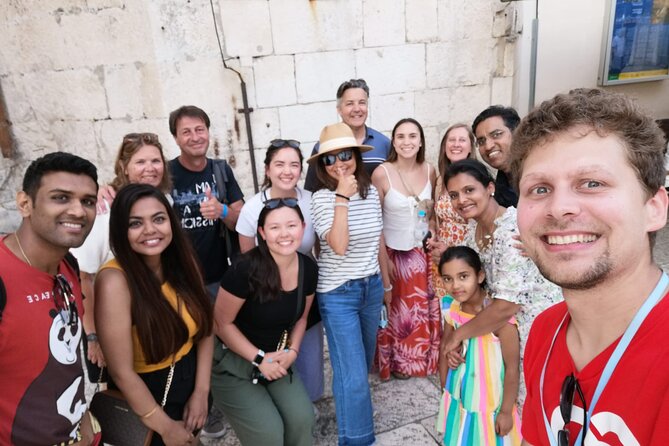
Split’s great surprise is that Diocletian’s Palace is not a fenced-off ruin. It is the working heart of Split, with homes, cafés, shops, laundry, and daily life tucked inside a Roman imperial complex. This tour uses that unusual setting well, pairing the stones with stories from a history professor.
I like the clear historical thread, which moves from Emperor Diocletian to medieval Split and Napoleon’s Dalmatia. I also like the practical side: guides such as Mario and Anita add food, ATM, onward travel, and local-life tips instead of stopping at dates and names.
The main consideration is time. The tour is advertised at about two hours and 20 minutes, but the full route can run closer to three hours if the guide follows questions or adds stories. You will also see the Cathedral of Saint Domnius and Temple of Jupiter from outside only.
Key points to know before booking
- A Roman palace that became a city: You walk through a living neighborhood, not an isolated archaeological site.
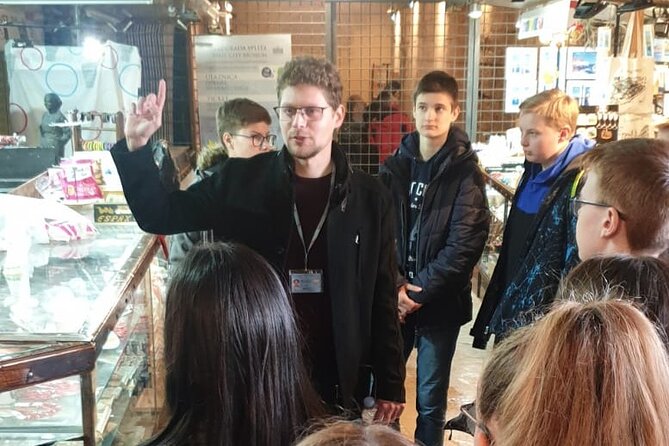
- Professor-led storytelling: Mario is known for humor, myth-busting, and strong historical context, while Anita brings warmth and pride in Croatian culture.
- A broad route: The walk covers the Riva, palace substructures, Peristyle, Vestibule, cathedral, Jupiter’s Temple, Golden Gate, Marmontova Street, Prokurative, and Fruit’s Square.
- Good value at $24.19: The price includes the guided walk and taxes, while paid interior admissions are left for you to choose later.
- Expect a longer outing: Plan for roughly two hours and 20 minutes, with the possibility of closer to three.
- Small, but not private: The maximum group size is 17, and a private upgrade is available if you want more personal attention.
Why Split’s Roman palace works so well on foot
I find Split easiest to understand when you treat the old center as a sequence of layers. Diocletian built his palace in the early fourth century, but the place did not freeze in Roman times. Later residents reused its walls, temples, halls, and gates, creating the compact city you see today.
That is the central strength of this walk. You are not simply ticking off ruins. You are learning why a mausoleum became a cathedral, why a Roman gate still frames daily movement, and how medieval buildings were fitted into an imperial plan.
The tour starts at the Brass Gate, or Porta Aenea, on the Riva at Obala Hrvatskog narodnog preporoda 22. This is a sensible meeting point because the promenade gives you room to find the group before you move into the tighter lanes of the old center. The tour ends back at the meeting point, so you will not need to arrange a separate pickup.
English is the tour language. Confirmation is provided at booking, and the activity is near public transportation. Service animals are allowed, and the operator says most people can participate.
More history-led days in Split:
- Walking Tour of Split with a ‘Magister’ of History
★ 5.0 · 1,122 reviews - Split: History and Heritage Walking Tour
★ 4.9 · 650 reviews - Split History and Gastro Small-Group Tour with Food and Drinks
★ 5.0 · 375 reviews
Beginning on the Riva with coffee, sunlight, and Roman walls
The Riva is more than a pretty waterfront strip. It is where Split’s public life gathers, with people meeting for coffee, sitting in the sun, and watching the harbor. Beginning here gives you a useful first lesson: Split’s history is not kept apart from local life.
You will spend about 15 minutes at the promenade and the nearby model of the Palace. Your guide can use this opening to explain the palace’s position and broad shape before the group enters the dense old center.
I like this start because it eases you into the city. You get a sense of present-day Split first, then begin reading the old walls with better context.
The palace substructures reveal the original plan
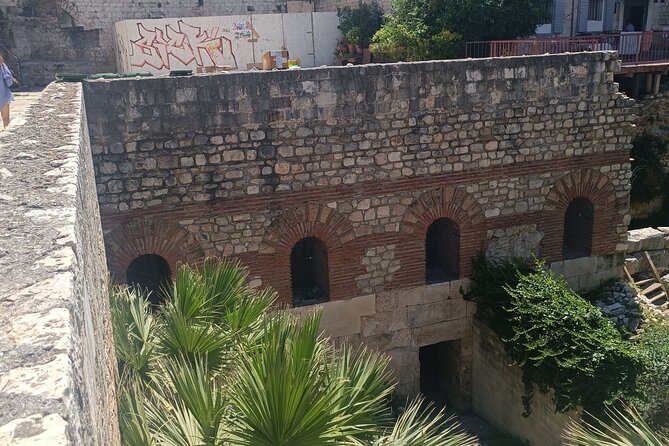
The basement halls, more accurately called the palace substructures, are among the best-preserved complexes from classical antiquity. They also help explain the shape of the streets above. In places, the lower rooms mirror the former imperial apartments and show how the palace was organized.
The stop lasts about 15 minutes, and admission is listed as free. It is a short introduction rather than a long archaeological visit, so do not expect an exhaustive examination of every chamber.
Still, this is one of the most useful parts of the route. The upper palace can feel like a maze. Once you understand that the lower halls supported and reflected the imperial layout, the Peristyle, Vestibule, and surrounding lanes make much more sense.
Peristyle and Vestibule: where ceremony took over
The Peristyle was the palace’s central square and the formal stage for the emperor. Diocletian was presented as the living son of Jupiter, so approaching him was designed as a ritual, not a casual audience. Your guide explains how subjects might kneel, kiss the edge of his scarlet cloak, or prostrate themselves before him.
About 10 minutes is scheduled here. That may sound brief, but the square is compact, and the key point is the ceremony and power built into the space. Look up at the surrounding stone and imagine how intimidating this approach must have been when the emperor appeared beneath the central architrave.
The nearby Vestibule, also called the Rotonda, was the formal entrance to the imperial apartments. Built by the beginning of the fourth century, this circular hall once had a dome and measured about 17 meters high and 12 meters across.
You get another 10 minutes here. The room was meant for selected audiences, including ambassadors, rather than ordinary public use. Its shape and height make the imperial message plain: you were entering a ruler’s private and carefully controlled world.
The guide’s delivery matters in these spaces. Mario is described as mixing scholarly detail with jokes and trivia, while also asking questions that make you think about what you are seeing. That approach should suit you if you want more than a memorized list of Roman facts.
More walking tours in Split:
- Split: Old Town and Diocletian Palace Walking Tour
★ 4.9 · 4,727 reviews - Walking Tour of Split and Diocletian’s Palace
★ 5.0 · 2,588 reviews - Krka Waterfalls tour with Trogir Walking tour and Krka panoramic boat cruise
★ 5.0 · 1,659 reviews - Split & Diocletian’s Palace Walking Tour
★ 5.0 · 1,125 reviews
Saint Domnius and Jupiter’s Temple show the palace changing
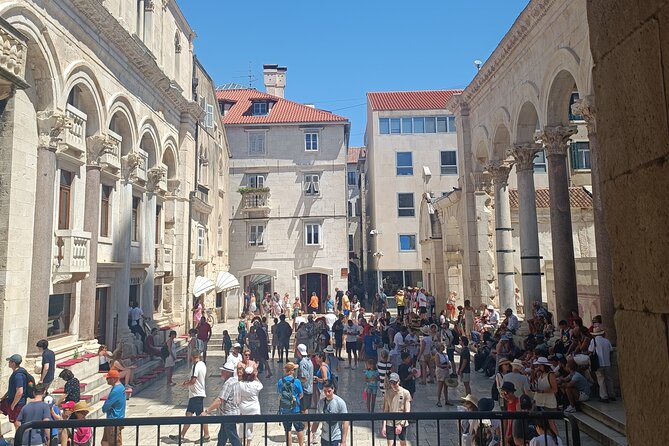
The Cathedral of Saint Domnius is a particularly good example of Split’s layered identity. Look at it as a Roman mausoleum, a former imperial structure, and a church, depending on which period you are considering.
The tour spends about 20 minutes here, but the visit is outside only. Entry is not included. That is not necessarily a weakness. An exterior explanation lets you decide later if the interior deserves time from your own schedule, rather than building a paid admission into a short walking tour.
Next comes the Temple of Jupiter, with about 10 minutes outside. Jupiter was the Roman sky and thunder god, and the building was later converted into a baptistery dedicated to Saint John the Baptist. That change captures Split’s long religious and political shifts in one small site.
On the way toward the Golden Gate, you pass Let Me Pass Street, a tiny lane squeezed between the ancient temple and a medieval building. Local people call it the narrowest street in the world. Treat that as a local claim and a fun stop, not as a measurement you need to verify. The point is seeing how little space the old city sometimes leaves for modern movement.
Golden Gate and Gregory of Nin add the city’s favorite rituals
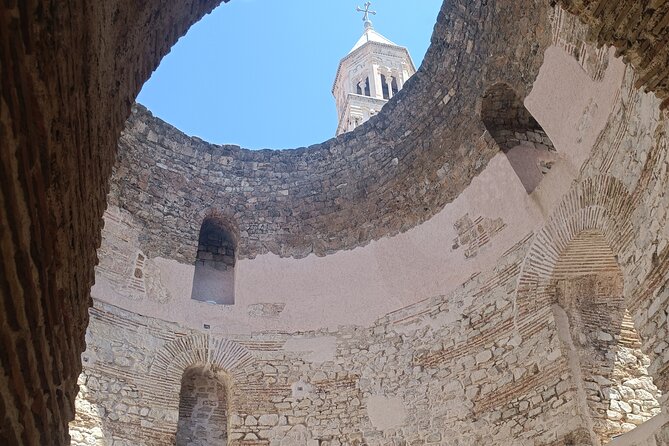
The Golden Gate, or Northern Gate, was one of four main Roman entrances into the palace. It was the route Diocletian used to enter the complex and was decorated to signal its importance.
The gate later lost its columns and statues and was sealed during the Middle Ages. It was reopened and repaired in modern times, and today it is one of the most recognizable spots in Split.
The scheduled stop is about 15 minutes. I would pay attention to the change in scale here. The Riva feels open, the palace squares feel ceremonial, and the Golden Gate feels like a defensive threshold. Together, the three settings show how the palace controlled movement.
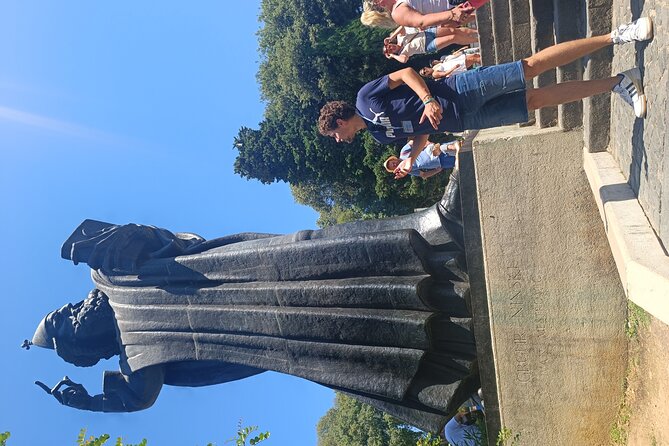
About 10 minutes is set aside for the statue of Gregory of Nin, the 8.5-meter figure by Croatian sculptor Ivan Meštrović. The statue’s polished toe is the city’s most obvious good-luck ritual. You can rub it if you like, though the worn shine already shows how many hands have done so before you.
This is also a good moment to ask your guide about Croatian cultural figures. The tour does not treat Split as Roman-only, and that wider national context gives the later stops more meaning.
Marmontova Street and Prokurative shift the story forward
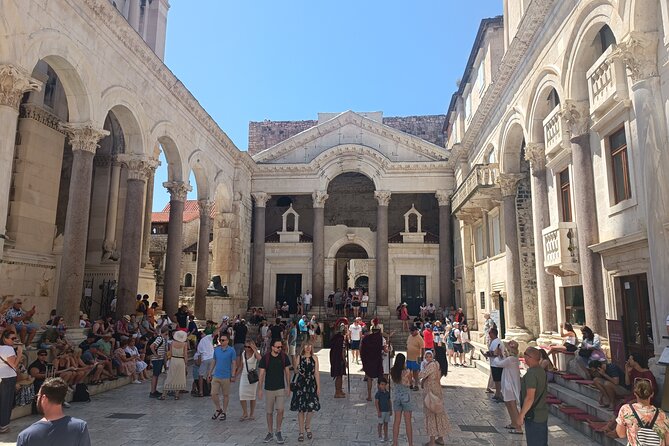
Marmontova Ulica brings you out of the ancient and medieval story and into the period of French influence. Marshal Marmont helped urbanize Dalmatian cities during Napoleon’s rule, and Split named this important street after him.
You spend about 10 minutes here. The stop is useful because it reminds you that Split’s identity was shaped by more than Rome, Venice, or medieval Croatia. Streets and public works can tell a political story just as clearly as monuments.
The walk continues to Prokurative, officially Republic Square. This large open space is enclosed on three sides by elaborate Neo-Renaissance buildings. Another 10 minutes is planned here.
Prokurative is a good contrast with the cramped lanes around the palace. Its open plan and decorative façades feel more formal and modern. Your guide can help connect the square to Split’s later urban growth rather than treating it as an unrelated photo stop.
Fruit’s Square finishes with Croatian culture and food
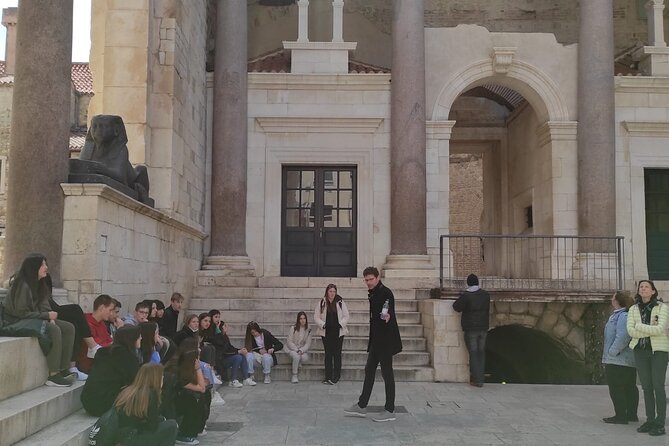
The final stop is Fruit’s Square, or Trg Braće Radić. It is a small, attractive square where women once sold fruit. The stop lasts about 15 minutes and includes the statue of Marko Marulić, often called the father of Croatian literature.
This is a fitting ending because the discussion can move from buildings to people, language, food, and local identity. The square is also a useful place to ask for suggestions about Croatian dishes and places to eat.
Mario has been especially praised for giving practical advice about restaurants, shops, ATMs, and onward travel. He has also followed up with additional suggestions after the walk. Anita is described as attentive to a group and proud of her Croatian background, with a friendly and caring manner.
Those details matter. A city walk is more useful when it helps you decide what to do next, not just what you have already seen.
What the $24.19 price gets you
At $24.19 per person, this is a reasonable price for a guided introduction to Split’s center. You are paying for about 140 minutes of structured interpretation, a route through the key Roman and later sites, and the chance to ask questions in a group capped at 17 people.
All fees and taxes are included. Alcoholic drinks are not included, though the tour itself does not depend on food or drink purchases.
The main value comes from the guide. You could walk around the palace for free, but the layout is confusing and the historical changes are easy to miss. A professor-led explanation gives you a framework you can use when you return on your own.
The price does not include entry to the Cathedral of Saint Domnius or the Temple of Jupiter. Both are visited from outside, and the guide provides information so you can choose to pay for a closer look later. The substructures are listed with free admission.
A private upgrade is available. I would consider it if you have limited time, specific historical interests, or a group that wants to ask many questions. The standard group is a better deal if you enjoy shared discussion and do not need the guide entirely to yourself.
Timing, walking conditions, and group size
The advertised duration is approximately two hours and 20 minutes. The scheduled stops add up to a little over two hours, leaving time for movement between locations and questions.
Plan for the possibility of a longer outing. One recorded experience lasted about three hours because the guide added more context. That can be a benefit if you love history, but it may matter if you have a ferry, meal reservation, or another timed activity.
The route is a walking tour through paved squares, narrow streets, and historic interiors where available. The operator says most people can participate, but the supplied information does not give a detailed route assessment for every mobility need. If you have concerns, check with the provider before booking.
The maximum group size is 17. That is small enough for a personal feel compared with a large coach group, though it is not the same as a private walk. Guides are praised for keeping groups together, using shade when possible, moving people between explanations, and avoiding the thickest crowds.
Weather matters. The experience requires good weather, and a cancellation for poor conditions results in a new date or a full refund. You can cancel for a full refund up to 24 hours before the start time. Changes or cancellations inside that window are not accepted and are not refunded.
Who will get the most from this Split walk
I would choose this tour for a first visit to Split, especially if you want the old center to make sense before exploring it alone. It suits people who enjoy history but do not want a dry lecture, since the guides combine facts with humor, questions, and local stories.
It is also a good fit for a short stay. The route covers a lot of ground without requiring a full day, and the ending at Fruit’s Square leaves you in a useful part of the center for lunch or further wandering.
Families and mixed-age groups may appreciate the variety. There are emperors, temples, statues, narrow lanes, legends, and food talk, so the subject changes often enough to hold attention.
You may prefer another format if you want extensive interior visits. This experience explains the Cathedral and Temple of Jupiter from outside, and the basement stop is short. It is primarily an orientation and interpretation walk, not a full archaeological tour.
You should also allow extra time if you tend to ask questions or enjoy the guide’s added stories. The appeal is partly the professor’s ability to go beyond the basic script, but that can make the walk longer than the stated estimate.
Should you book the Split Walking Tour with Professor of History?
I would book it if you want a strong introduction to Split’s Roman core and prefer a guide who can explain how the city changed over centuries. The combination of Diocletian’s Palace, later neighborhoods, local customs, Croatian culture, and practical advice gives you more than a quick monument tour.
The best reason to choose it is the guide style. Mario is repeatedly described as funny, clear, passionate, and able to bring Split to life. Anita is praised for her warmth, care, and command of Croatian history. The exact guide may vary, so book for the format and subject rather than assuming one particular person.
At $24.19, the walk offers solid value, especially when you consider that the palace’s free public spaces are much easier to understand with an expert. Just leave room in your schedule, bring sensible walking gear, and remember that the cathedral and Jupiter’s Temple require separate admission if you want to go inside.
FAQ
Where does the Split walking tour start?
The tour starts at the Brass Gate, also called Porta Aenea, at Obala Hrvatskog narodnog preporoda 22, Split.
Where does the tour end?
The activity ends back at the meeting point.
How long does the tour last?
The stated duration is approximately two hours and 20 minutes. It may run longer, with one experience lasting about three hours.
What language is the tour offered in?
The tour is offered in English.
How much does the tour cost?
The listed price is $24.19 per person.
What is the maximum group size?
The group can include a maximum of 17 people. A private upgrade is also available.
Are entry tickets included?
All fees and taxes are included, and the palace substructures are listed with free admission. The Cathedral of Saint Domnius and Temple of Jupiter are visited from outside, and their admission is not included.
Can I cancel for a full refund?
Yes. You can cancel at least 24 hours before the start time for a full refund. Cancellations or changes made less than 24 hours before the start are not accepted or refunded.
What happens if the weather is poor?
The tour requires good weather. If it is canceled because of poor weather, you will be offered another date or a full refund.
Just added around Split
- From Trogir, Seget, Okrug: Krka Waterfalls & Šibenik Culture Tour★ 5.0 · 10 reviews
- Krka Waterfalls & Primošten from Trogir, Seget, Čiovo & Kaštela★ 5.0 · 18 reviews
- Island Hopping Boat Excursion with Lunch (Trogir,Blue Lagoon, Šolta)★ 3.5 · 6 reviews
- From Split & Trogir: ATV Quad Tour on Island Čiovo★ 5.0 · 21 reviews
- Slatine – Island Hopping Excursion (Trogir/Blue Lagoon/Shipwreck)★ 4.0 · 24 reviews
- Split: Blue Lagoon Boat Trip with Lunch, Wine and Snorkeling★ 5.0 · 3 reviews
- Split Sunset Stand Up Paddle Tour★ 5.0 · 16 reviews
- Split: Sunset Guided Kayaking Tour★ 4.8 · 71 reviews
Split Tours, compared.

Krka Waterfalls Trip with Boat Cruise and Swimming
Read our review →

Blue cave, Mamma Mia and Hvar, 5 islands speedboat tour
Read our review →
Blue Cave, Mamma Mia, Hvar and 5 Island Tour
Read our review →
Blue Lagoon & 3 Islands Cruise with Lunch from Split
Read our review →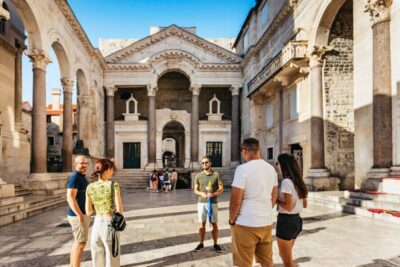

Blue Lagoon Boat Party with DJs, Shots & After Party
Read our review →Browse the lists this tour appears in