
Reviewed · SPLIT TOURS
Walking Tour of Split with a ‘Magister’ of History
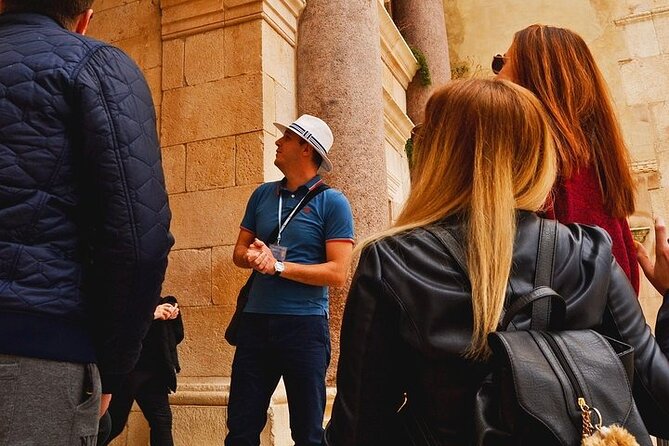
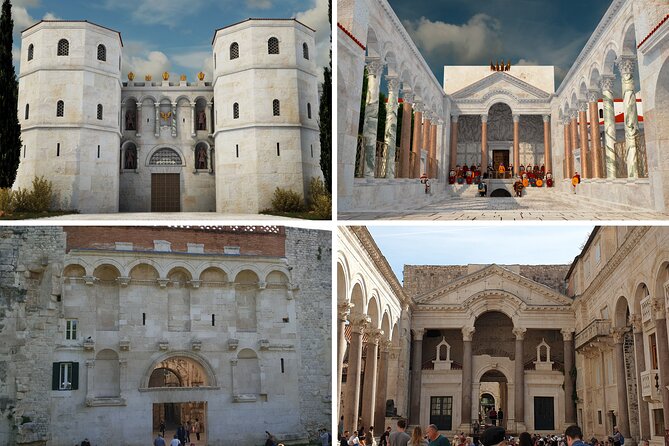
Split’s most useful history lesson takes place on foot, inside a living Roman palace. Toni Šare, a Split-born historian and teacher, connects Diocletian’s retirement home with medieval streets, Venetian palaces, Croatian culture, and modern city life. His 3D reconstructions help you picture the marble, columns, and grand rooms that time has worn away.
I like the clear route from the Riva to Piazza Square, and I like that Toni points out small details you could easily walk past. The tour also works well for different budgets, since you can join a group of up to 18 or upgrade to a private outing. The main drawback is that paid sites are viewed from outside, so you will need separate tickets if you want to enter the cathedral, Temple of Jupiter, or museums.
Key points to know before you book
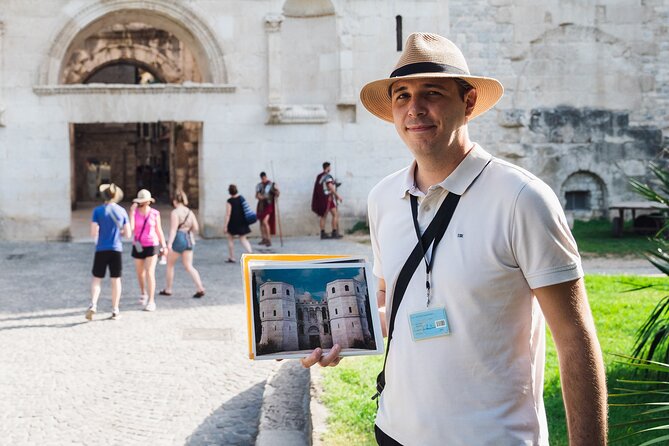
- Toni Šare leads the walk: He is the owner of DiocleSpot Tours, grew up in Split, and brings local as well as academic knowledge to the route.
- The 3D palace images are a major feature: Toni uses his own reconstructions to show how Diocletian’s Palace looked in its Roman prime.
- You see more than Roman ruins: Medieval, Renaissance, Venetian, and early modern buildings all appear along the route.
- The walk lasts about 1 hour 40 minutes: It begins at the Brass Gate and ends at Piazza Square, a useful place for continuing your day.
- Entry tickets are not included: The main explanations happen outdoors, with no museum or paid-site admission built into the price.
- The group can reach 18 people: That keeps the cost moderate, though a private option is available if you want more control over the pace.
Why Toni’s 3D reconstructions change the way you see Split
Diocletian’s Palace can be confusing at first. It is not a quiet ruin set apart from city life. It is a dense old town, with homes, shops, cafés, lanes, churches, and later buildings fitted into Roman walls.
That is why Toni’s visual material matters. At the Riva and inside the palace, he uses 3D reconstructions to show the original plan and decoration. You can compare the surviving stone with an image of the full imperial complex, which makes the remains easier to understand.
This approach gives the walk a useful rhythm. You are not only hearing dates and names. You are looking at a column, gate, wall, or doorway and seeing how it once worked as part of a larger design.
Toni also brings in the later life of the city. Split was not frozen after the Roman period. Medieval residents adapted the palace, noble families built new homes, and Venetian influence shaped later architecture. You get a better sense of how one city kept reusing its past rather than simply preserving it behind glass.
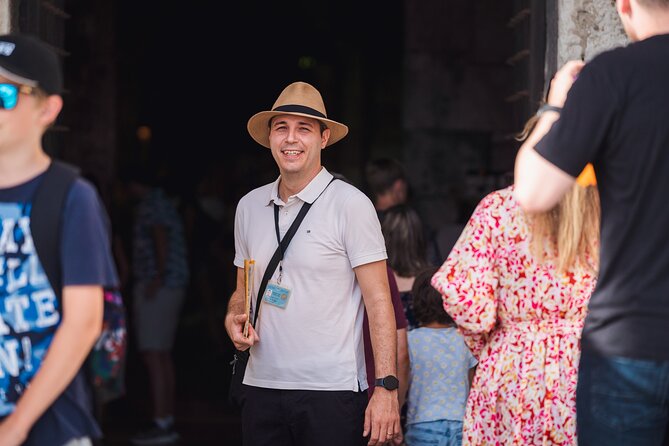
The tour is offered in English. Past participants have especially valued Toni’s ability to explain architecture, religion, politics, language, and local customs without turning the walk into a dry lecture. His enthusiasm is part of the experience, but the real strength is the amount of context he gives you.
More history-led days in Split:
- Split Walking Tour with Professor of History
★ 5.0 · 926 reviews - Split: History and Heritage Walking Tour
★ 4.9 · 650 reviews - Split History and Gastro Small-Group Tour with Food and Drinks
★ 5.0 · 375 reviews
Starting at the Riva and the southern wall
The meeting point is at the Brass Gate, also called Porta Aenea, on the Riva at Obala Hrvatskog narodnog preporoda 22. This is a practical starting place because the waterfront is easy to locate and the southern wall of Diocletian’s Palace is clearly visible from here.
Toni begins with an introduction to the palace using graphic and model representations. Before you enter the old town, you get a sense of what the emperor’s complex was meant to be and how its position by the sea shaped its design.
The Riva is also an important part of present-day Split. It is a social center for local residents, not just a photo stop. Spending about 15 minutes here gives Toni room to place the palace in the life of the modern city.
I like this opening because it prevents the usual first mistake: treating the palace as a collection of unrelated stones. You begin with the whole plan, then move into the details.
The Peristyle, where Roman and modern Split meet
The Peristyle is the central square of Diocletian’s Palace and one of the most important spaces in Split. Here, Roman structures are still visible, but the square is also part of the working old town.
Toni uses his reconstructions to show how much of the original setting has survived and how much decoration has disappeared. That comparison is especially useful at the Peristyle, where the scale of the Roman project is easier to sense than in the narrower lanes.
You spend about 10 minutes here. That is enough for a strong explanation, though anyone fascinated by ancient architecture may wish for extra time to study the stones and take photographs after the group moves on.
The square can be busy, and sound may carry poorly if several groups are gathered nearby. A smaller group helps, and Toni’s maximum of 18 people is reasonable for a walking tour in tight historic spaces.
Saint Domnius and the emperor’s former mausoleum
The Cathedral of Saint Domnius began as Diocletian’s mausoleum. Its continued use as a cathedral gives you one of the clearest examples of how Christian Split adapted a Roman imperial building.
Toni explains the original purpose of the structure, the bell tower, and the change from imperial tomb to Christian place of worship. The tour does not enter the cathedral, so you will hear the story from outside and will need a separate admission ticket if you want to see the interior.
That limitation is worth noting before booking. The explanation is included, but the entry itself is not. If you plan to visit inside, you can return later and use the tour’s background to read the building with greater care.
The stop lasts about 10 minutes. Toni’s focus here is not just on construction. He also explains how changes in religion and power altered the meaning of the building.
More walking tours in Split:
- Split: Old Town and Diocletian Palace Walking Tour
★ 4.9 · 4,727 reviews - Walking Tour of Split and Diocletian’s Palace
★ 5.0 · 2,588 reviews - Krka Waterfalls tour with Trogir Walking tour and Krka panoramic boat cruise
★ 5.0 · 1,659 reviews - Split & Diocletian’s Palace Walking Tour
★ 5.0 · 1,125 reviews
The Temple of Jupiter and Roman construction mistakes
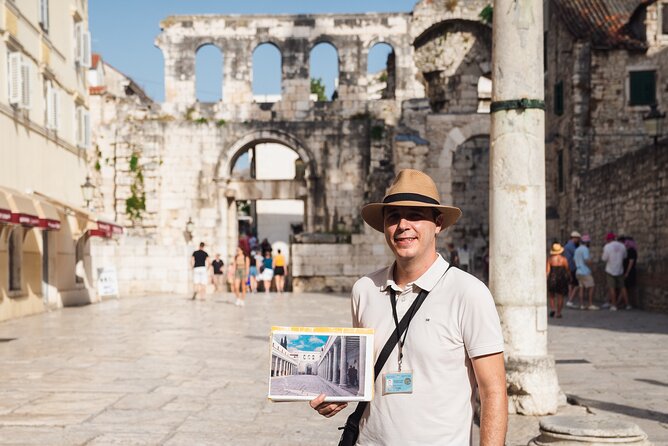
The Temple of Jupiter is presented as one of the best-preserved late Roman temples in the city. Toni points out construction anomalies and mistakes that the Roman builders made.
That detail adds welcome humor and humanity. Ancient buildings can seem perfect when you see only the finished façade. Looking at errors and odd features reminds you that real people built them, adjusted plans, and solved problems as they went.
You do not enter the temple. Toni covers the relevant points from outside, and admission is not included. The stop lasts around 15 minutes, giving him time to explain both the temple and its place in the palace complex.
For visitors who like small discoveries, this may be one of the better stops. It shifts your attention from famous monuments to the evidence left by ordinary construction work.
The Silver Gate and the surviving Roman road
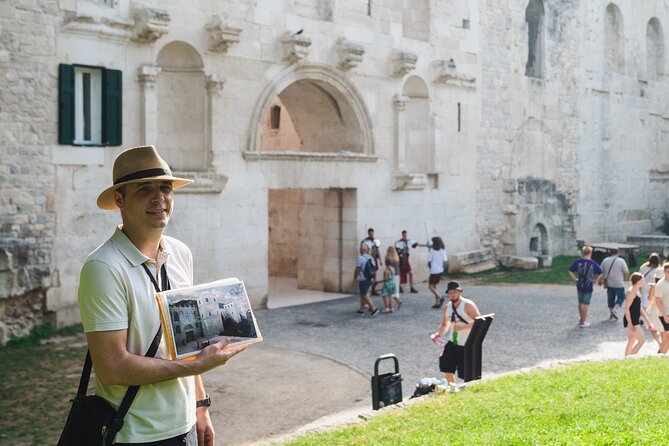
At the Eastern, or Silver, Gate, Toni shows you one of the strongest views of the palace layout. The cathedral is on one side, the gate on the other, and below is the only preserved section of the original Roman road.
This short, five-minute stop works as a visual pause. You can see how the palace entrances, streets, and major buildings related to one another. It is also a good place to understand the defensive role of the walls.
Because the stop is brief, you may want to ask questions while you are there rather than waiting until later. The tour moves at a steady pace, and the route includes many small details beyond the main monuments.
Grgur Ninski and the meaning of Croatian language
The statue of Grgur Ninski is a recognizable Split landmark. Toni explains what the figure represents and why he matters to Croatian language and culture during the early medieval period.
This is a useful change of subject after several Roman stops. It shows that Split’s story did not end with Diocletian. Language, religion, and medieval identity also shaped the city and the country around it.
The stop takes about five minutes. You will have time to see the statue and hear the main explanation, but it is not intended as a long art-history talk.
The Vestibule and Diocletian’s private residence
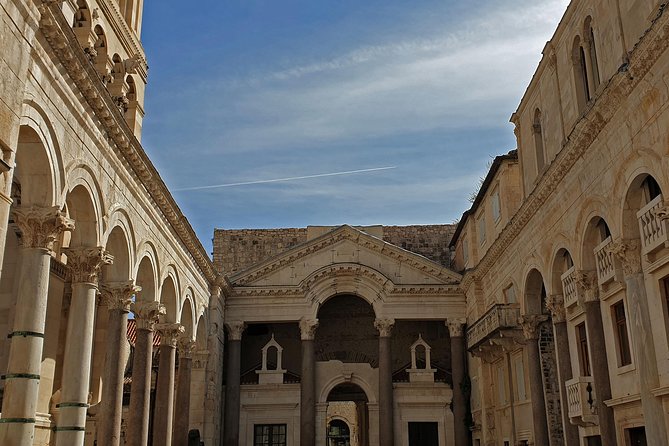
The Vestibule was the ancient entrance to Diocletian’s private residence. From here, Toni leads you around the remains connected with the emperor’s personal area.
The distinction between public and private space helps explain how the palace functioned. Diocletian was not simply building a fortress or a country house. He was creating a carefully planned residence with ceremonial areas, religious buildings, defenses, and spaces for daily life.
The stop lasts around 10 minutes. Toni’s reconstructed images are particularly useful here, since surviving walls alone can make the original rooms difficult to picture.
The route then passes several noble palaces. These buildings show how wealthy families later made use of the Roman city. You also see Renaissance and early modern details, along with examples of Venetian influence.
Noble palaces, City Museum courtyard, and later Split
One of the pleasant surprises of this walk is its attention to later architecture. Split is famous for the Roman palace, but noble residences from later centuries are part of the same streetscape.
The City Museum of Split occupies one of the best-preserved Renaissance noble palaces. The tour does not enter the museum, but Toni visits its courtyard so you can see the palace from within.
This is where his explanation of Venetian history becomes useful. The courtyard and building style give you a visible link to the period when Venetian influence shaped local architecture and urban life.
You do not need to be an architecture specialist to appreciate this section. Toni points out the features that matter, then places them in the city’s wider story. If you only focus on Roman remains, you miss how Split actually developed.
Game of Thrones locations along the way
If the group is interested, Toni points out Game of Thrones filming locations encountered during the walk. The route also passes the series’ fan shop.
This is handled as an optional extra rather than the main subject. That makes sense. Fans can get location notes and connections to the show, while visitors more interested in archaeology, architecture, or local history can keep their attention on the older city.
The filming references are best seen as a bonus. They do not replace the main historical route, which remains focused on the palace and Split’s successive periods.
The Golden Gate and the northern wall
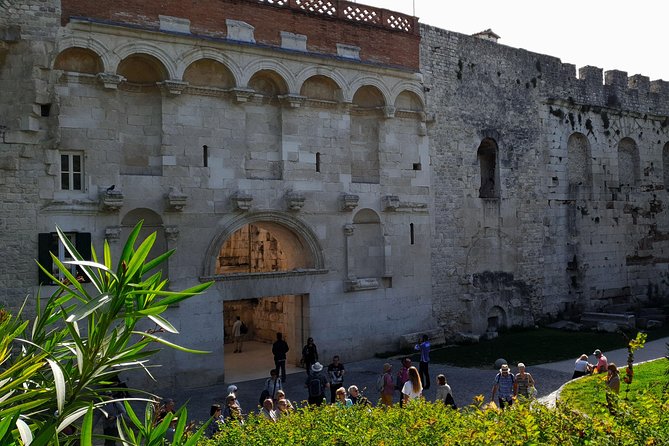
The Golden Gate is the palace’s main entrance and the best-preserved of its four gates. It is also the most decorated and visually memorable.
From this point, you can see the northern wall and understand how the medieval city reused Roman structures for defense. Later residents removed or altered parts they no longer needed, while keeping other sections in service.
This is a strong stop because it brings several periods together. Roman engineering, medieval defense, and modern city life all appear in one view. Toni’s explanation helps you notice the difference between what was built for Diocletian and what later residents changed.
You spend about 15 minutes here. That gives you time to inspect the gate, follow the wall, and ask questions.
Finishing at Piazza Square and the Old Town Hall
The walk ends at Narodni trg, commonly called Piazza Square or Pjaca. This has been the city’s main square since medieval times.
The 14th-century Old Town Hall and other historic structures surround the square. It is a sensible place to finish because many other parts of central Split are easy to reach from here.
I like the ending because it leaves you oriented rather than stranded beside one isolated monument. You can continue exploring, find a café, return to a site you want to study, or use the square as a reference point for the rest of your stay.
The route from the Riva to Piazza Square is about 1 hour 40 minutes to 1 hour 50 minutes. It is long enough to give you a solid introduction, but short enough to fit into a morning or evening plan.
Price, group size, and the best time to go
At $34.83 per person, the tour is priced above a casual free walk but below many private history tours. The value comes from the guide’s special material, the local perspective, and the range of periods covered in a short time.
You are paying for interpretation, not admission tickets. Since the cathedral, Temple of Jupiter, museums, and other paid sites are not entered, budget separately if you want to go inside them later.
The group limit is 18 people. That is not a private experience, but it is small enough for questions and for moving into narrow spaces. A private upgrade may suit you if your group wants a slower pace or more time on particular subjects.
Timing matters in Split’s summer heat. An evening start can make the walk more comfortable, while a morning tour gives you the rest of the day to revisit places that catch your attention. Several people have also found it useful to take the tour early in their stay, then return to the palace with a better sense of what they are seeing.
The tour requires good weather. You can cancel for a full refund up to 24 hours before the start time. If poor weather forces cancellation, you are offered another date or a full refund.
Who will get the most from this walk
I would choose this tour if you want the story behind the stones. It suits anyone interested in Roman architecture, medieval Croatia, religion, language, Venetian influence, or the way old buildings remain part of daily life.
It is also a good first activity in Split. The route gives you a map in your head, and Toni’s practical recommendations can help you decide where to spend more time afterward.
You may want something else if your main goal is entering monuments or visiting museums. This tour stays outside paid sites, so it is better as a historical orientation than as a ticketed sightseeing package.
It also suits people who enjoy questions and conversation. Toni’s approach includes cultural and political context, and he is willing to answer questions after the formal walk. The experience is less suited to someone who wants only quick photo stops with minimal explanation.
Should you book Toni’s Split history tour?
Book it if you want to understand how Split became a city rather than simply collect photographs of Roman ruins. Toni Šare’s local background, teaching experience, personal reconstructions, and enthusiasm give the walk a clear purpose.
The strongest reasons to go are the 3D images, the attention to small architectural details, and the way the route moves from Roman imperial life through medieval, Renaissance, Venetian, and modern Split. The main tradeoff is simple: you see paid attractions from outside and must pay separately for entry.
For the best value, take it near the start of your stay, choose a cooler morning or evening time, and keep the rest of your day open for returning to the places that interest you most.
FAQ
Where does the walking tour begin?
It begins at the Brass Gate, also called Porta Aenea, at Obala Hrvatskog narodnog preporoda 22 in Split.
Where does the tour end?
The tour ends at Narodni trg, known as Piazza Square or Pjaca, in the center of Split.
How long does the tour last?
The walk lasts approximately 1 hour 40 minutes to 1 hour 50 minutes.
Who leads the tour?
The guide is Toni Šare, owner of DiocleSpot Tours.
Is the tour offered in English?
Yes. The tour is offered in English.
Are entrance tickets included?
No. The tour does not enter museums or paid sites. Admission to places such as the Cathedral of Saint Domnius and the Temple of Jupiter is not included.
How large is the group?
The group can include a maximum of 18 people. A private tour upgrade is also available.
Can I cancel the booking?
You can cancel up to 24 hours before the start time for a full refund. If poor weather causes the tour to be canceled, you are offered another date or a full refund.
Just added around Split
- From Trogir, Seget, Okrug: Krka Waterfalls & Šibenik Culture Tour★ 5.0 · 10 reviews
- Krka Waterfalls & Primošten from Trogir, Seget, Čiovo & Kaštela★ 5.0 · 18 reviews
- Island Hopping Boat Excursion with Lunch (Trogir,Blue Lagoon, Šolta)★ 3.5 · 6 reviews
- From Split & Trogir: ATV Quad Tour on Island Čiovo★ 5.0 · 21 reviews
- Slatine – Island Hopping Excursion (Trogir/Blue Lagoon/Shipwreck)★ 4.0 · 24 reviews
- Split: Blue Lagoon Boat Trip with Lunch, Wine and Snorkeling★ 5.0 · 3 reviews
- Split Sunset Stand Up Paddle Tour★ 5.0 · 16 reviews
- Split: Sunset Guided Kayaking Tour★ 4.8 · 71 reviews
Split Tours, compared.

Krka Waterfalls Trip with Boat Cruise and Swimming
Read our review →

Blue cave, Mamma Mia and Hvar, 5 islands speedboat tour
Read our review →
Blue Cave, Mamma Mia, Hvar and 5 Island Tour
Read our review →
Blue Lagoon & 3 Islands Cruise with Lunch from Split
Read our review →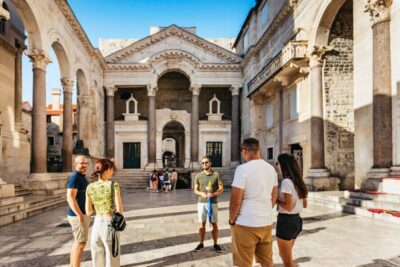

Blue Lagoon Boat Party with DJs, Shots & After Party
Read our review →Browse the lists this tour appears in