
Reviewed · SPLIT TOURS
Split: Diocletian Palace & Old Town Guided Walking Tour
Diocletian’s Palace is not a fenced-off ruin. It is Split’s town center, with cafés, homes, shops, and narrow lanes built into a Roman imperial complex. This 50-minute walking tour gives you a brisk introduction to that unusual mix before the heat and crowds wear you down.
I like the clear route through the Peristyle and four ancient gates, and I like the guides’ habit of adding useful city tips after the main history lesson. Ina, Nataša, Tin, and Darko are repeatedly praised for making the past easy to follow. The tradeoff is simple: at $17, you get a smart overview, not a slow archaeological study or a full visit to every interior.
Key points at a glance

- A Roman palace that became a city: See how Split grew inside and around Emperor Diocletian’s 4th-century residence.
- The Peristyle is the visual centerpiece: This grand courtyard links the palace’s imperial past with modern Split.
- Four original gates shape the walk: Pass through the Bronze, Silver, Golden, and Iron Gates.
- Local guides add practical context: Ina, Nataša, Tin, and Darko are praised for clear stories, humor, and helpful suggestions for the rest of your stay.
- Short enough for a hot day: The compact route works well for a first look, families with young children, and visitors making a brief stop.
- Expect old stone underfoot: Comfortable shoes, water, and care on uneven cobbles matter more than fancy gear.
Why Diocletian’s Palace feels different from other ruins

The first thing to understand is that Diocletian’s Palace is not simply a monument you visit and leave behind. It forms the core of Split’s Old Town. Roman walls support later buildings, ancient lanes lead to working businesses, and the palace courtyards still function as public spaces.
That makes a guided walk especially useful. On your own, you can admire the stonework, but it is easy to miss the basic plan of the complex. Your guide explains how an emperor’s retirement residence, built in the 4th century AD, became the framework for a medieval and later Venetian city.
I value this kind of explanation because it turns scattered columns and walls into a readable place. You are not just looking at old stones. You are seeing layers of power, religion, trade, and daily life placed one on top of another.
The tour begins near the Riva, Split’s palm-lined waterfront, at Apodos Travel Agency. Look for the open-top red bus and staff in red or white shirts. They connect you with the guide, so allow a little time to find the correct meeting point, especially if buses or waterfront activity make the area confusing.
More Old Town Walking Tours in Split
- Split: Old Town and Diocletian Palace Walking Tour
★ 4.9 · 4,727 reviews - Diocletian’s Palace and Old Town SMALL GROUP Walking Tour
★ 5.0 · 502 reviews - SPLIT-PRIVATE Walking Tour of Diocletian’s Palace & Old Town
★ 5.0 · 467 reviews
From the Riva into an emperor’s palace
The Riva is a fitting starting point. It gives you a quick sense of modern Split before you turn toward the palace. Cafés and the Adriatic sit on one side, while the Old Town rises directly behind you. The contrast helps explain why Split feels like a lived-in city rather than a museum district.
From there, the group enters Diocletian’s Palace. The route includes sightseeing, photo stops, and a guided walk through the main historic areas. The pace is purposeful. You stop often enough to hear the story and take pictures, but you do not spend long periods examining one wall or inscription.
This is a good format if you have just arrived and want to get your bearings fast. Several guides also give suggestions for places to see and things to do after the walk. That extra local advice can be as useful as the formal history, especially if you have only a day in Split.
The short format also has a limit. If you want lengthy time for photography, shopping, or quiet study, you may feel hurried. You can always return to the places that catch your attention after the tour.
The palace cellars reveal the original plan
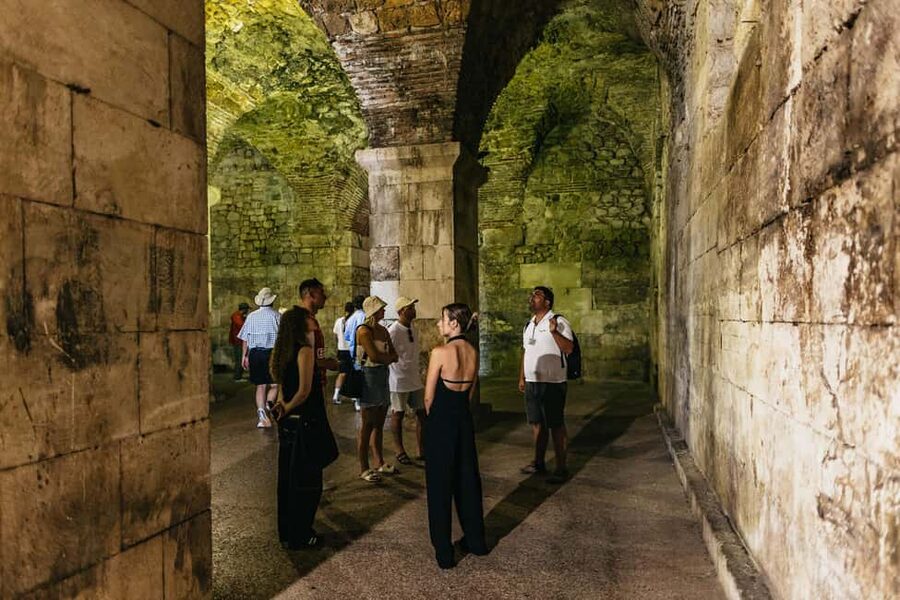
The palace cellars are one of the most useful stops because they show the scale and structure of Diocletian’s project. The lower level reflects the rooms and layout above it, helping you picture the private chambers and ceremonial areas that are harder to read from street level.
The cellars also offer a change from the bright waterfront and open courtyards. Bring water, but expect the route to move between shaded and sunny sections. Your guide’s explanation matters here because the plain stone rooms do not explain themselves.
The tour includes access to the Peristyle courtyard and an exploration of the emperor’s private observatory. These stops help connect the palace’s public and private sides. Diocletian needed grand spaces for ceremony, but he also built a retreat for his later life.
For the best result, listen for the guide’s explanation of how the palace worked as a whole. The value is not just in seeing individual rooms. It is in understanding how entrances, courtyards, religious buildings, and private areas fit together.
The Peristyle puts Roman power on display
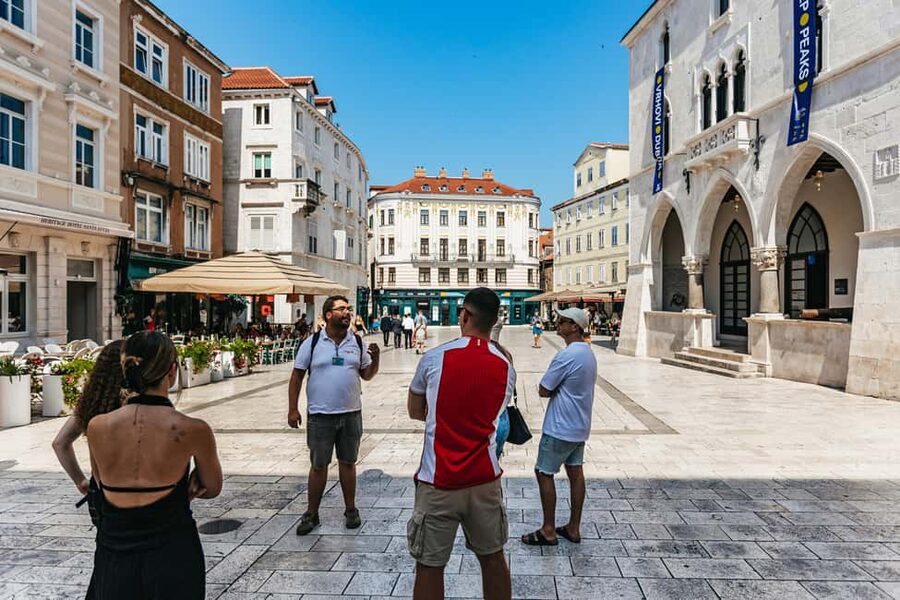
The Peristyle is the tour’s natural centerpiece. It is the grand courtyard where the palace’s Roman identity is easiest to imagine. Columns, stone walls, and surrounding buildings create a strong sense of enclosure, even as modern life continues around them.
Your guide will explain the courtyard’s role and point out how later changes altered the original Roman setting. This is where a good storyteller earns the $17 price. The architecture is impressive, but the human story gives it shape.
The strongest guides on this route are described as clear, funny, and patient with questions. Ina is often singled out for her grasp of archaeology and her lively delivery. Nataša is praised for her art-history background and enthusiasm. Tin is noted for his confidence, humor, and care for people at the back of the group. Darko brings historical interest and local insight.
Guide quality can vary from one departure to another, but the repeated pattern is encouraging: you should expect an informed local presenter rather than a guide who simply recites dates. Groups can reach around 15 people, and at quieter times the walk may be much smaller.
More old town walks in Split:
- Discover The Old Town Split 1.5h walking Small group tour
★ 4.8 · 93 reviews - From Split: Half-Day Tour of Trogir Old Town in Small Group
★ 4.9 · 77 reviews - Split: Old Town and Marjan Park Bike Tour
★ 4.6 · 51 reviews - Split: History Walking Tour of the Old Town
★ 5.0 · 12 reviews
Four gates, four ways into Split’s past
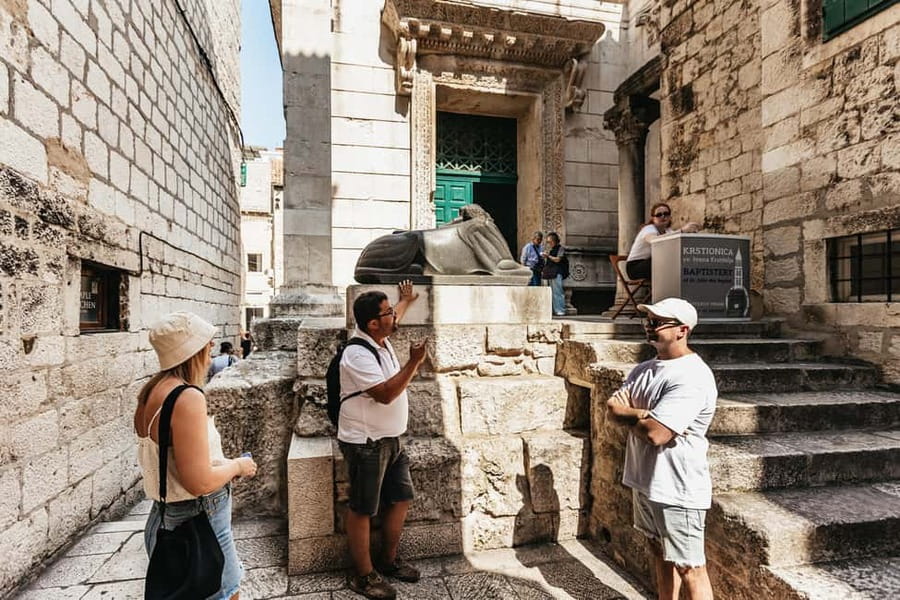
The Bronze, Silver, Golden, and Iron Gates are included in the route. These were the original entrances to the palace, and each gives you a different sense of how the complex connected with its surroundings.
The names are easy to remember, but do not expect four identical photo stops. The gates relate to different sides and functions of the palace. Together, they help you picture the fortified rectangle and understand how people entered, left, and moved through the imperial compound.
The Golden Gate is especially important to the palace’s formal approach, while the other entrances help show the connection between the palace and the sea or surrounding land. Your guide supplies the context as you walk, which is more useful than trying to memorize a diagram before arriving.
These passageways can be narrow and busy. Stay close enough to hear, and do not assume the group will stop in a wide open space. A small audio system is not specifically promised, and one booking noted that a microphone would have helped. If you have difficulty hearing in crowds, stand near the guide.
St. Domnius Cathedral links empire and Christianity
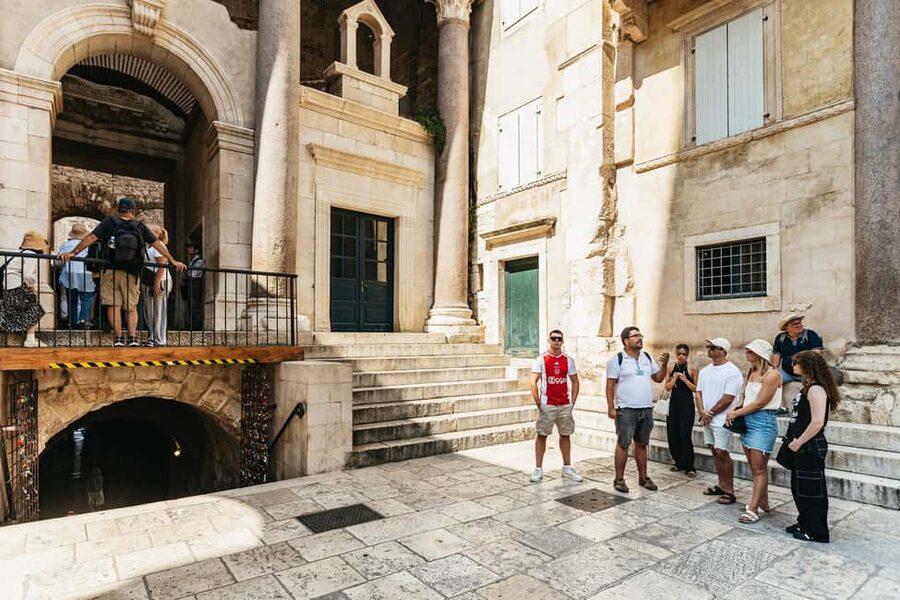
The Cathedral of St. Domnius, or Sv. Duje, occupies a special place in the palace. It began as Diocletian’s mausoleum and later became a cathedral, creating one of the clearest examples of changing religious and political life within the old complex.
This stop gives the tour a strong historical turn. The building is tied directly to the emperor who ordered the palace, yet its later role reflects a different age and faith. That change is central to understanding Split.
The tour description also presents a bell tower climb for views over the city and harbor. Check the exact arrangements when booking, since the listed $17 guided experience does not clearly state that a tower ticket is included. If you do climb, sunglasses and a hat are sensible on a sunny day, while long sleeves can help on windy days.
Do not judge this stop only by the tower view. The more valuable point is the building’s transformation from imperial tomb to cathedral. It shows how Split reused the palace instead of abandoning it.
Medieval lanes, Town Hall, and Fruit Square
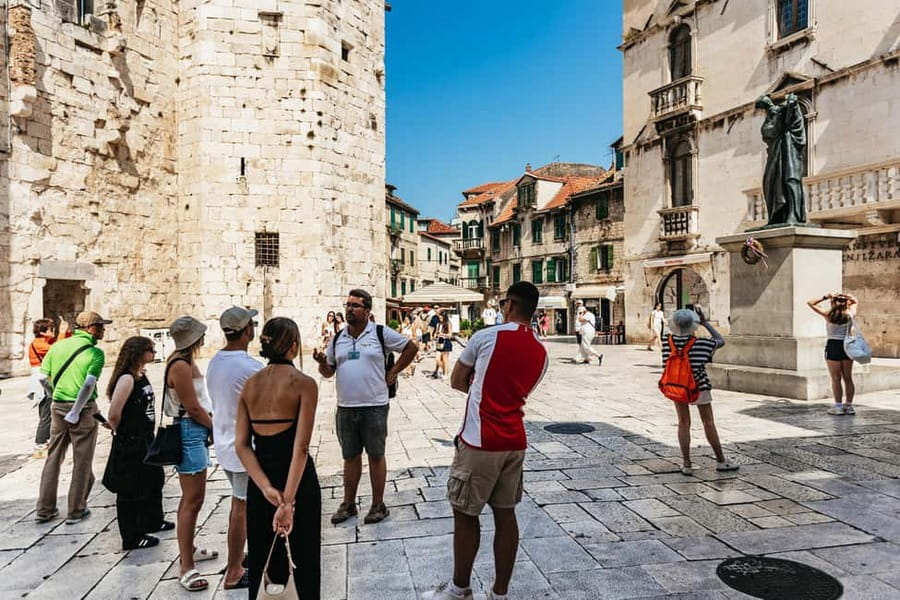
After the Roman core, the walk moves through the maze of Old Town streets. Here the palace becomes less like an ancient site and more like a neighborhood. Medieval details, later stonework, and Venetian influence appear along the route.
The 15th-century Town Hall is one of the less obvious stops, and it helps widen the story beyond Diocletian. Split did not stop developing after the Roman period. Its civic buildings and public spaces reflect later governments and local life.
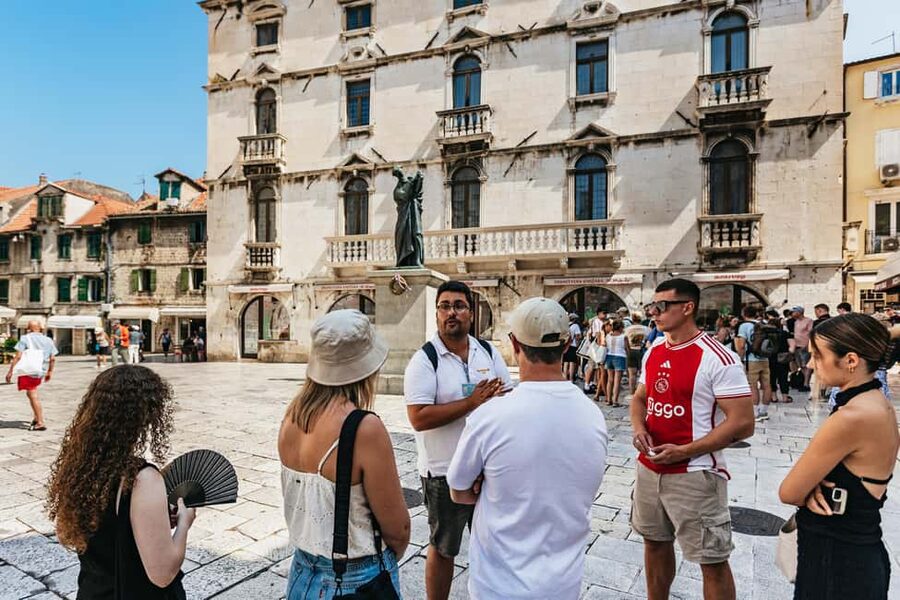
Fruit Square brings another change in mood. Its baroque monuments show how the city’s appearance shifted again over time. This is a good place to notice that Split’s identity is not purely Roman. The Old Town carries several eras at once.
I like this broader approach. A palace-only tour can leave you thinking of Split as a single ancient monument. This route explains why the old center still feels active and social. At the same time, the short duration means you will get an introduction rather than a full study of Venetian architecture or Split’s later history.
What the 50-minute format does well
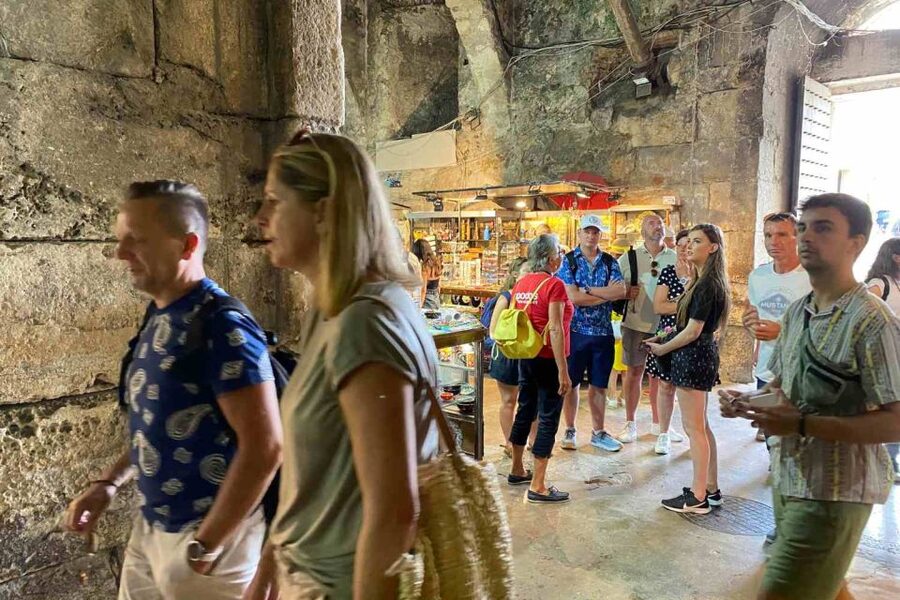
Fifty minutes is a practical length in Split’s summer heat. You get the main sights without committing half a day to a walking group. Families with toddlers have found the duration manageable, and the compact route can also work for visitors using strollers or wheelchairs, although the surface remains uneven and some steps are unavoidable.
The stated requirement is that you can manage uneven and cobblestone ground with about 15 to 30 steps. That makes comfortable walking shoes more important than anything else. The tour is marked wheelchair accessible, and a guide may help with paths that have fewer steps, but you should still confirm your personal needs before booking.
The route is also useful at the start of a Split stay. You learn the basic layout, then can return to the places that interest you. A late tour may offer softer light and a different mood, while a daytime departure gives you clearer views and a stronger sense of the busy town center.
The downside is that the schedule leaves little room for lingering. If you want to climb the bell tower, explore the cellars at length, or browse the Old Town shops, plan extra time afterward.
Is $17 good value for Split?
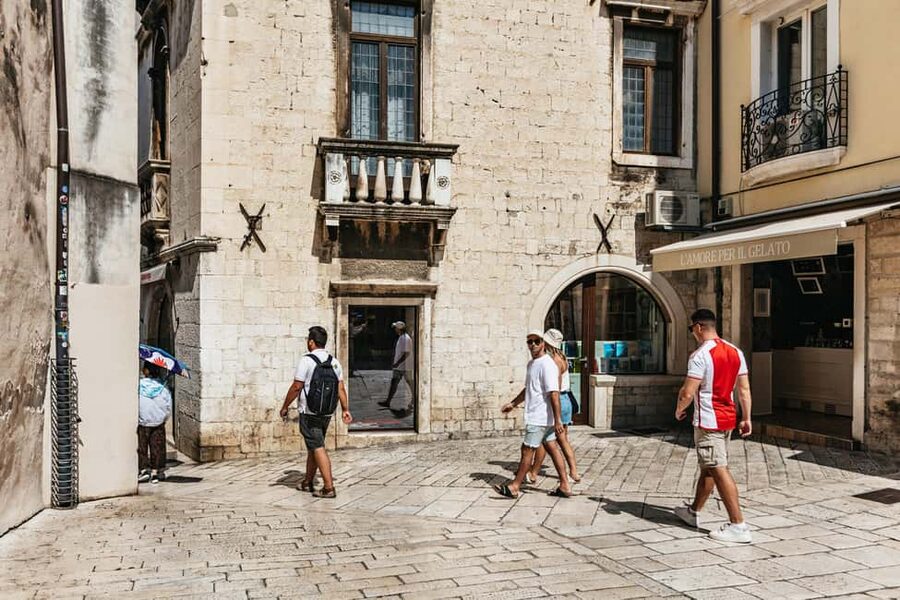
At $17 per person, this is a reasonable purchase if you want orientation, structure, and access to a local guide without spending much of your day. You receive a guided look at the palace and Old Town, the Peristyle, the four gates, the private observatory, the Town Hall, and Fruit Square.
The price does not cover meals, drinks, transportation to the meeting point, souvenirs, or personal spending. Those exclusions are normal for a walking tour, but remember that you must reach the Riva meeting area on your own.
The value depends on your expectations. For a first introduction, $17 is easy to justify. You get the major story in one compact walk, and the guide can answer questions that a sign or map cannot.
If you already know Roman architecture well, or prefer to explore alone, the tour may feel too basic. Its purpose is not specialist detail. It is a clear, lively framework that helps you make sense of Split before exploring at your own speed.
Practical advice for making the walk easier
Wear shoes with a firm sole. Polished stone and cobbles can be awkward, especially around narrow lanes and steps. Bring water, a camera, sunglasses, and a hat for sunny weather.
On windy days, add a long-sleeved layer. The route moves through open courtyards and waterfront areas, so conditions can change quickly.
Arrive at the open-top red bus beside Apodos Travel Agency and look for staff in red or white shirts. The meeting point is easy once you know what to seek, but one person had trouble locating it when the sightseeing bus was delayed.
The tour is offered in English, Spanish, and Italian. Cancellation is free up to 24 hours before the start, and you can reserve now and pay later. Those terms are useful if your Split schedule depends on a ferry, cruise arrival, or changing weather.
Who should book this tour?
I would choose this walk for a first visit to Split, a short port stop, or anyone who wants the main story before exploring independently. It suits couples, families, and solo visitors who prefer a guide but do not want a long, demanding excursion.
It is also a good fit if you enjoy history delivered through anecdotes rather than a long lecture. The strongest guide experiences here combine archaeology, art history, humor, and practical local suggestions.
I would look elsewhere if you want a private, slow-paced archaeological tour, guaranteed bell tower access, or extensive time inside the cathedral. You may also prefer self-guided wandering if you dislike fixed routes and group pacing.
Final verdict
Book this Diocletian’s Palace and Old Town walk if you want a short, affordable introduction with a strong chance of an engaging local guide. The 4.7 rating from 882 bookings reflects its main strengths: clear explanations, friendly presentation, sensible pacing, and guides such as Ina, Nataša, Tin, and Darko who make questions welcome.
The walk will not cover every corner of Split, and you should not expect every entrance or tower activity to be included in the $17 price. But as a first step into the city, it gives you the essential map: Roman palace, medieval streets, cathedral, Venetian touches, and a town still living inside the old walls.
FAQ
Where does the tour start?
It starts at Apodos Travel Agency near Split’s Riva promenade. Look for an open-top red bus and staff wearing red or white shirts, who will connect you with the guide.
How long does the tour last?
The advertised duration is 50 minutes. The palace portion is described as a guided walk lasting about one hour in the itinerary details, so check the selected departure for the exact timing.
What is the price?
The price is $17 per person.
Which languages are available?
The tour is offered in English, Spanish, and Italian.
Is Diocletian’s Palace included?
Yes. The guided walk covers Diocletian’s Palace and Split Old Town, including the Peristyle courtyard, palace cellars, private observatory, and four ancient gates.
Does the tour visit the four palace gates?
Yes. The route includes the Bronze, Silver, Golden, and Iron Gates.
Is St. Domnius Cathedral included?
The tour describes a visit to St. Domnius Cathedral, formerly Diocletian’s mausoleum. It also describes a bell tower climb, but the supplied details do not clearly confirm whether a tower ticket is included in the $17 price.
Is the tour wheelchair accessible?
The activity is marked wheelchair accessible. You must still be able to manage uneven cobblestones and approximately 15 to 30 steps, although guides may help find routes with fewer steps.
What should I bring?
Bring comfortable shoes, water, and a camera. Sunglasses and a hat are recommended on sunny days, while long sleeves are useful on windy days.
Can I cancel or pay later?
You can cancel up to 24 hours in advance for a full refund. The reserve-now, pay-later option lets you book without paying immediately.
More Walking Tours in Split
- Walking Tour of Split and Diocletian’s Palace
★ 5.0 · 2,588 reviews - Krka Waterfalls tour with Trogir Walking tour and Krka panoramic boat cruise
★ 5.0 · 1,659 reviews - Split & Diocletian’s Palace Walking Tour
★ 5.0 · 1,125 reviews - Walking Tour of Split with a ‘Magister’ of History
★ 5.0 · 1,122 reviews
Just added around Split
- From Trogir, Seget, Okrug: Krka Waterfalls & Šibenik Culture Tour★ 5.0 · 10 reviews
- Krka Waterfalls & Primošten from Trogir, Seget, Čiovo & Kaštela★ 5.0 · 18 reviews
- Island Hopping Boat Excursion with Lunch (Trogir,Blue Lagoon, Šolta)★ 3.5 · 6 reviews
- From Split & Trogir: ATV Quad Tour on Island Čiovo★ 5.0 · 21 reviews
- Slatine – Island Hopping Excursion (Trogir/Blue Lagoon/Shipwreck)★ 4.0 · 24 reviews
- Split: Blue Lagoon Boat Trip with Lunch, Wine and Snorkeling★ 5.0 · 3 reviews
- Split Sunset Stand Up Paddle Tour★ 5.0 · 16 reviews
- Split: Sunset Guided Kayaking Tour★ 4.8 · 71 reviews
Split Tours, compared.

Krka Waterfalls Trip with Boat Cruise and Swimming
Read our review →

Blue cave, Mamma Mia and Hvar, 5 islands speedboat tour
Read our review →
Blue Cave, Mamma Mia, Hvar and 5 Island Tour
Read our review →
Blue Lagoon & 3 Islands Cruise with Lunch from Split
Read our review →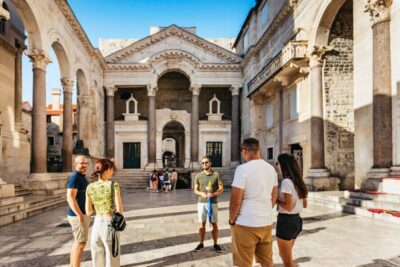

Blue Lagoon Boat Party with DJs, Shots & After Party
Read our review →Browse the lists this tour appears in