
Reviewed · SPLIT TOURS
Split: History Walking Tour of the Old Town
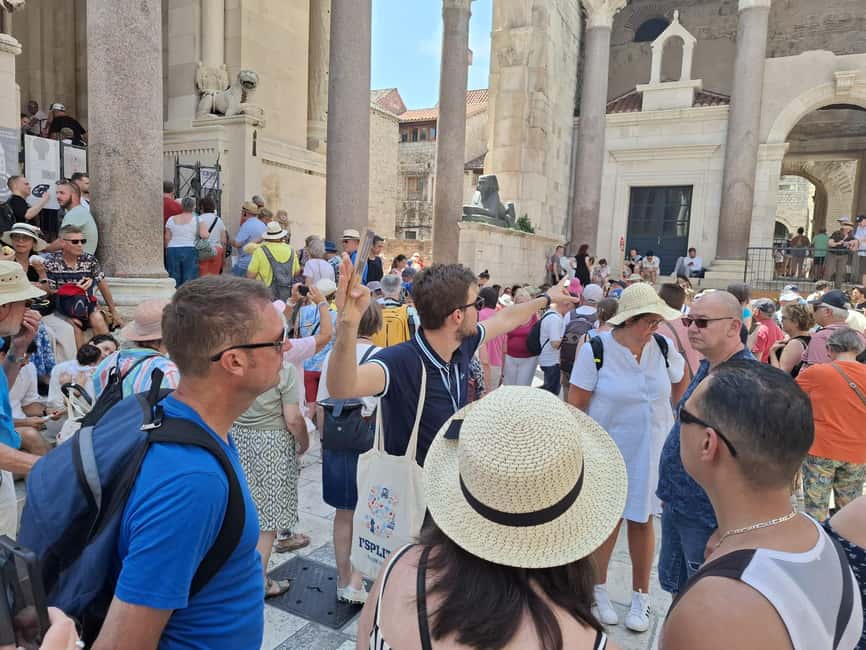
Split’s Old Town is not a museum set apart from modern life. It is an ancient Roman palace still used as the city center, with cafés, shops, homes, church bells, and laundry tucked among imperial stonework. This 90-minute walking tour gives you the basic map and the backstory before you wander off on your own.
I like the route for two clear reasons: the cellars offer cool relief on a hot day, and the guide connects Roman history with daily life in present-day Croatia. The playful riddles, jokes, maps, and photographs used by guides such as Maya, Marko, Marc, and Nina can also make the history easier to remember. The main drawback is that 90 minutes goes quickly, so the tour introduces many places rather than allowing long visits at each one.
Key things to know before you book
- Diocletian’s Palace is still a living city center: You walk through streets and squares where modern Split carries on inside an ancient Roman plan.
- The cellars are a major stop: You see the rooms used in Game of Thrones as the place where Daenerys’s dragons were chained.
- The route covers the essential sights: Golden Gate, Đardin Park, Peristyle, Mausoleum, Jupiter’s Temple, Vestibule, People’s Square, Fruit Square, and the Riva.
- Guiding style is interactive: Expect questions, riddles, jokes, maps, and stories about Emperor Diocletian, Venetian rule, food, and local customs.
- A small group can change the experience: Private tours are available, and some departures may be very small.
- The tour ends with useful local advice: You receive suggestions for food, beaches, ice cream, islands, and the rest of your time in Split.
Why Split’s Roman palace makes a strong walking tour
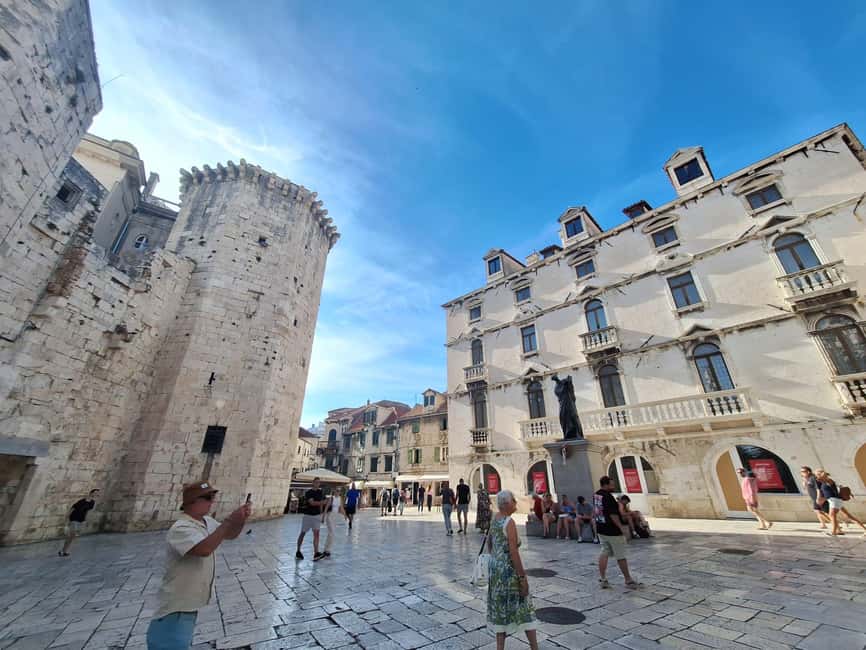
The best way to understand Split is to stop thinking of Diocletian’s Palace as one building. It is a walled Roman complex that became the foundation for the modern city. The old streets, courtyards, gates, churches, and houses fit into a plan created for Emperor Diocletian around 1,700 years ago.
That unusual mix gives the walk its character. You might pass from a busy square into a shadowy stone passage, then emerge beside a café or a bell tower. The guide helps you see the Roman structure beneath the later layers, which is not always obvious when you are exploring alone.
I especially like the way this tour treats history as a story about people, not only dates and monuments. You learn about Diocletian as a powerful ruler and major persecutor of Christians, but also about his habits, including the strange explanation for why he vomited after dinner. The stories are designed to keep you alert rather than force you through a list of names.
More Old Town Walking Tours in Split
- Split: Old Town and Diocletian Palace Walking Tour
★ 4.9 · 4,727 reviews - Split: Diocletian Palace & Old Town Guided Walking Tour
★ 4.7 · 882 reviews - Diocletian’s Palace and Old Town SMALL GROUP Walking Tour
★ 5.0 · 502 reviews
Golden Gate and Đardin Park: starting with the city’s front door
The walk begins at or near the Golden Gate, depending on the option you choose. This is a useful starting point because it gives you an immediate sense of the palace walls and the scale of the old city.
The gate was one of the main entrances into the Roman complex. From here, the guide can explain how people entered the palace and how the fortified structure later became part of Split’s urban fabric. The nearby Đardin Park offers a change of pace before the route moves into tighter streets.
Allow yourself a little patience at the start. The exact meeting point can vary, and the listed timing is an outline rather than a promise that every stop receives the same number of minutes. On a busy day, the guide may need to adjust the pace around other groups and narrow passages.
Peristyle and the Mausoleum: the palace at its grandest
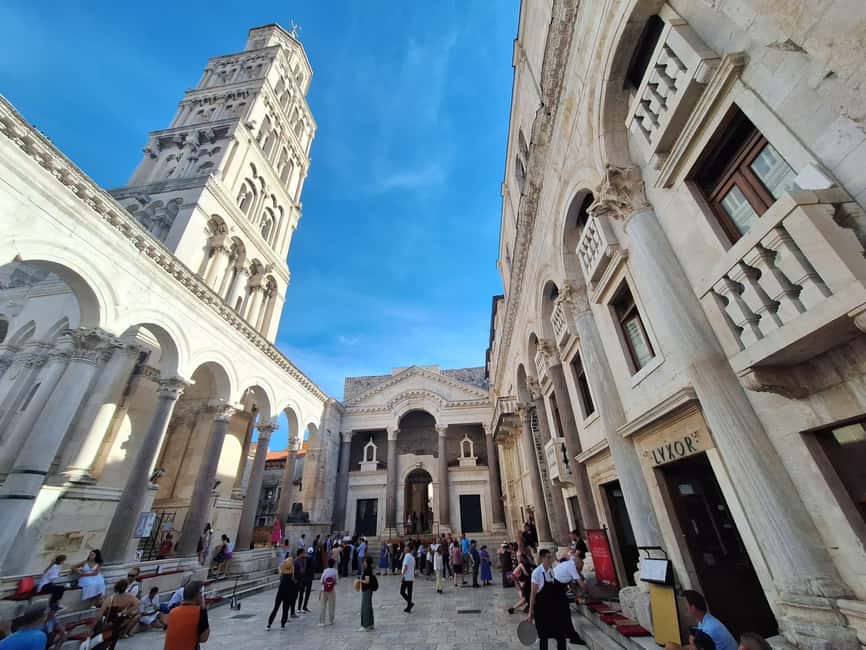
The Peristyle is the visual heart of the walk. This grand Roman courtyard gives you the clearest sense of Diocletian’s power, with the surrounding stone buildings framing the open space. It is the place where the palace feels most like an imperial stage.
The guide explains how the square worked within the palace and points out the relationship between the emperor’s former mausoleum and the rest of the complex. The Mausoleum is now associated with the Cathedral of Saint Domnius, described during the tour as the oldest cathedral in the world. Its bell tower adds a strong vertical marker to a city otherwise dominated by low stone streets.
This is also where the tour’s storytelling style matters. Instead of only naming architectural parts, the guide uses questions and visual material to help you picture how the space functioned. Diego’s guide Maya, for example, used a folder with photographs and maps, a useful aid when Roman and medieval layers begin to blur together.
You should expect people and activity here. Peristyle is one of Split’s most photographed spaces, so you may not get a quiet view. The guide’s ability to find a workable spot and explain the sight without blocking the flow of the square is part of the value.
Jupiter’s Temple and the headless Sphinx
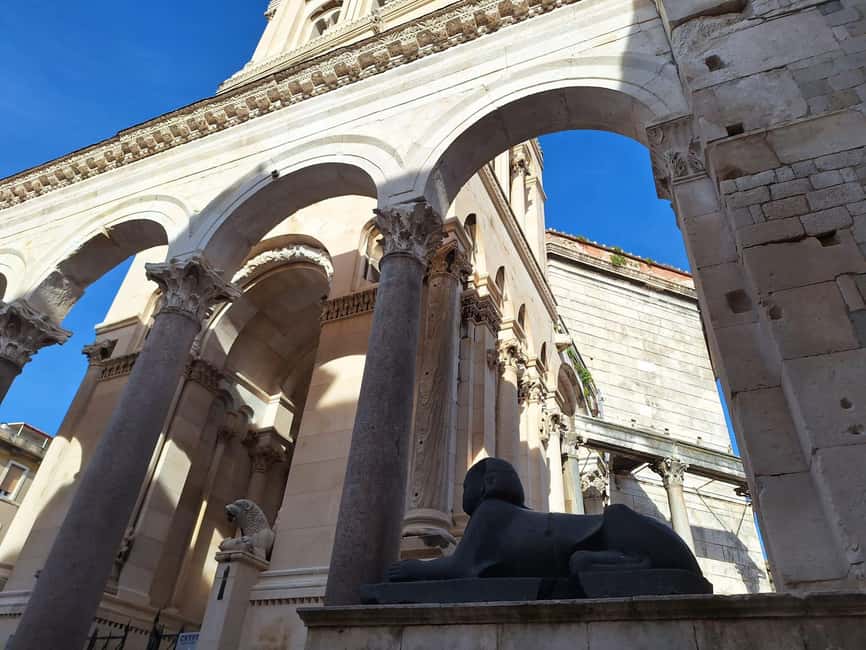
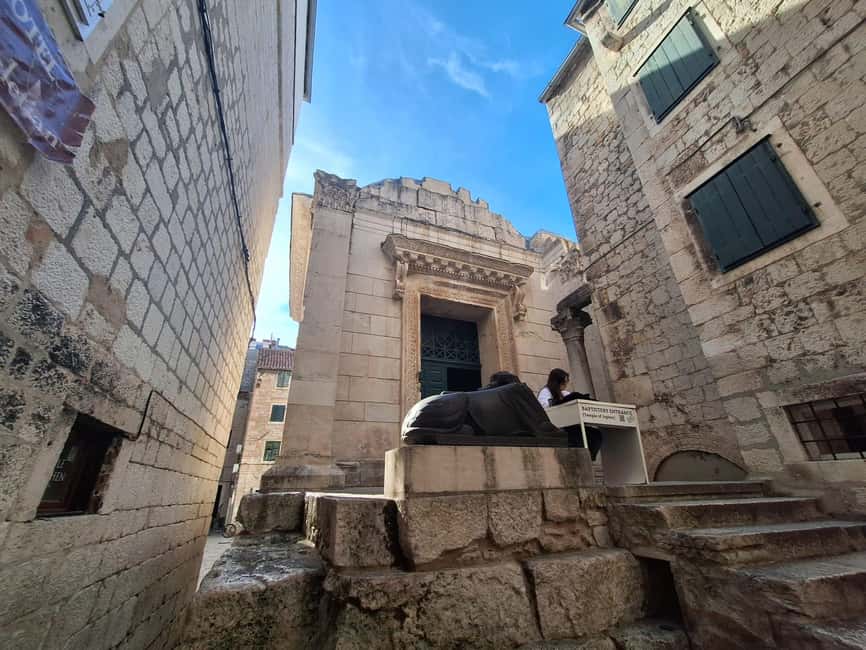
The short stop at Jupiter’s Temple packs in a surprising amount. The temple is tied to the Roman religious world of the palace, while the nearby Egyptian sphinx adds a striking reminder that Diocletian’s reach and tastes extended well beyond the Adriatic.
One of the tour’s memorable questions concerns the headless Sphinx guarding the entrance to Jupiter’s Temple. The answer gives you a glimpse into the changing religious and political forces that reshaped Split after the Roman period. The guide may also ask you to imagine replacing your head with the Sphinx’s and solving the Sphinx’s riddle, an odd but effective way to make the monument stick in your memory.
The stop itself is brief, listed at about five minutes, so do not expect a full archaeological lecture. You get the essential explanation and a chance to look closely before moving on.
More old town walks in Split:
- SPLIT-PRIVATE Walking Tour of Diocletian’s Palace & Old Town
★ 5.0 · 467 reviews - Discover The Old Town Split 1.5h walking Small group tour
★ 4.8 · 93 reviews - From Split: Half-Day Tour of Trogir Old Town in Small Group
★ 4.9 · 77 reviews - Split: Old Town and Marjan Park Bike Tour
★ 4.6 · 51 reviews
The Vestibule and the old palace’s human mousetrap

The Vestibule is another compact space with a strong visual effect. Its rounded form and stone construction show how grand entrances were designed inside the palace. The guide uses it to explain movement through the imperial complex and the way the building’s original purpose changed over time.
The route also introduces the palace’s human mousetrap, a nickname that hints at the confusing passageways and controlled entrances within the old structure. That detail makes the palace easier to picture as a secure residence rather than a simple collection of ruins.
The Vestibule can feel crowded, especially when several groups arrive at once. You will get more from the stop if you listen closely to the guide’s position rather than trying to stand in the center. Comfortable shoes help here, as they do throughout the old town.
Diocletian’s Cellars: cool stone and Game of Thrones
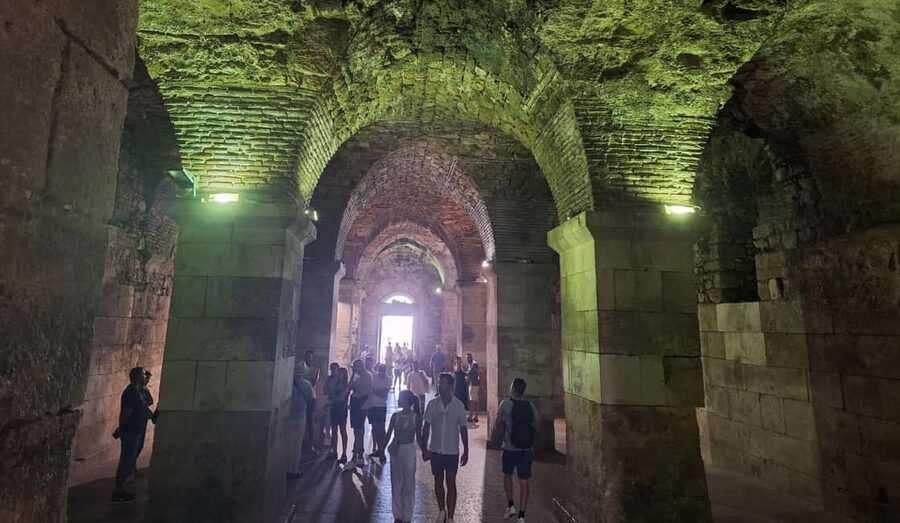
The cellars are one of the strongest parts of the experience. They sit below the palace and provide welcome shade when Split’s summer heat is pressing down. Marko has been praised for guiding groups through the underground rooms at a comfortable pace, allowing the history to unfold without the heat wearing you out.
These spaces also have a modern claim to fame. Game of Thrones fans will recognize the cellars as the place where Daenerys Targaryen’s dragons were chained. The tour also points out the setting associated with the Unsullied fighting the Sons of the Harpy.
You do not need to be a fan of the show to enjoy this stop. The screen connection gives you a quick visual hook, while the older story is the real reason to pay attention. The cellars help you understand the solid base of the palace and how later generations reused Roman rooms.
The underground visit is not a separate attraction with a long free period. It is part of the guided route, and the time is limited. If you want to study every wall or take a detailed set of photographs, you will need to return later on your own.
People’s Square and Fruit Square: from empire to everyday Split

After the Roman core, the walk moves into People’s Square, also known as Pjaca. This helps you see how Split expanded and changed beyond the original palace layout. The square links the old town’s grand imperial center with its later civic and commercial life.
Fruit Square, or Voćni trg, adds another useful layer. The name points toward the market life that once took place there, and the guide uses the area to discuss local habits and food. I like this shift because it keeps the tour from treating Split as a collection of ancient stones. You get a sense of how the old town still works as part of the city.
The food advice is one of the practical benefits of the final part of the walk. You can ask where to find Dalmatian specialties and what locals eat, rather than choosing a restaurant only because it sits beside a famous monument. The guide also offers suggestions for ice cream, beaches, and ways to spend the rest of the day.
Ending on the Riva with a plan for the afternoon
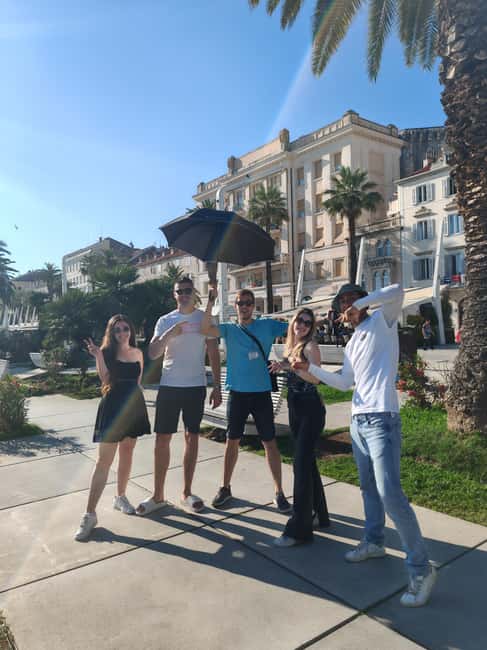
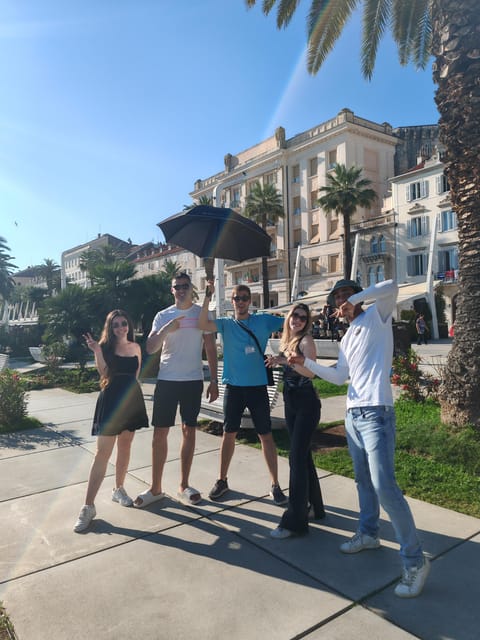
The route finishes at the Riva, Split’s seafront promenade lined with tall palm trees. This is a satisfying ending because the walk moves from Roman imperial space to the open waterfront and the modern rhythm of the city.
The Riva is also a useful orientation point. From here, you can decide if you want food, a swim, a longer look at the old town, or a trip to one of the nearby islands. The guide’s island suggestions are especially helpful if Split is one stop on a longer Croatian trip.
Do not mistake the final stop for a long waterfront outing. The tour ends here after the guided sightseeing, with advice for what to do next. That suits people who want a strong introduction and freedom afterward, but it may disappoint you if you are looking for a half-day tour with extended free time at each sight.
Guide style, languages, and group size
The tour is offered in English and Spanish, and a private group option is available. Pickup can be arranged depending on the booking choice, including a hotel or cruise ship location if you provide the relevant name and street information.
The guides use a lively teaching style. Maya has been noted for clear explanations, humor, maps, and photographs. Nina has been praised for making history fun in a very small group. Marc handled a solo departure with detailed answers, while Marko used riddles and jokes to keep the walk moving.
Those names do not mean you can select a particular guide unless the booking option says so. They do show the range of the guiding approach you can expect: local history, questions, humor, and practical advice rather than a dry recital.
A private tour may be worthwhile if you want to ask many questions or control the pace. At $41 per person, the public tour is fairly priced if you want context for the palace and local recommendations. It is less compelling if you only want to photograph the major sights, since you can see many of them from public streets without paying.
Timing, comfort, and what to bring
The stated duration is 90 minutes. That is long enough to cover the main old-town sights without taking over your day, and short enough to fit before a meal, ferry, beach visit, or evening plan.
Split’s stone streets can be uneven, and the route includes outdoor sections, steps or passages may be encountered within the old town, and an underground cellar visit. Wear comfortable shoes, bring water, and use a hat and sunscreen. The cellars offer shade, but much of the route is outside.
The route may feel warm and crowded in summer. A guide who can find shade and manage the group adds real value, and that practical skill has been part of the praise for this experience. Still, you should not expect every stop to be quiet or spacious.
Free cancellation is available up to 24 hours before the start for a full refund, and you can reserve now and pay later. Starting times and the meeting point depend on the option selected, so check those details before you commit your day.
Who will get the most from this tour?
I would choose this walk for a first visit to Split, especially if you want the old town to make sense before exploring it alone. It suits history fans, Game of Thrones followers, cruise passengers with limited time, and anyone who wants direct advice on food and the next part of a Croatian itinerary.
Families may appreciate the riddles and unusual stories more than a formal lecture. The route also works well for people who want a small-group feel, particularly if a private option is available for their date.
You may want a different activity if your priority is a long archaeological visit, a food-focused tour, or an in-depth look at every cathedral and museum interior. This is a brisk orientation walk. Its strength is the combination of major sights, clear context, local tips, and a few memorable oddities.
Should you book the Split History Walking Tour?
I would book it if you want to understand why Split feels both Roman and thoroughly lived-in. The price is reasonable for a licensed guide, a focused route through the palace, the cellars, and several central squares, plus advice that can improve the rest of your stay.
Book early in your day if possible. You will finish at the Riva with enough time to use the recommendations on food, beaches, ice cream, or islands. Skip it only if you prefer to explore at your own pace and are happy to research the palace’s complicated past yourself.
FAQ
How long is the Split Old Town walking tour?
The tour lasts 90 minutes.
How much does the tour cost?
The listed price is $41 per person.
Which languages are available?
The tour is available in English and Spanish.
Is a private tour available?
Yes. A private group option is available.
Where does the tour begin?
The meeting point can vary depending on the option booked. Pickup may be available, and you can provide a hotel name and street or cruise ship details when requested.
Where does the tour finish?
The walk ends at the Riva. The listed drop-off options are the historical core of Split and Split Riva.
What sights are included?
The route includes the Golden Gate, Đardin Park, Peristyle, Mausoleum, Jupiter’s Temple, Vestibule, Diocletian’s Cellars, People’s Square, Fruit Square, and the Riva.
What should I bring?
Bring comfortable shoes, a hat, sunscreen, and water.
More Walking Tours in Split
- Walking Tour of Split and Diocletian’s Palace
★ 5.0 · 2,588 reviews - Krka Waterfalls tour with Trogir Walking tour and Krka panoramic boat cruise
★ 5.0 · 1,659 reviews - Split & Diocletian’s Palace Walking Tour
★ 5.0 · 1,125 reviews - From Split: Krka Waterfalls Cruise & Trogir Walking Tour
★ 4.7 · 681 reviews
More Historical Tours in Split
- Walking Tour of Split with a ‘Magister’ of History
★ 5.0 · 1,122 reviews - Split Walking Tour with Professor of History
★ 5.0 · 926 reviews - Split: History and Heritage Walking Tour
★ 4.9 · 650 reviews - Split History and Gastro Small-Group Tour with Food and Drinks
★ 5.0 · 375 reviews
Just added around Split
- From Trogir, Seget, Okrug: Krka Waterfalls & Šibenik Culture Tour★ 5.0 · 10 reviews
- Krka Waterfalls & Primošten from Trogir, Seget, Čiovo & Kaštela★ 5.0 · 18 reviews
- Island Hopping Boat Excursion with Lunch (Trogir,Blue Lagoon, Šolta)★ 3.5 · 6 reviews
- From Split & Trogir: ATV Quad Tour on Island Čiovo★ 5.0 · 21 reviews
- Slatine – Island Hopping Excursion (Trogir/Blue Lagoon/Shipwreck)★ 4.0 · 24 reviews
- Split: Blue Lagoon Boat Trip with Lunch, Wine and Snorkeling★ 5.0 · 3 reviews
- Split Sunset Stand Up Paddle Tour★ 5.0 · 16 reviews
- Split: Sunset Guided Kayaking Tour★ 4.8 · 71 reviews
Split Tours, compared.

Krka Waterfalls Trip with Boat Cruise and Swimming
Read our review →

Blue cave, Mamma Mia and Hvar, 5 islands speedboat tour
Read our review →
Blue Cave, Mamma Mia, Hvar and 5 Island Tour
Read our review →
Blue Lagoon & 3 Islands Cruise with Lunch from Split
Read our review →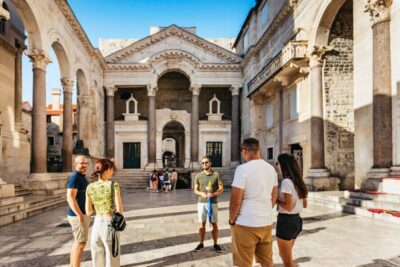

Blue Lagoon Boat Party with DJs, Shots & After Party
Read our review →Browse the lists this tour appears in