
Reviewed · SPLIT TOURS
Split: Walking tour of Split with a ‘Magister’ of History
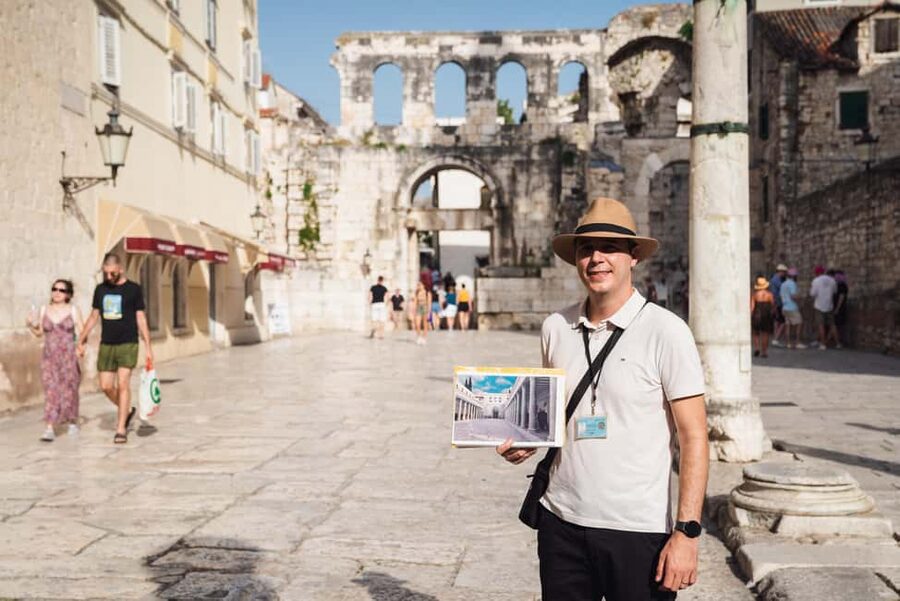
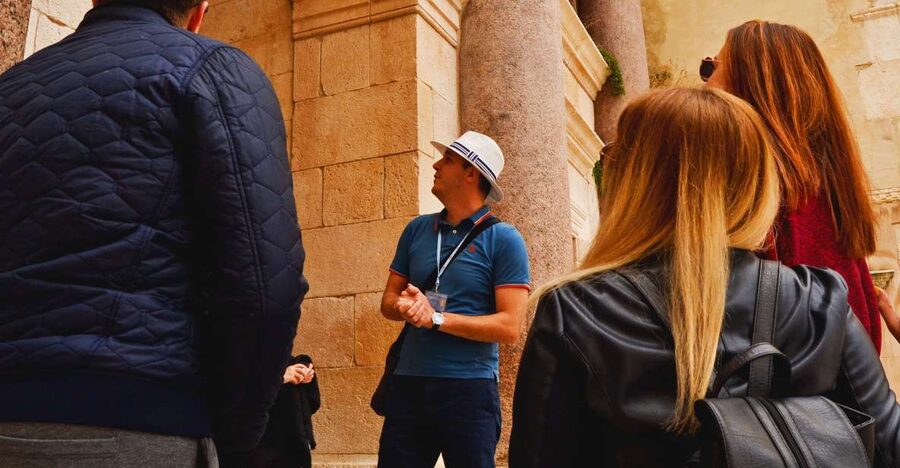
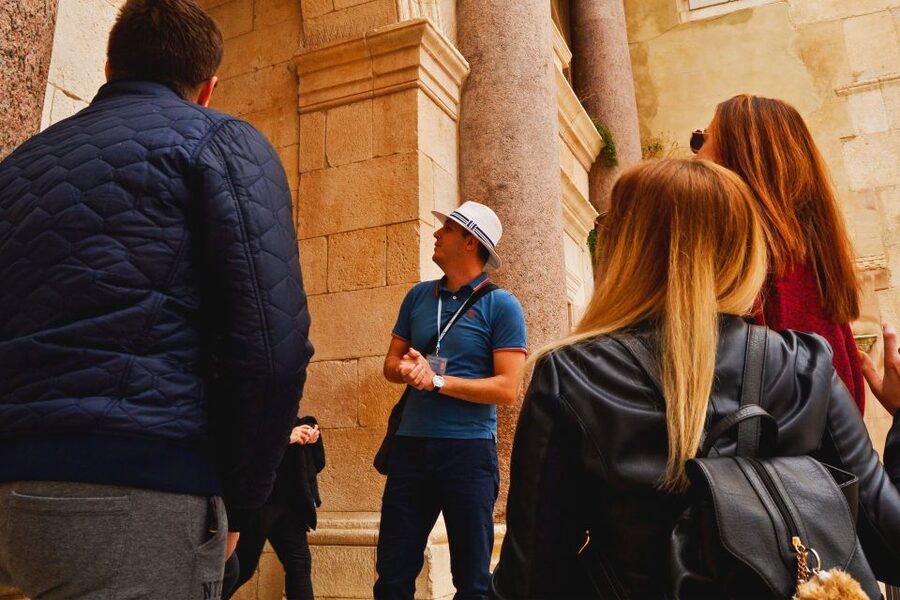
Diocletian’s Palace is not a fenced-off ruin. It is the working heart of Split, with homes, cafés, shops, churches, and narrow lanes built into the old Roman plan. This walking tour makes sense of that living monument with Toni Šare, a Split-born historian and former teacher who uses 3D reconstructions to show what the palace looked like in Roman times.
I like two things here. First, the tour follows Split through several periods instead of stopping with Diocletian: Roman, medieval, Venetian, and modern. Second, Toni encourages questions and is happy to discuss recent Croatian history, local customs, and the way old events still shape Split today. The main consideration is that the tour does not include entry to paid museums or sights, and busy summer crowds can gather around the palace by the end.
Key points at a glance
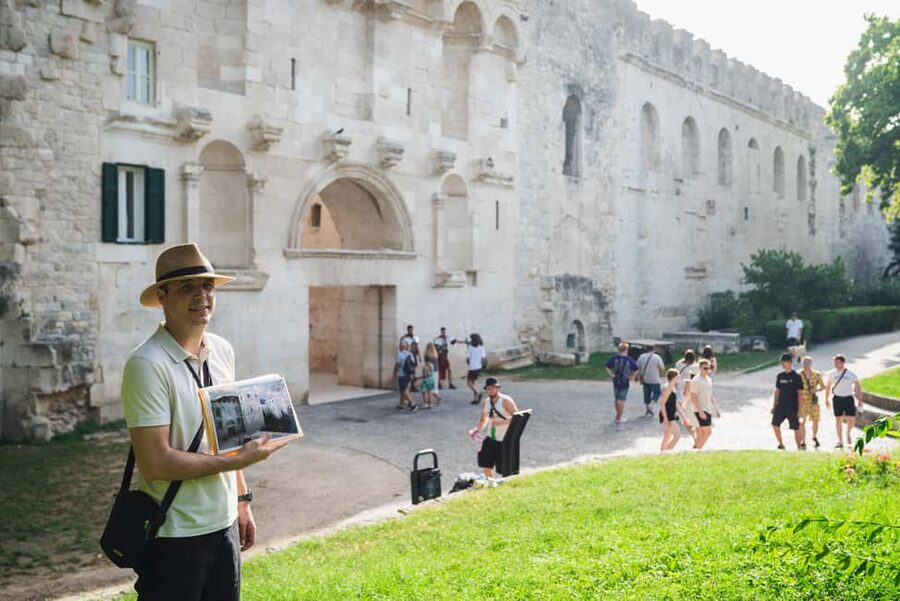
- Toni Šare brings a teacher’s method: His explanations are structured, selective, and open to questions rather than being a list of dates.
- The palace is still a city: You walk through streets and courtyards where modern Split carries on inside the Roman walls.
- Printed 3D images make the ruins clearer: The reconstructions help you picture lost columns, walls, rooms, and decoration.
- The route covers 110 minutes: You move from the Riva and Bronze Gate through the palace to the Golden Gate.
- The history keeps moving forward: Roman, medieval, Venetian, and recent Croatian history all receive attention.
- The price is $33 per person: That is more than a bare-bones group walk, but fair if you want serious explanation and visual aids.
Why this tour helps you understand Split
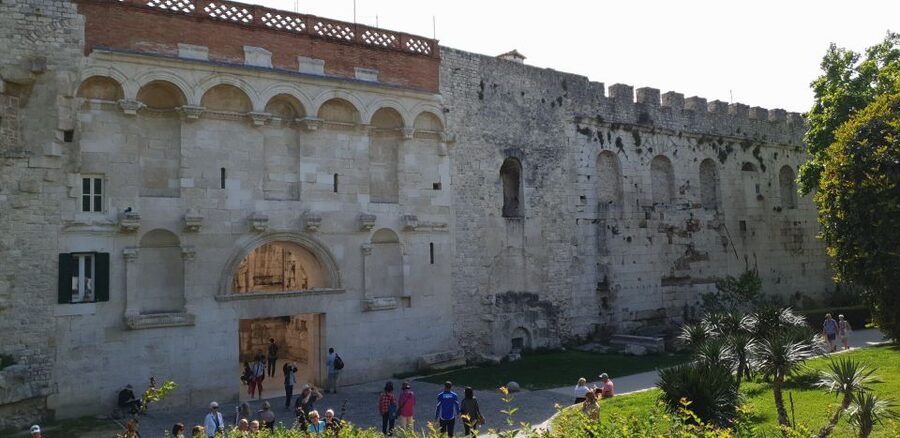
Split can be confusing at first. The old town has no simple boundary between ancient ruins and modern life. A Roman wall may form the back of a house. A medieval doorway may sit beneath a later building. A café table may occupy a space that once served an emperor.
That is why a guide with a clear historical plan matters. Toni begins with the oldest layers and works forward. You are not simply shown a palace and told that it is old. You learn how Diocletian’s residence became the core of Split, how later residents adapted its rooms, and how the city grew around the imperial structure.
The tour is led in English and lasts 110 minutes. That is enough time for a real overview without turning the day into a long march. Toni’s former teaching background is useful here. He focuses on the parts that help you read the city, rather than trying to recite every date connected with Dalmatia.
I also like that the format invites conversation. If you want to ask about Roman government, the Venetian period, Croatia’s recent past, or the meaning of a local custom, you can raise the subject. The experience is built around dialogue, not a one-way speech.
More history-led days in Split:
- Walking Tour of Split with a ‘Magister’ of History
★ 5.0 · 1,122 reviews - Split Walking Tour with Professor of History
★ 5.0 · 926 reviews - Split: History and Heritage Walking Tour
★ 4.9 · 650 reviews
Meeting at the Riva and Bronze Gate
The meeting point is the Bronze Gate, also called the Brass Gate, at Obala Hrvatskog narodnog preporoda 22. Find the Riva promenade first, then walk along the seafront to the southern entrance of Diocletian’s Palace.
This is a sensible starting place. The Riva gives you an immediate view of Split’s relationship with the sea, while the Bronze Gate leads straight into the palace. You do not waste time on transport, and you begin with the contrast that defines the city: a modern waterfront beside an ancient imperial complex.
Take care with the meeting point. The palace has several gates, and the Bronze Gate is the seaside entrance, not the Golden Gate on the north side. Arriving early is wise, especially during the summer, when the promenade can be crowded.
The tour takes place in rain or shine. Bring drinking water, since much of the route is outdoors and shade is not guaranteed at every stop. The guide makes an effort to find shade and quieter corners when possible, but this remains a walking tour through a busy old town.
Entering through the Bronze Gate and Diocletian’s Cellars
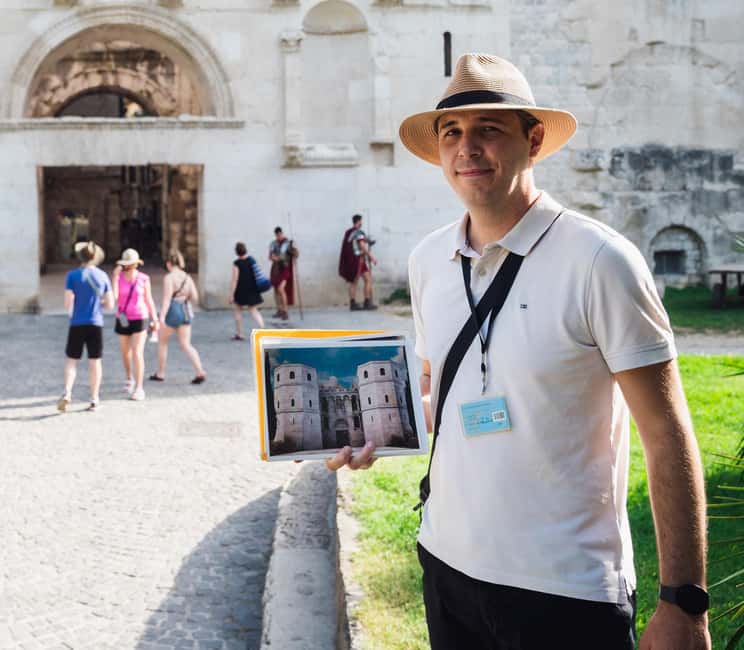
The Bronze Gate is a modest entrance compared with the larger northern gate, but it has an important role in the route. From here, you enter the lower part of the palace and reach Diocletian’s Cellars.
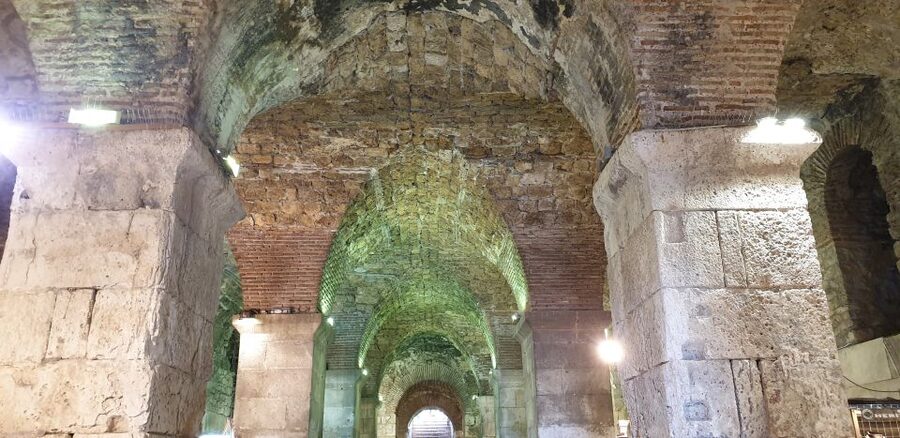
The cellars are particularly helpful for understanding the building above them. Their layout reflects the upper palace, so the lower rooms give you a sense of the imperial residence’s original plan. The tour spends about ten minutes passing through this section, with time to pause for questions.
You do not need an admission ticket to enter Diocletian’s Palace itself. That is an important value point, since the palace is not operated like a single museum. However, the experience does not include paid entry to museums or other ticketed areas. If you want to visit a paid section afterward, plan and pay for that separately.
The cellars can feel more enclosed than the open squares later in the route. If you prefer bright outdoor sightseeing, this portion may seem brief and practical rather than spectacular. Its real value is explanatory: it shows how the Roman structure was arranged and how later Split grew above it.
Reading the palace as a living neighborhood
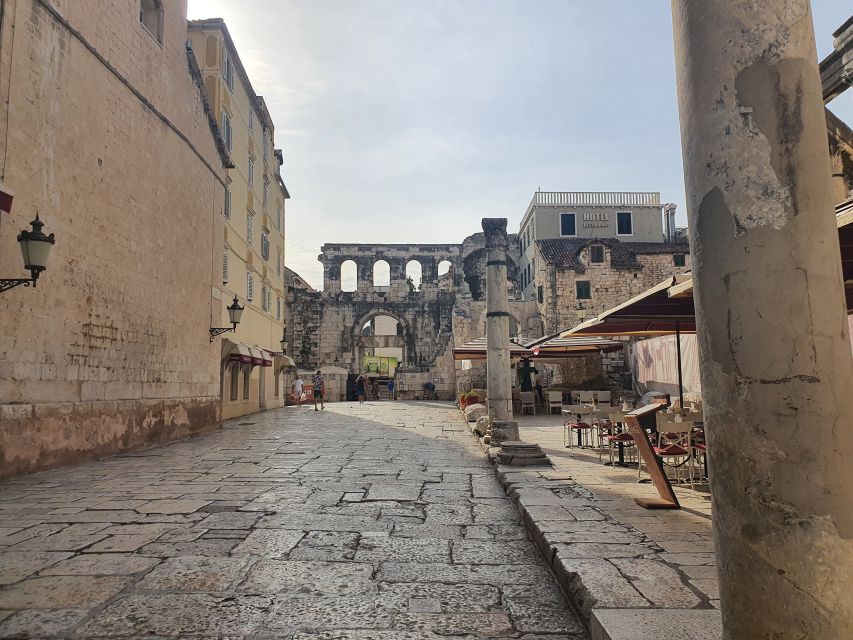
The main palace section takes about an hour and forms the center of the tour. You move through the remains of Diocletian’s private residence, along streets shaped by the original plan, and past medieval houses that have survived within the Roman walls.
This is where the tour’s local viewpoint becomes useful. A guide can point out not only what was built in Roman times, but also how the site changed when people began living inside and around the former imperial complex. The palace is not frozen in one period. It is a record of adaptation.
You should expect uneven stone paving, narrow passages, and frequent interruptions from normal city life. That is part of the appeal, but it also means the route does not feel like a quiet archaeological park. Shops, residents, and other tour groups share the same streets.
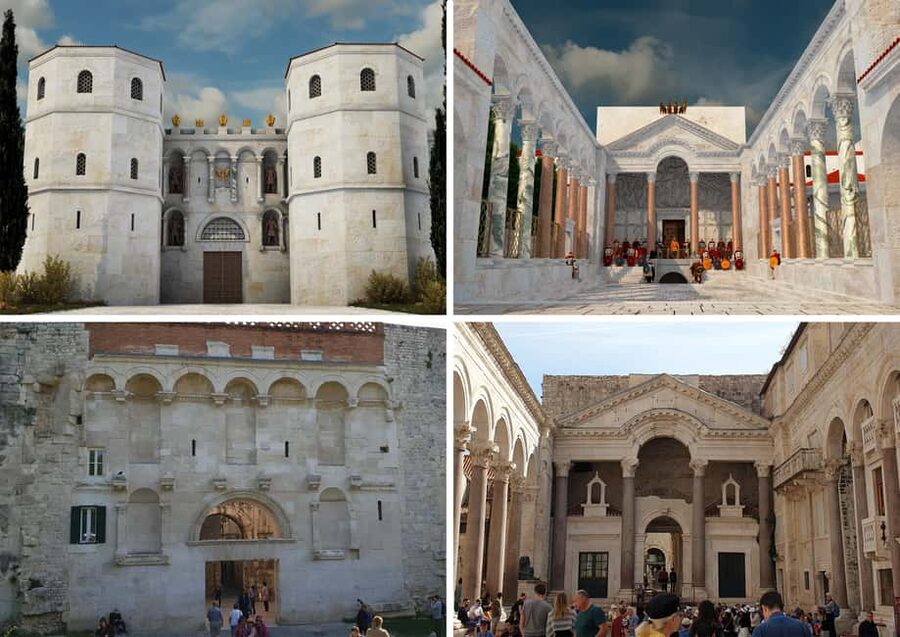
Toni’s visual material adds something that bare ruins cannot. The printed 3D reconstructions show how the palace may have looked when its architecture was complete. Columns, walls, rooms, and decorative features are easier to picture when you can compare the image with what remains on the ground.
The images are not just decoration. They help answer basic questions: What was missing from this wall? How did the palace connect its public and private areas? Why does a fragment of stone matter? For me, this is one of the strongest reasons to choose this tour over a simpler walk with only spoken commentary.
More walking tours in Split:
- Split: Old Town and Diocletian Palace Walking Tour
★ 4.9 · 4,727 reviews - Walking Tour of Split and Diocletian’s Palace
★ 5.0 · 2,588 reviews - Krka Waterfalls tour with Trogir Walking tour and Krka panoramic boat cruise
★ 5.0 · 1,659 reviews - Split & Diocletian’s Palace Walking Tour
★ 5.0 · 1,125 reviews
Peristyle, Vestibule, and the imperial center
The Peristyle is the visual high point of the route. This open square was the palace’s ceremonial center, and today it remains one of Split’s most striking spaces. Its stonework and surviving Roman elements show the scale of the original design, while later buildings press in around it.
The square is also where the layers of Split become easiest to see. Roman structures, later religious use, and modern public life occupy the same space. Toni explains the relationship between these parts, giving you a better sense of why the Peristyle feels both ancient and active.
The Mausoleum of Diocletian, now connected with the Cathedral of Saint Domnius, is nearby. The tour passes by the cathedral rather than entering it. That distinction matters if you are hoping for an interior visit. You can see the building as part of the route, but admission to paid sights is not included.
The Vestibule receives a shorter stop of about five minutes. This circular entrance space once formed part of the approach to the emperor’s private rooms. Its shape and proportions make more sense when Toni’s reconstruction is placed beside the surviving structure.
You may find this part crowded, particularly later in the morning or during peak summer hours. One practical tip is to choose the earliest available start time if you want a calmer experience. By the end of the route, the old core can become noticeably busier.
Triklinij and the palace’s private side
The stop at Triklinij lasts about five minutes and helps shift attention away from the grand public square. This part of the palace relates to the private residential side of the complex, so it adds balance to the better-known ceremonial spaces.
That balance is important. Many quick tours focus on the Peristyle, cathedral, and Jupiter’s Temple, then move on. Here, you get some sense of how the emperor’s residence functioned as a place of living and administration, not only as a dramatic monument.
The visit is still an overview, not a specialist archaeological seminar. If you already have a strong background in Roman architecture, you may want more time at individual structures. For most visitors, though, the short stop works well because the tour has several historical periods to cover.
Jupiter’s Temple, the Silver Gate, and the northern route
The tour passes by Jupiter’s Temple for about five minutes. This gives you another look at the palace’s religious architecture and the way later buildings were fitted into the Roman complex.
The route then reaches the Silver Gate, where there is a short guided stop. Like the Bronze Gate, it helps you understand the palace as a fortified and organized residence with more than one point of access. The gates are not just convenient openings in the walls. They help explain the palace’s orientation and connection with the wider city.
From here, the route continues toward the Golden Gate. A statue of Bishop Gregory of Nin can be seen along the north wall. The statue has become one of Split’s best-known public landmarks, and its location makes sense as part of the transition from the palace to the medieval and Venetian layers beyond it.
This section may feel more like a city walk than a monument visit. That is a benefit if you want to understand Split as a place where history remains part of daily life. It is less suited to you if you want extended time inside every major sight.
The Golden Gate and the story beyond Rome

The tour finishes at the Golden Gate, the large northern entrance to Diocletian’s Palace. The gate provides a clear sense of the complex’s scale and makes a useful endpoint for exploring the old town on your own.
By this stage, the story has moved well beyond the Roman emperor. You have seen how medieval residents used the old palace, how Venetian influence shaped later Split, and how the city reached its current form. Toni can also discuss more recent history if you ask, which gives the tour a wider frame than a standard Roman sightseeing walk.
I value that approach. Split is not only a Roman attraction. Its identity also comes from the centuries after Diocletian, from local families and buildings, from Venetian rule, and from Croatia’s more recent political and cultural experience. You leave with a better basis for exploring the city independently because you understand what changed and what stayed in place.
The Golden Gate is also a practical finish. You can continue through the northern part of the old town, return toward the Riva, or use the new context to revisit the palace without a guide.
How good is the $33 value?
At $33 per person, this is not the cheapest way to walk around Split. You can enter the old core on your own without paying for access to the palace streets. The question is what the extra money buys.
Here, you are paying for 110 minutes with a local historian, a structured explanation across several periods, an open question format, and the printed 3D reconstructions. The visual material is especially useful because much of the palace survives in fragments or altered form.
The price makes the most sense if you are visiting Split for the first time, enjoy history, or want the old town to become legible quickly. It is also a good choice for families with older children. One 12-year-old was able to enjoy the tour, and the teacher-style explanations can hold attention better than a dense academic lecture.
You may not find the cost worthwhile if you already know Diocletian’s Palace well, plan to visit only for photographs, or prefer wandering without a schedule. You also need to budget separately for food, drinks, and any paid museums or monuments you choose to enter.
Free cancellation up to 24 hours before the start and the option to reserve now and pay later make the booking less rigid. Still, the real value depends on using the tour as an introduction, then exploring further on your own.
Who should book this Split walking tour?
I would choose this tour if you want facts with context, not just a fast list of sights. Toni’s local connection matters because he was born and has lived his entire life in Split, and his teaching background shapes the pace and structure.
It suits:
- First-time visitors who want a clear introduction to the old core
- History fans interested in Roman, medieval, Venetian, and modern periods
- Families with older children and teenagers
- Visitors who like asking questions during a tour
- Anyone who wants to see how an ancient palace became a modern city
You should think twice if you need step-free access. The tour is not suitable for wheelchair users, and old stone streets can be difficult for anyone with limited mobility. It is also not suitable for people over 95 according to the activity information.
Wear comfortable shoes, bring water, and consider an early start. The tour runs in all weather, and crowded streets can make the later part less relaxed.
Should you book it?
Book this tour if you want Split’s famous palace to make sense, not just look impressive. The strongest features are Toni Šare’s teaching style, his local knowledge, willingness to answer questions, and the 3D images that show the lost Roman form of the buildings.
Skip it if you want a free, unstructured stroll or if paid interiors are your main goal. For most first visits, though, $33 is a fair price for a focused 110-minute introduction that gives you useful bearings for the rest of your time in Split.
FAQ
How long does the Split walking tour last?
The tour lasts 110 minutes.
What language is the tour in?
The live tour guide conducts the experience in English.
Who guides the tour?
The guide is Toni Šare, a Split-born local historian, former teacher, and holder of a Master’s degree in history.
Where does the tour begin?
The meeting point is at the Bronze Gate, also called the Brass Gate, at Obala Hrvatskog narodnog preporoda 22.
Where does the tour finish?
The tour finishes at the Golden Gate of Diocletian’s Palace.
Does the tour enter Diocletian’s Palace?
The tour walks through Diocletian’s Palace. Entering the palace itself does not require admission, but paid sites and museums are not included.
Are paid museums or monuments included?
No. The tour does not include entry to paid sites or museums.
Are food and drinks included?
No. Food and drinks are not included. You should bring drinking water.
Does the tour run in bad weather?
Yes. The tour takes place rain or shine.
Can wheelchair users join the tour?
No. The activity is not suitable for wheelchair users.
Just added around Split
- From Trogir, Seget, Okrug: Krka Waterfalls & Šibenik Culture Tour★ 5.0 · 10 reviews
- Krka Waterfalls & Primošten from Trogir, Seget, Čiovo & Kaštela★ 5.0 · 18 reviews
- Island Hopping Boat Excursion with Lunch (Trogir,Blue Lagoon, Šolta)★ 3.5 · 6 reviews
- From Split & Trogir: ATV Quad Tour on Island Čiovo★ 5.0 · 21 reviews
- Slatine – Island Hopping Excursion (Trogir/Blue Lagoon/Shipwreck)★ 4.0 · 24 reviews
- Split: Blue Lagoon Boat Trip with Lunch, Wine and Snorkeling★ 5.0 · 3 reviews
- Split Sunset Stand Up Paddle Tour★ 5.0 · 16 reviews
- Split: Sunset Guided Kayaking Tour★ 4.8 · 71 reviews
Split Tours, compared.

Krka Waterfalls Trip with Boat Cruise and Swimming
Read our review →

Blue cave, Mamma Mia and Hvar, 5 islands speedboat tour
Read our review →
Blue Cave, Mamma Mia, Hvar and 5 Island Tour
Read our review →
Blue Lagoon & 3 Islands Cruise with Lunch from Split
Read our review →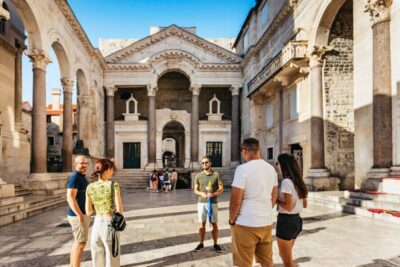

Blue Lagoon Boat Party with DJs, Shots & After Party
Read our review →Browse the lists this tour appears in